
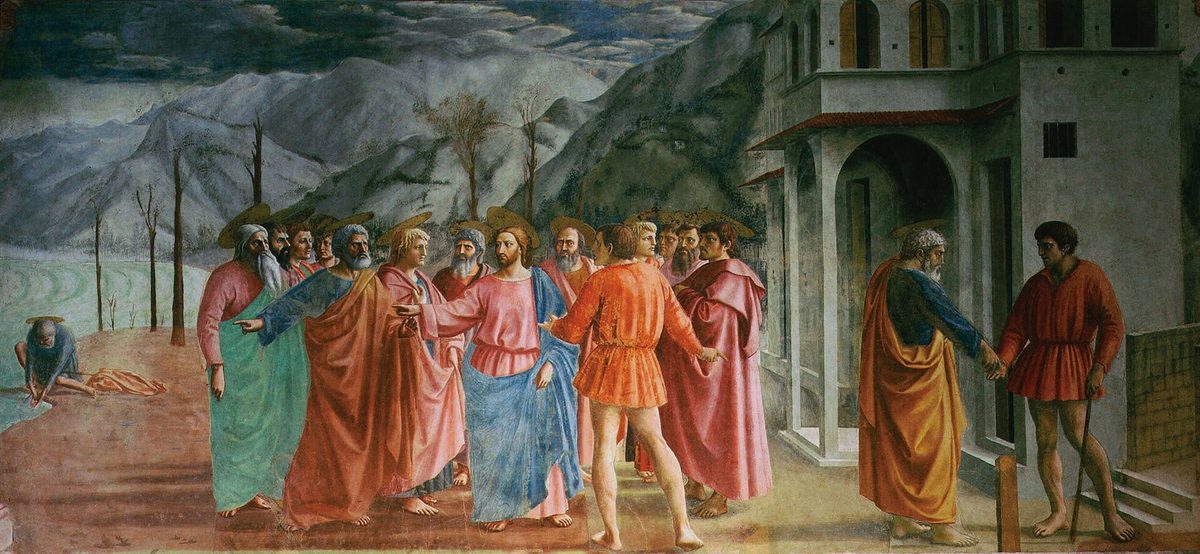
Brancacci Chapel Frescoes (Stories of St Peter)
Tribute Money — Masaccio, Brancacci Chapel, c.1425
Masaccio, Public domain, via Wikimedia Commons
The Brancacci Chapel frescoes are the most important single monument in the history of Western painting after Giotto's Arena Chapel — the cycle of frescoes depicting the life of St Peter (and a few other scenes) painted in the Brancacci family chapel in Santa Maria del Carmine, Florence, begun by Masolino and Masaccio in approximately 1424-1427 and completed by Filippino Lippi in approximately 1481-1487 after the original programme was abandoned. The frescoes by Masaccio — particularly the Tribute Money, the Expulsion of Adam and Eve, and the Healing of the Lame Man — represent the founding moment of the European Renaissance: Masaccio (1401-1428) introduced the systematic use of atmospheric perspective, a unified light source, the representation of three-dimensional figures in rational space, and psychological expressiveness at a level not achieved again until Michelangelo's response to them in the Sistine Chapel. Every major Florentine painter of the 15th century studied these frescoes — Filippo Lippi, Fra Angelico, Verrocchio, Leonardo, and Michelangelo all copied or drew from them.
Masaccio (Tommaso di Ser Giovanni di Simone, 1401-1428) died at approximately 27 years old — one of the greatest early deaths in art history, comparable to Keats in poetry. In six or seven years of documented painting activity, he transformed Italian art completely.
The Brancacci Chapel frescoes, made jointly with the older and more conservative Masolino (c.1383-c.1447), show the contrast between the two painters' approaches: Masolino's figures are elegant and decorative (International Gothic); Masaccio's are monumental, sculptural, and emotionally direct (proto-Renaissance). Standing before the Tribute Money and identifying each painter's hand is one of the essential exercises of Italian art history.
Timed entry tickets are required for the Brancacci Chapel (maximum 30 visitors per timed session). The Expulsion of Adam and Eve (Masaccio, west wall upper register) is the most famous individual scene: Adam covers his face with both hands in a gesture of total shame; Eve screams, her mouth open, her arms crossed on her chest.
The bodies are specific, anatomical, psychologically specific. Compare Masaccio's Expulsion with Masolino's Temptation (opposite lunette) — the two scenes depict the same moment from before and after: Masolino's figures are elegant, decorative, and emotionally blank; Masaccio's are devastated.
When standing before this work, look carefully: Tribute Money — Masaccio, Brancacci Chapel, c.1425. Give it time — what seems decorative often carries the central meaning.
When standing before this work, look carefully: Expulsion of Adam and Eve — Masaccio, west wall. Give it time — what seems decorative often carries the central meaning.
When standing before this work, look carefully: Masolino Temptation vs Masaccio Expulsion — comparison. Give it time — what seems decorative often carries the central meaning.
When standing before this work, look carefully: Brancacci Chapel interior — the complete fresco cycle. Give it time — what seems decorative often carries the central meaning.
Santa Maria del Carmine, Piazza del Carmine, Florence. Brancacci Chapel: timed entry required — book online in advance. Open daily except Tuesday; admission fee.