
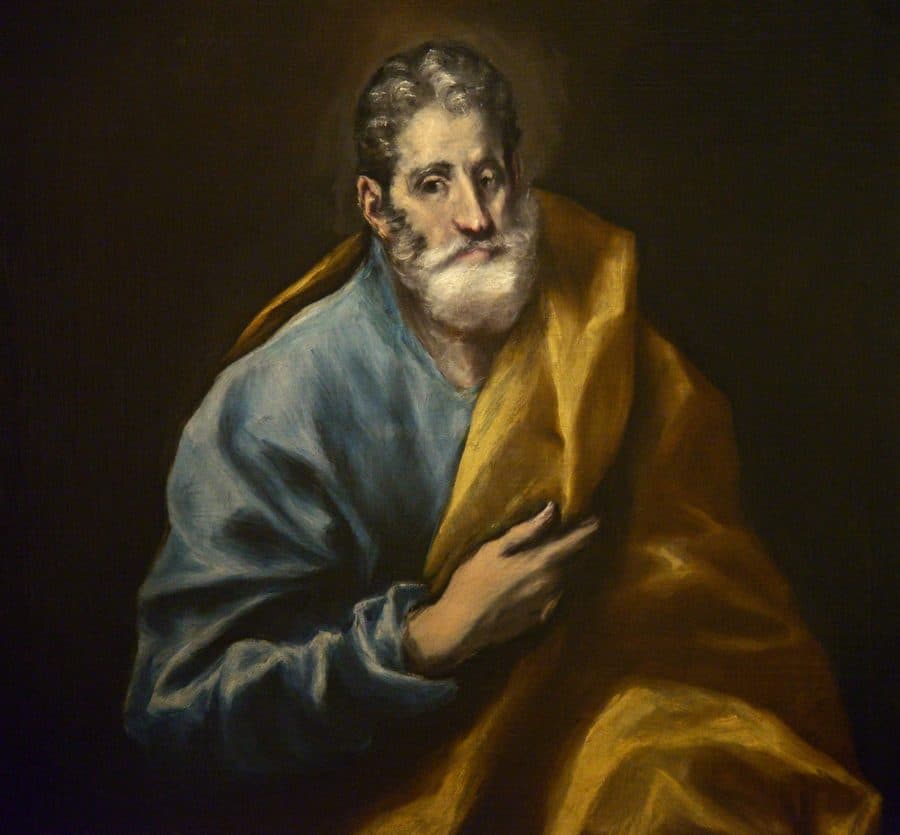
The Life
Simon Peter was a fisherman from Bethsaida on the Sea of Galilee — impulsive, passionate, frequently wrong, and yet chosen above all others to be the rock on which the Church was built. His story is simultaneously the story of spectacular failure and spectacular recovery: of a man who denied Jesus three times on the night of his arrest and became the first pope of the Church that Jesus founded. He is the patron of all who have failed and come back, of all who have been restored after betrayal, of all who carry responsibilities that feel too large for who they are.
His original name was Simon. Jesus gave him the name Cephas (in Aramaic) or Peter (in Greek) — both meaning rock — at their first meeting (John 1:42), before Peter had done anything to deserve such a name. It is entirely typical of the Gospel's strange economics that the most important name Peter ever received came before his greatest failures, not after. The name preceded the person. The identity was given before it was earned.
The Gospels of Matthew, Mark, and Luke give us a consistent portrait of Peter throughout the public ministry: he is the spokesman of the twelve, the one who asks questions and makes declarations, who walks on water (briefly), who confesses that Jesus is the Christ, and who rebukes Jesus for talking about suffering and death. At the Transfiguration, he proposes building three shelters because he does not know what to say (Mark notes this apologetically). He falls asleep in Gethsemane. He cuts off the ear of the high priest's servant in the garden. He follows Jesus to the courtyard of the high priest and then, over the course of a few hours, denies three times that he knows him. The cock crows. He goes out and weeps bitterly.
After the resurrection, Jesus appears to the disciples at the Sea of Galilee and asks Peter three times: Do you love me? Three times Peter says yes. Three times Jesus responds: Feed my sheep. The triple question mirrors the triple denial. The restoration is as specific and deliberate as the failure. Peter is then told that he will be led where he does not want to go — a prediction of his martyrdom — and told to follow. He follows. He goes to Jerusalem, to Antioch, to Corinth, and finally to Rome, where he is crucified upside-down under the Emperor Nero, in approximately 64-68 AD, at his own request — because he considers himself unworthy to be crucified in the same position as Jesus. His tomb is beneath the high altar of the Basilica of St Peter in the Vatican.
The Confession at Caesarea Philippi
Jesus asks his disciples: Who do people say the Son of Man is? Various answers are given. Then: But who do you say I am? Peter answers immediately: You are the Christ, the Son of the Living God. Jesus responds: Blessed are you, Simon Bar-Jonah, for this was not revealed to you by flesh and blood, but by my Father in heaven. And I tell you, you are Peter, and on this rock I will build my church, and the gates of hell will not overcome it. I will give you the keys of the kingdom of heaven. This is the founding moment of the papacy — the conferral of the keys — and it happens because Peter answered a question correctly, in a moment of clarity, before his worst failures. The Denial and the Restoration On the night of Jesus's arrest, Peter follows from a distance to the courtyard of the high priest's house. Three times during that night, someone says to him: You were with this Jesus. Three times he denies it. On the third denial, the cock crows, and Jesus — being led past as a prisoner — turns and looks at Peter. Peter goes out and weeps bitterly. After the resurrection, on the beach at Galilee, Jesus asks him three times: Do you love me? Three times Peter says yes. Three times Jesus says: Feed my sheep. The restoration is exact, deliberate, and complete. Peter's authority over the Church comes not before his failure, but after it, through it, because of what happened in the courtyard and on the beach. Pentecost — the transformation of the denier into the preacher At Pentecost, fifty days after the resurrection, the Holy Spirit descends on the disciples gathered in the upper room with Mary. Peter — the man who, fifty days earlier, had denied Jesus three times to a servant girl — stands up in front of thousands of people in Jerusalem and preaches. Three thousand people are baptised that day. The change is absolute and irreversible: the tongue that said I do not know the man now declares with complete confidence: God has made this Jesus, whom you crucified, both Lord and Christ. Pentecost is Peter's second birth; the dove undoes what the cock announced. Rome and the Upside-Down Cross Peter was crucified in Rome during the persecution of Nero, in approximately 64-68 AD. According to the tradition recorded by Origen and Eusebius, he asked to be crucified upside-down because he considered himself unworthy to die in the same position as his Lord. His tomb was marked by the earliest Christian community in Rome and became the centre of the Christian presence in the city. The Basilica of Saint Peter was built over his tomb by the Emperor Constantine in the 4th century. The current St Peter's Basilica — the largest church in the world — stands above the same grave. To stand at the high altar of St Peter's is to stand above the bones of the fisherman.
Walk in Their Footsteps
Pilgrimage sites connected to St Peter
Ask St Peter to Intercede
Bring these intentions to this saint in prayer:
Jesus gave Peter his name — rock — before Peter had done anything to deserve it. The name was the promise, not the description. Peter spent the rest of his life becoming what he was named. He failed spectacularly in the middle. He came back. He became the rock. The name preceded the person. God's names for us work the same way: they describe what we will become, not what we already are. The question is whether we will become it.
“And I tell you that you are Peter, and on this rock I will build my church, and the gates of Hades will not overcome it.”
St Peter, rock and denier and restorer — pray for me. I have denied. I have failed. I have wept bitterly over my own betrayals. Ask Jesus to find me on the beach and ask me three times if I love him. I will say yes. Three times, yes. And then tell me to feed his sheep — give me the responsibility that proves the restoration. Amen.