
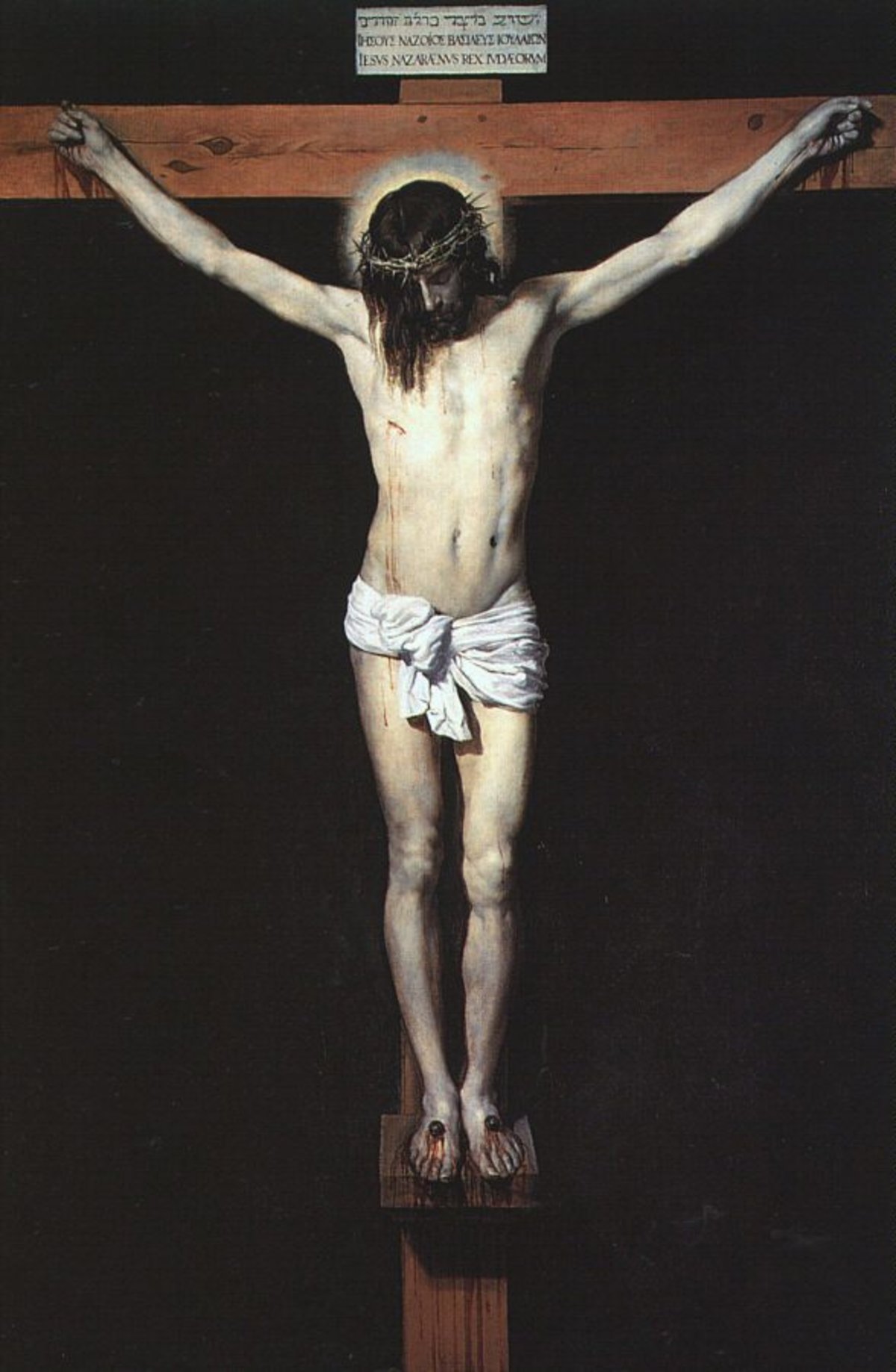
Christ Crucified
Christ Crucified — Velázquez, c.1632
Diego Velázquez, Public domain, via Wikimedia Commons
Velázquez's Christ Crucified is the most famous devotional painting in Spain and one of the most moving depictions of the Crucifixion in Western art. It shows Christ on the cross against an absolutely dark background, his head bowed forward (covered by long black hair, the face almost invisible), his body illuminated from the left by a cool, precise light that picks out the anatomy of shoulder, rib, and hip.
The figure is idealized but not abstracted: the body has weight, the arms strain slightly under the weight of the body, and the feet (crossed and nailed together) rest on a wooden suppedaneum. The four-nail convention (Christ nailed at both feet separately, a Spanish iconographic tradition) is replaced here by three nails (both feet together on a single nail) — a variant associated with the particular crucifix in San Plácido convent, Madrid, for which this painting was made.
Diego Velázquez (1599-1660) was the court painter of Philip IV of Spain and the greatest Spanish painter of the Baroque. The Christ Crucified was painted around 1632 for the convent of San Plácido in Madrid.
The dark background, the precise light, and the formal simplicity of the composition reflect the Spanish Baroque tradition of intimate devotional painting — the viewer is placed in a one-to-one relationship with the dead Christ, without narrative context, landscape, or other figures. The influence of Flemish painting (Rubens had visited Madrid in 1628-29 and Velázquez studied his works) and of classical sculpture (the figure's proportions and surface treatment recall Hellenistic idealism) is absorbed into a deeply personal and typically Castilian spiritual intensity.
The painting's formal simplicity is its devotional power. The dark background removes all distraction: there is only the body.
The hair obscuring the face focuses attention on the body's physical evidence of suffering rather than facial expression — the viewer is not asked to respond to Christ's pain through his face but to contemplate the body's testimony alone. The blood (flowing from the crown of thorns, the nail wounds, and the spear wound in the side) is precisely observed and non-theatrical — not a dramatic flow but an accurate forensic observation. The suppedaneum (footrest) below the feet is a piece of carpenter's work that anchors the abstract composition in physical reality.
When standing before this work, look carefully: Christ Crucified — Velázquez, c.1632. Give it time — what seems decorative often carries the central meaning.
When standing before this work, look carefully: The feet on the suppedaneum. Give it time — what seems decorative often carries the central meaning.
When standing before this work, look carefully: The body — cool Flemish precision. Give it time — what seems decorative often carries the central meaning.
When standing before this work, look carefully: The Velázquez rooms at the Prado. Give it time — what seems decorative often carries the central meaning.
Museo Nacional del Prado, Madrid. Room 15A (Velázquez). The Christ Crucified is one of the most visited works in the Prado and one of the founding images of Spanish Catholic culture.