Church of St Francis of Assisi, Goa

Church of St Francis of Assisi, Goa

Established 1521 and rebuilt in 1661, the Church of St Francis of Assisi, Goa is a UNESCO World Heritage Site

Type
Church
Country
India
Location
Off National Highway 4, Velha Goa, Old Goa
Scroll
01At a Glance

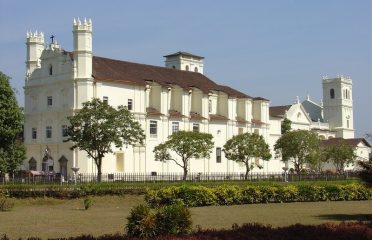
Soon after the Portuguese conquest of Goa in 1510, many religious orders from Europe made their way to India to carry out the Evangelisation of the East. The year 1517 saw the first batch of eight Franciscan friars arriving in Goa. By 1521, the Franciscans had built a small chapel dedicated to the Holy Ghost, which was the predecessor to the Church of St Francis of Assisi, Goa. Later years saw the chapel being expanded, and by 1602 it was consecrated as a church. In due course, that church gave way to the present edifice which was erected in 1661, and dedicated to the founder of the Franciscan Order, St Francis of Assisi. The new church displays mixed architectural elements in its three tiered exterior. While the outer facade is relatively simple, employing the Tuscan style of architecture, the portal of the old structure cast in the Portuguese Manueline style, has been retained. Impressively flanking the facade on either side are twin octagonal towers of majestic appearance. Housed in a small niche at the entrance is a statue of Our Lady of Miracles which was brought from Jaffna in Sri Lanka. It is the interior of the church however, that brings to life the richness of European art of that period. The main altar is a lavish and extravagant affair, which displays craftsmanship of the highest order. The style is mostly Baroque with Corinthian elements woven into it. A tabernacle supported by the four Evangelists Matthew, Mark, Luke and John occupies centre stage. Placed prominently above it are two large statues one of St Francis of Assisi and the other of Christ crucified on the cross. Beneath the statues are inscribed the Franciscan vows of ‘Poverty, Humility and Obedience’. The church of St Francis of Assisi, Goa is smaller when compared to its neighbour, the imposing Se Cathedral , yet makes up by the sheer beauty of its interiors, what it lacks in size. On the left at the entrance, is an intricately carved wooden pulpit, decorated with floral patterns. The church’s gilded interior is decorated with paintings, carved woodwork, additional statues and frescoes laden with intricate floral designs. The paintings depict events from the life of St Francis of Assisi and the history of the Seraphic Order. Set into the floor of the church are tombstones, inscribed with intricate carvings, rich in detail. It is a single-nave church with three small altars on either side of the nave. Behind the main altar is an ornate sacristy with the belfry to the north of the altar. The chapels and the gallery which runs around the top of the church are separated by internal buttresses. The Franciscan Convent, contiguous to the church, was built around 1527 and later expanded. Today it houses a Museum set up by the Archaeological Survey of India in 1964. On display are priceless sculptures and icons of the pre-Portuguese era, besides portraits of Viceroys and Governor Generals. In its time, this beautiful church has borne witness to the rise of the Portuguese Empire. And then in more recent years, watched the sun set gently on its reign. Today the Church of St Francis of Assisi, Goa has come into a glory of its own, being designated as a World Heritage Site by UNESCO in 1986. To visit the church and the Museum is certainly worth the effort. Considering the richness and ageless beauty of its treasures, it would be time well spent.

1

The year 1517 saw the first batch of eight Franciscan friars arriving in Goa

2

By 1521, the Franciscans had built a small chapel dedicated to the Holy Ghost, which was the predecessor to the Church of St Francis of Assisi, Goa

3

Later years saw the chapel being expanded, and by 1602 it was consecrated as a church

4

In due course, that church gave way to the present edifice which was erected in 1661, and dedicated to the founder of the Franciscan Order, St Francis of Assisi

5

Housed in a small niche at the entrance is a statue of Our Lady of Miracles which was brought from Jaffna in Sri Lanka

02Plan Your Visit
Getting There
Old Goa, North Goa, Goa 403402 (adjacent to the Se Cathedral)

Adjacent to the Se Cathedral in Old Goa. From Panaji by bus: 30 minutes. By taxi: 20 minutes. From Goa airport: 45 minutes. The church is the second building from the Se Cathedral toward the Basilica of Bom Jesus.

Open in Google Maps →
IST (UTC+5:30)
--:--:--

Plan at least 1.5 hours for the church and museum together. The interior painting is best seen in daylight — morning visits are recommended. Photography inside requires a camera fee.

Opening Hours
Church9:00 AM - 5:30 PM daily
Archaeology Museum10:00 AM - 5:00 PM; closed Fridays
03Must See

What to seek out, and why it matters

I
From the Se Cathedral approach

The Manueline-Baroque Facade

The facade of St Francis of Assisi — with its twin octagonal towers, the Manueline doorway between them, and the complex carved stonework above — is the finest facade in Old Goa and one of the finest in India. The combination of Late Gothic Manueline detail and Portuguese Baroque towers is found nowhere else in the world outside the Estado da India.

II
Nave walls and ceiling

The Interior Polychrome Painting

The entire interior of the church — walls, arches, and ceiling — is painted with exuberant floral and geometric designs in green, red, gold, and ochre. The effect is unlike any other church interior in India — not sombre but joyful, not austere but celebratory. It is the interior of a faith that expressed itself in colour and abundance.

III
Nave floor

The Memorial Tomb Floor

The entire nave floor is paved with tombstones — dozens of them, each bearing the coat of arms, name, and epitaph of a Portuguese officer or official. Walking across them, one steps across the identities of the men who built and governed Portuguese Goa: soldiers, judges, merchants, and governors. It is one of the most unusual floors in the world.

IV
The apse behind the altar

The Gilded Retable

The carved and gilded retable behind the high altar depicts St Francis receiving the stigmata, flanked by Franciscan saints. It is the finest retable in Old Goa and among the finest examples of Portuguese religious woodcarving in Asia. The gold leaf, the dynamic carving, and the scale of the piece fill the apse.

V
Convent building

The Archaeology Museum

The museum in the adjacent convent building is unmissable — the portrait gallery of Portuguese governors alone is worth the visit, presenting 50-odd portraits of the men who governed the richest trading empire in Asia, from Dom Francisco de Almeida to the last governor. The sculpture collection includes some of the finest pieces of Portuguese colonial religious art in India.

04Masses & Events
Sunday MassOccasionally celebrated for local communities

Check with the Old Goa parish office

Feast of St Francis of AssisiOctober 4

The patronal feast

5Reflection & Prayer

St Francis of Assisi said: Start by doing what is necessary, then what is possible, and suddenly you are doing the impossible. He started a movement that rebuilt the 12th-century Church. The Franciscans who came to Goa in 1521 — 300 years after Francis — built this church in his name on the farthest edge of the known world. They painted the walls in flowers. They buried their dead in the floor. They lived the impossible that Francis prescribed. This is what their impossible looks like: four centuries later, still standing.

Matthew 5:3

Blessed are the poor in spirit, for theirs is the kingdom of heaven.

Read in full on Bible Gateway →
A Pilgrim's Prayer

St Francis, you gave everything away and received everything in return — the birds, the wolf, the sun, the moon, the wounds, the joy. Teach me the poverty that makes one rich. Let me walk across this floor of dead men and understand that their coats of arms and their titles and their victories are all equal to nothing now — equal to each other, equal to the poor man whose name no one recorded. Let me choose the poverty that lasts. Amen.

06More

Soon after the Portuguese conquest of Goa in 1510, many religious orders from Europe made their way to India to carry out the evangelisation of the East. The year 1517 saw the first batch of eight Franciscan friars arriving in Goa.

History

By 1521, the Franciscans had built a small chapel dedicated to the Holy Ghost, which was the predecessor to the Church of St Francis of Assisi, Goa. Later years saw the chapel being expanded, and by 1602 it was consecrated as a church. In due course, that church gave way to the present edifice, which was erected in 1661 and dedicated to the founder of the Franciscan Order, St Francis of Assisi.

Architecture

The new church displays mixed architectural elements in its three-tiered exterior. While the outer facade is relatively simple, employing the Tuscan style of architecture, the portal of the old structure, cast in the Portuguese Manueline style, has been retained. Impressively flanking the facade on either side are twin octagonal towers of majestic appearance. Housed in a small niche at the entrance is a statue of Our Lady of Miracles, which was brought from Jaffna in Sri Lanka.

Interior and Art

It is the interior of the church, however, that brings to life the richness of European art of that period. The main altar is a lavish and extravagant affair, displaying craftsmanship of the highest order. The style is mostly Baroque, with Corinthian elements woven into it. A tabernacle supported by the four Evangelists — Matthew, Mark, Luke and John — occupies centre stage. Placed prominently above it are two large statues, one of St Francis of Assisi and the other of Christ crucified on the cross. Beneath the statues are inscribed the Franciscan vows of ‘Poverty, Humility and Obedience’.

The church of St Francis of Assisi is smaller when compared to its neighbour, the imposing Se Cathedral, yet makes up by the sheer beauty of its interiors what it lacks in size. On the left at the entrance is an intricately carved wooden pulpit, decorated with floral patterns. The church’s gilded interior is decorated with paintings, carved woodwork, additional statues and frescoes laden with intricate floral designs. The paintings depict events from the life of St Francis of Assisi and the history of the Seraphic Order. Set into the floor of the church are tombstones, inscribed with intricate carvings, rich in detail.

It is a single-nave church with three small altars on either side of the nave. Behind the main altar is an ornate sacristy, with the belfry to the north of the altar. The chapels and the gallery, which runs around the top of the church, are separated by internal buttresses.

The Museum

The Franciscan Convent, contiguous to the church, was built around 1527 and later expanded. Today it houses a museum set up by the Archaeological Survey of India in 1964. On display are priceless sculptures and icons of the pre-Portuguese era, besides portraits of Viceroys and Governor Generals.

Visiting

In its time, this beautiful church has borne witness to the rise of the Portuguese Empire, and then in more recent years watched the sun set gently on its reign. Today the Church of St Francis of Assisi has come into a glory of its own, being designated as a World Heritage Site by UNESCO in 1986. To visit the church and the museum is certainly worth the effort. Considering the richness and ageless beauty of its treasures, it would be time well spent.
Saints Associated With This Site
Artworks Here
Part of this pilgrimage
13-day pilgrimage · Old Goa — the basilicas
India — St Thomas Trail
View itinerary →
More from India
Church of St John the Evangelist (Afghan Church), Mumbai
Shahid Bhagat Singh Road, Navy Nagar, Colaba
All Saints Cathedral, Allahabad
Sarojini Naidu Marg, Civil Lines, Prayagraj (Allahabad)
Archdioceasan Heritage Museum, Mumbai
Archdiocesan Heritage Museum, St Pius X College, Aarey Road
Basilica of Bom Jesus, Goa
Basilica of Bom Jesus, Old Goa Road, Bainguinim