
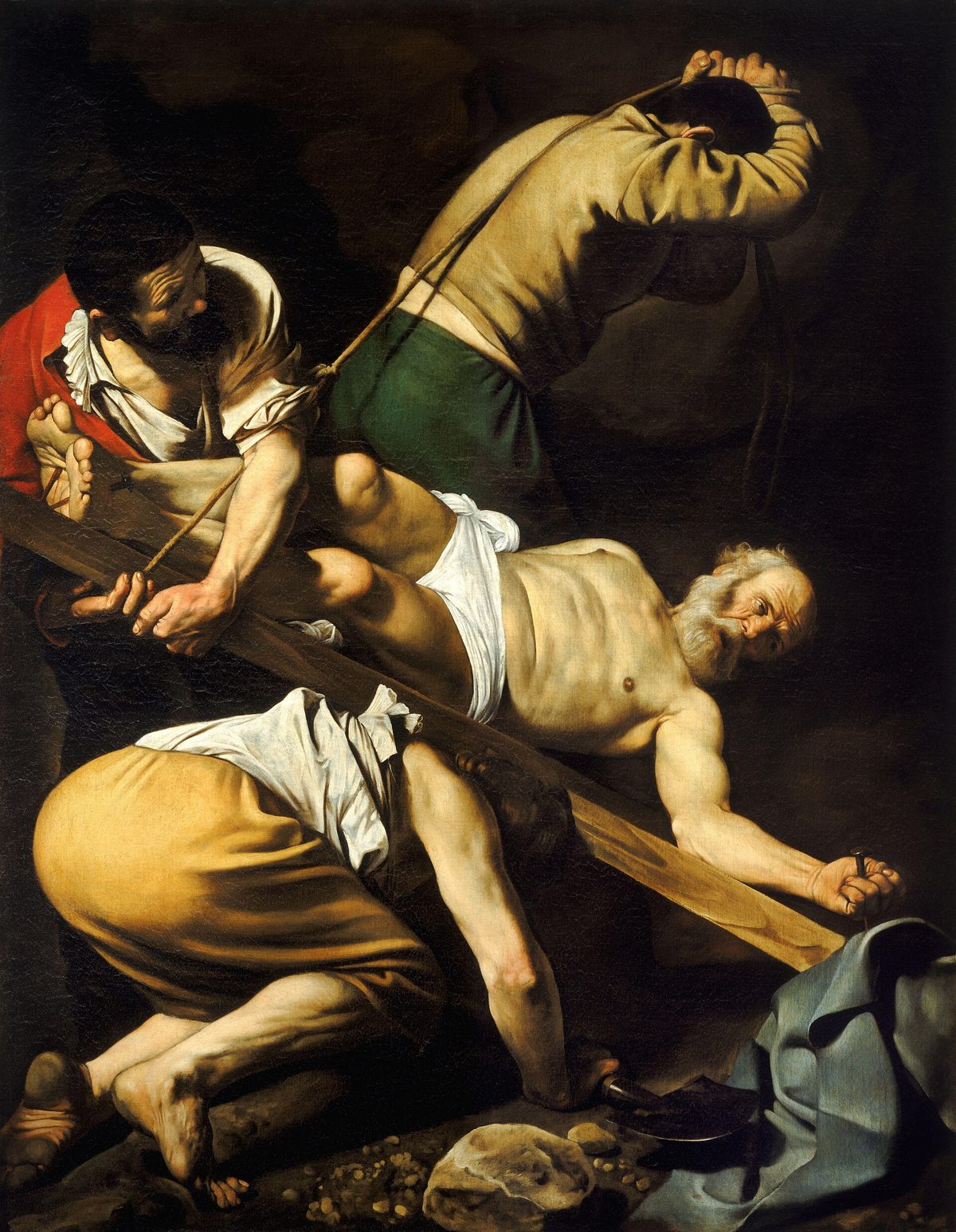
Crucifixion of St Peter
Crucifixion of St Peter — full composition
Caravaggio, Public domain, via Wikimedia Commons
Caravaggio's Crucifixion of St Peter hangs opposite the Conversion of Paul in the Cerasi Chapel — together the two paintings form a complementary meditation on the apostles' fates. In the Crucifixion, Peter is being raised on an inverted cross by three workers — the soldiers or workers are straining to lift the heavy wooden beam to which the old man is nailed. Peter, despite his age, does not cry out or look toward heaven; his face is that of a man enduring, concentrating on the act of endurance.
His left arm is raised, as if he is trying to help himself up. No miracle interrupts the brutal labour. Like the Conversion of Paul, this is the divine event stripped of all conventional signifiers of the divine.
The formal challenge Caravaggio set himself in both Cerasi Chapel paintings was identical: how to make a scene of miraculous transformation look entirely naturalistic, without the conventional apparatus of divine light, angelic intervention, or idealized figures. In the Crucifixion, the four workers occupy the canvas together with the inverted cross and Peter's body in a composition of extraordinary claustrophobic density — there is almost no sky, no background, no escape from the physical labour being depicted.
The workers are straining with real effort; they are not performing their action for the viewer's benefit. They are just working.
Peter's face — old, experienced, resigned — is the emotional centre. He looks neither up toward heaven nor down toward the crowd; his gaze is inward, focused on the act of endurance. The crossed arms of the workers create a series of overlapping diagonals that read as a compositional equivalent of struggle.
The white of Peter's body against the dark ground — he is almost the only light source in the painting — makes him the focal point that the workers' labour orbits. The nail in his hand catches the light. The inverted cross angles upward from lower left to upper right, while Peter's body angles downward — the intersection is the painting's structural and theological knot.
When standing before this work, look carefully: Crucifixion of St Peter — full composition. Give it time — what seems decorative often carries the central meaning.
When standing before this work, look carefully: Peter's face — endurance, not despair. Give it time — what seems decorative often carries the central meaning.
When standing before this work, look carefully: The workers straining to lift the cross. Give it time — what seems decorative often carries the central meaning.
When standing before this work, look carefully: Both Caravaggio paintings in the Cerasi Chapel. Give it time — what seems decorative often carries the central meaning.
Same chapel as the Conversion of Paul. The two paintings should be seen together; they answer each other compositionally (Peter's cross angling left, Paul's body angling right) and theologically (one apostle called, one martyred).