
Michelangelo, Public domain, via Wikimedia Commons
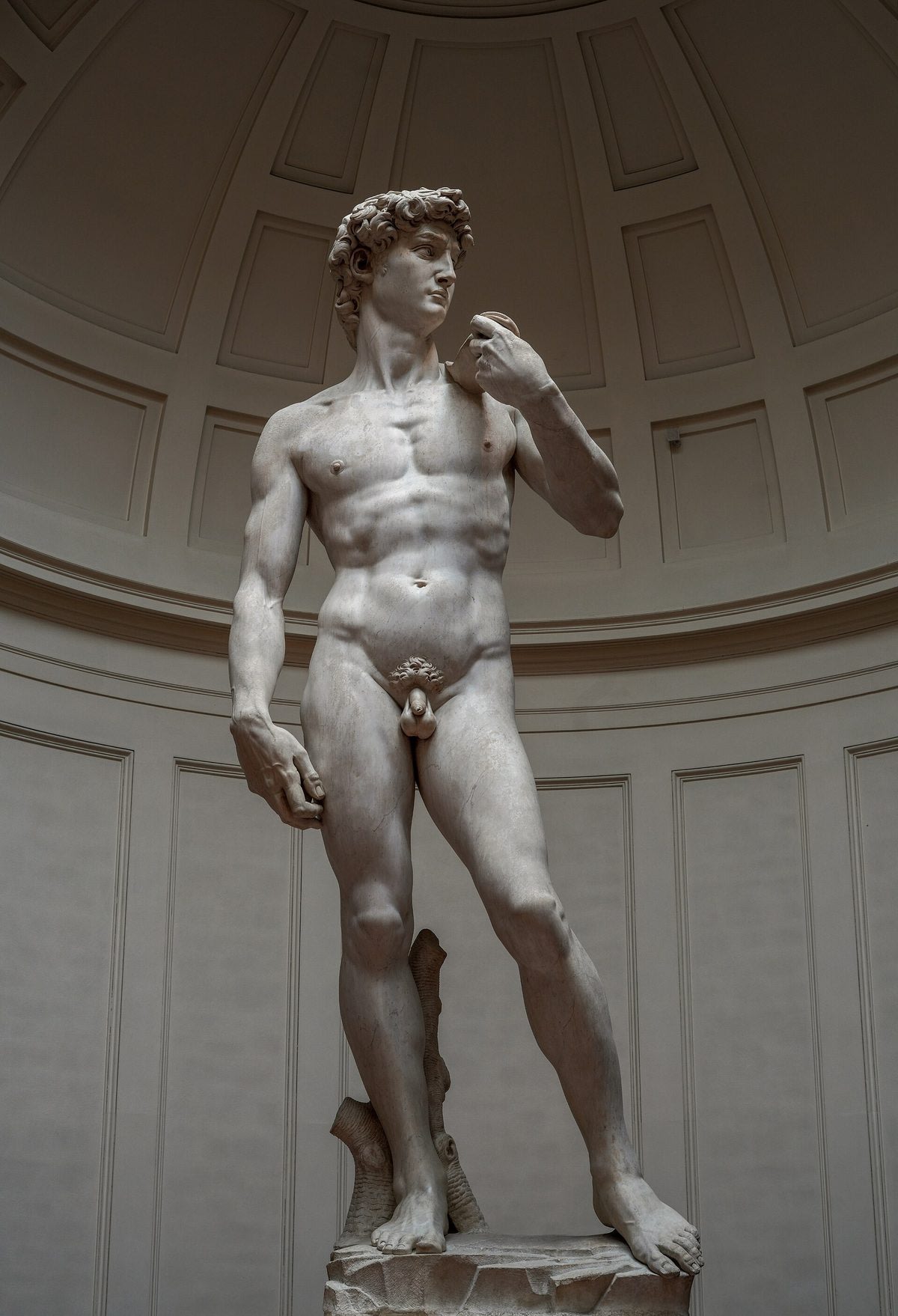
Michelangelo's David is the most celebrated sculpture in the world and the defining image of Renaissance humanism — the perfected human body as the measure of all things. Carved from a single block of Carrara marble over three years, the David depicts the biblical shepherd-king at the moment before his encounter with Goliath: coiled, watchful, with the sling over his shoulder and a stone in his right hand.
The work was originally intended for the Florence Cathedral, but was placed instead in front of the Palazzo della Signoria (now Palazzo Vecchio) as a symbol of Florentine civic virtue and independence. It was moved to the Accademia in 1873 and replaced by a copy at its original outdoor location.
The David was carved from a block of marble known as the Giant — already roughed out (and abandoned) by Agostino di Duccio in 1464. Michelangelo began work on it in 1501 at age 26 and delivered the finished statue in 1504.
The technical challenge was extreme: the marble block was unusually long and narrow, with the proportions of an adult figure but limited depth. Michelangelo solved this by slightly enlarging the head and hands relative to the body — an adjustment designed to correct the visual foreshortening that occurs when a tall statue is viewed from below. The sculpture was transported from the workshop to its outdoor location on rollers, a four-day operation that required the removal of a doorway.
The David is not the triumphant warrior after victory; he is the young man before the battle — the moment of decision and readiness. His gaze — to the left, slightly downward, intense — is aimed at Goliath somewhere in the middle distance. His right hand hangs at rest; his left hand, over his shoulder, holds the sling; his weight rests on his right leg in a classical contrapposto.
The scale is overwhelming: the statue is 5.17 metres tall, and the physical presence of the body in space is impossible to convey in photographs. Notice the exaggerated size of the right hand — the hand of power, of action — and the veins visible in the neck and forearms. Michelangelo's anatomical study is total.
When standing before this work, look carefully: Michelangelo's David — right profile. Give it time — what seems decorative often carries the central meaning.
When standing before this work, look carefully: The face of David — the moment before battle. Give it time — what seems decorative often carries the central meaning.
When standing before this work, look carefully: The right hand — deliberately oversized for effect. Give it time — what seems decorative often carries the central meaning.
When standing before this work, look carefully: The Tribune of the Accademia — the David in situ. Give it time — what seems decorative often carries the central meaning.
The Galleria dell'Accademia in Florence is accessible via pre-booked timed entry (essential in peak season). The David is housed in a purpose-built Tribune at the end of the museum, approached through a gallery of Michelangelo's unfinished Prisoners (Prigioni) — which are among the most powerful sculptures he ever made. The experience of walking toward the David through those four struggling figures is the intended viewing sequence and should not be rushed.