
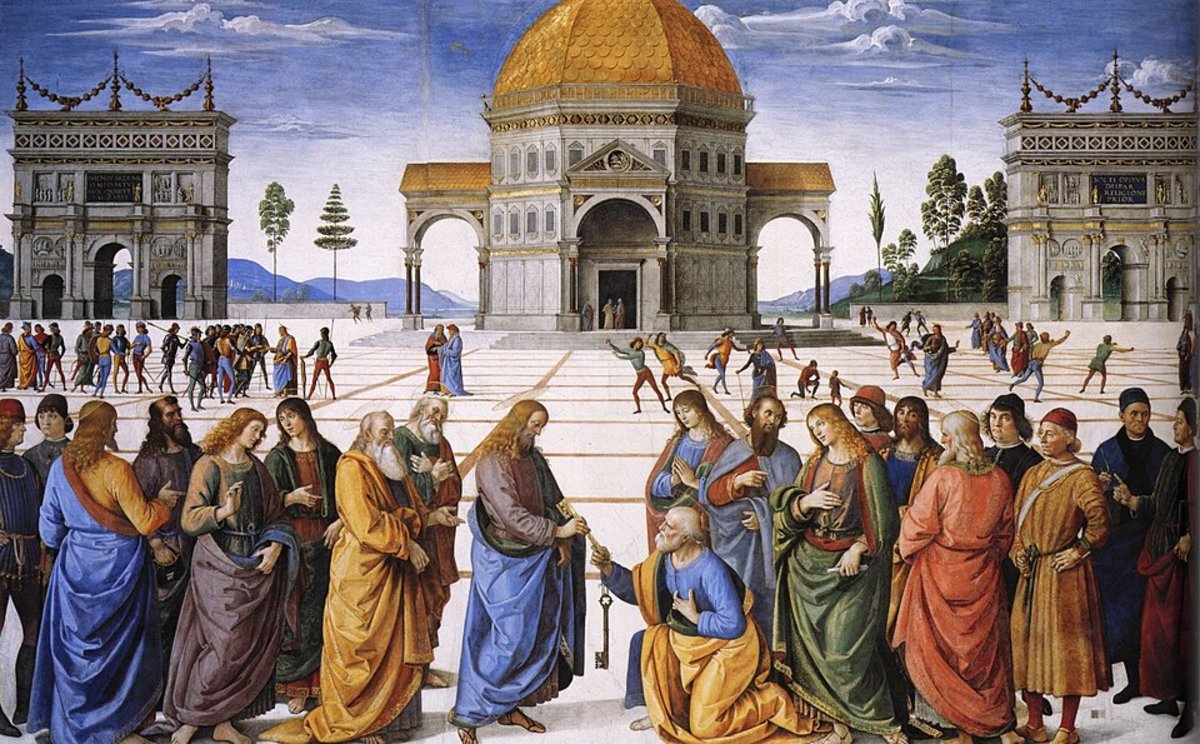
Delivery of the Keys (Christ Giving the Keys to St Peter)
Delivery of the Keys — Perugino, 1481-1482, Sistine Chapel
Pietro Perugino, Public domain, via Wikimedia Commons
Perugino's Delivery of the Keys is the central and most important of his Sistine Chapel frescoes — one of the most significant paintings of the fifteenth century in Italy. The scene (Matthew 16:19) shows Christ handing the keys of the Kingdom of Heaven to Peter in a vast, symmetrically organised square.
In the centre foreground, Christ and Peter face each other in the act of the transfer; behind them, the twelve apostles and other figures are arranged in two symmetrical groups. The background shows an octagonal centralised temple (an idealised architectural temple) flanked by two triumphal arches. The composition is a masterwork of Renaissance perspective — the tiles of the piazza recede to a central vanishing point, creating a deep space that matches the theological gravity of the scene.
The Delivery of the Keys was the capstone of the Sistine Chapel's fifteenth-century fresco cycle because it provided the theological justification for papal authority: Christ's gift of the keys to Peter is the founding moment of the papacy. Pope Sixtus IV (who commissioned the chapel and the frescoes) was the Vicar of Christ — Perugino's fresco is a statement of the theological basis of that role. The octagonal temple in the background has been identified with the Temple of Solomon and also with the Tempietto (a centralised temple plan that would become the ideal Renaissance church form).
The figure of Peter, receiving the keys, is Perugino's finest single figure from the Sistine cycle — the old man's posture, the kneeling forward lean, the upward look toward Christ, communicate deference and acceptance. The apostles in the middle ground are a gallery of early Renaissance figure types. The architectural background — perspectivally constructed and symmetrical — is as important as the figures in establishing the painting's meaning: this is a public, formal, constitutional moment, set in an ideal civic space.
When standing before this work, look carefully: Delivery of the Keys — Perugino, 1481-1482, Sistine Chapel. Give it time — what seems decorative often carries the central meaning.
When standing before this work, look carefully: Peter receiving the keys — posture of deference. Give it time — what seems decorative often carries the central meaning.
When standing before this work, look carefully: The octagonal temple — Renaissance perspective. Give it time — what seems decorative often carries the central meaning.
When standing before this work, look carefully: Christ and Peter — the central transfer moment. Give it time — what seems decorative often carries the central meaning.
Sistine Chapel, Vatican Museums, Vatican City. Admission via Vatican Museums.
Open Monday-Saturday 9:00-18:00 (last entry 16:00). The fresco is on the south wall, third from the altar end.