
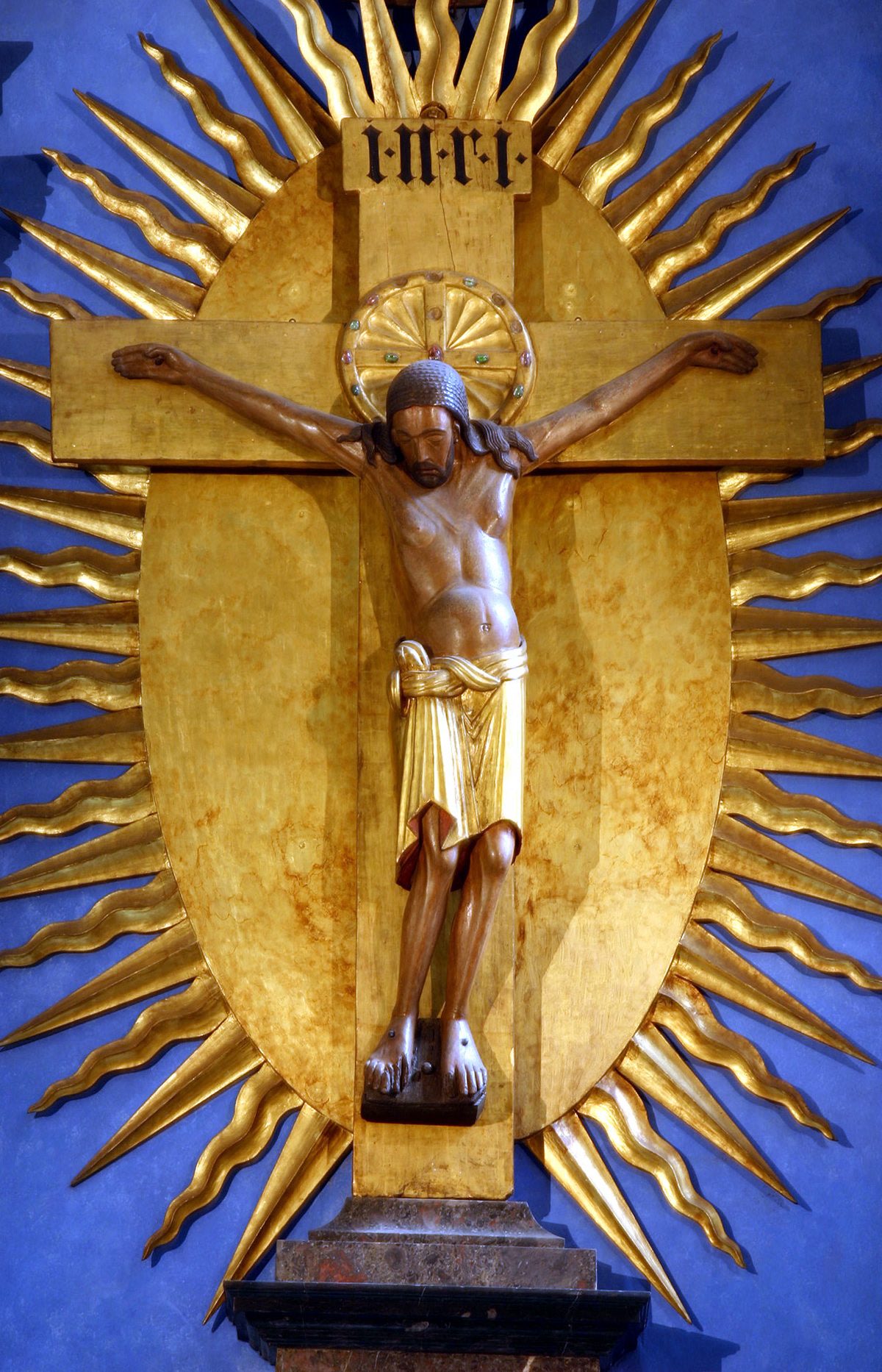
Gero Crucifix
Gero Crucifix — Cologne Cathedral, c.965-970
Public domain, via Wikimedia Commons
The Gero Crucifix in Cologne Cathedral is the oldest surviving monumental crucifix in the Western world — an oak figure of Christ approximately 187 cm tall, made around 965-970 for Archbishop Gero of Cologne. It is also the first known devotional image in Western art to depict Christ dead on the cross — with the head slumped forward, the mouth closed, the eyes shut, the body sagging in the way a real dead body would.
Before the Gero Crucifix, crucifixes in Western art showed Christ alive on the cross, reigning from the wood (the Christus triumphans tradition). The Gero Crucifix inaugurates the Christus patiens tradition — the suffering, dying, dead Christ — which would become the dominant form of Crucifixion imagery in Western Christianity for the next thousand years.
Archbishop Gero (Archbishop of Cologne 969-976) commissioned the crucifix for the cross-altar of the old Cologne Cathedral. A medieval legend (recorded by Thietmar of Merseburg, c.1012-1018) reported that when a crack appeared in the head, Gero placed a Eucharistic host inside it and the crack miraculously healed — a story that identifies the wooden Christ with the living sacrament.
The figure was subsequently carved several times (its original polychromy is largely gone) and the gilded nimbus is a later addition. The Gero Crucifix is now in the Gero Chapel (south transept) of the Gothic cathedral built around the earlier Romanesque church. The iconographic shift it inaugurated — from triumphant to suffering Christ — reflected the theological development of 10th-century piety toward a more personal, affective engagement with Christ's humanity.
The figure confronts the viewer at nearly life scale. The physical evidence of death — the slumped head, the sagging body, the folded abdomen — is depicted with a directness that was revolutionary in its period. The face (in its current state, partly reworked) has a quality of repose rather than agony: the death has already occurred, the suffering is over.
The crown of thorns is a later addition. The loincloth is the only covering; the body otherwise is depicted as it would be seen — a body of a man who has died by asphyxiation and heart failure, the physiological causes of death by crucifixion. Standing before the Gero Crucifix is an encounter with the beginning of Western devotional art's long engagement with the suffering Christ.
When standing before this work, look carefully: Gero Crucifix — Cologne Cathedral, c.965-970. Give it time — what seems decorative often carries the central meaning.
When standing before this work, look carefully: The slumped head — death depicted for the first time. Give it time — what seems decorative often carries the central meaning.
When standing before this work, look carefully: The full figure — 187 cm of oak and polychromy. Give it time — what seems decorative often carries the central meaning.
When standing before this work, look carefully: The Gero Chapel in Cologne Cathedral. Give it time — what seems decorative often carries the central meaning.
Cologne Cathedral, Gero Chapel (south transept). The chapel is named after the crucifix's donor. The figure stands on its own altar, visible on entry to the chapel.