
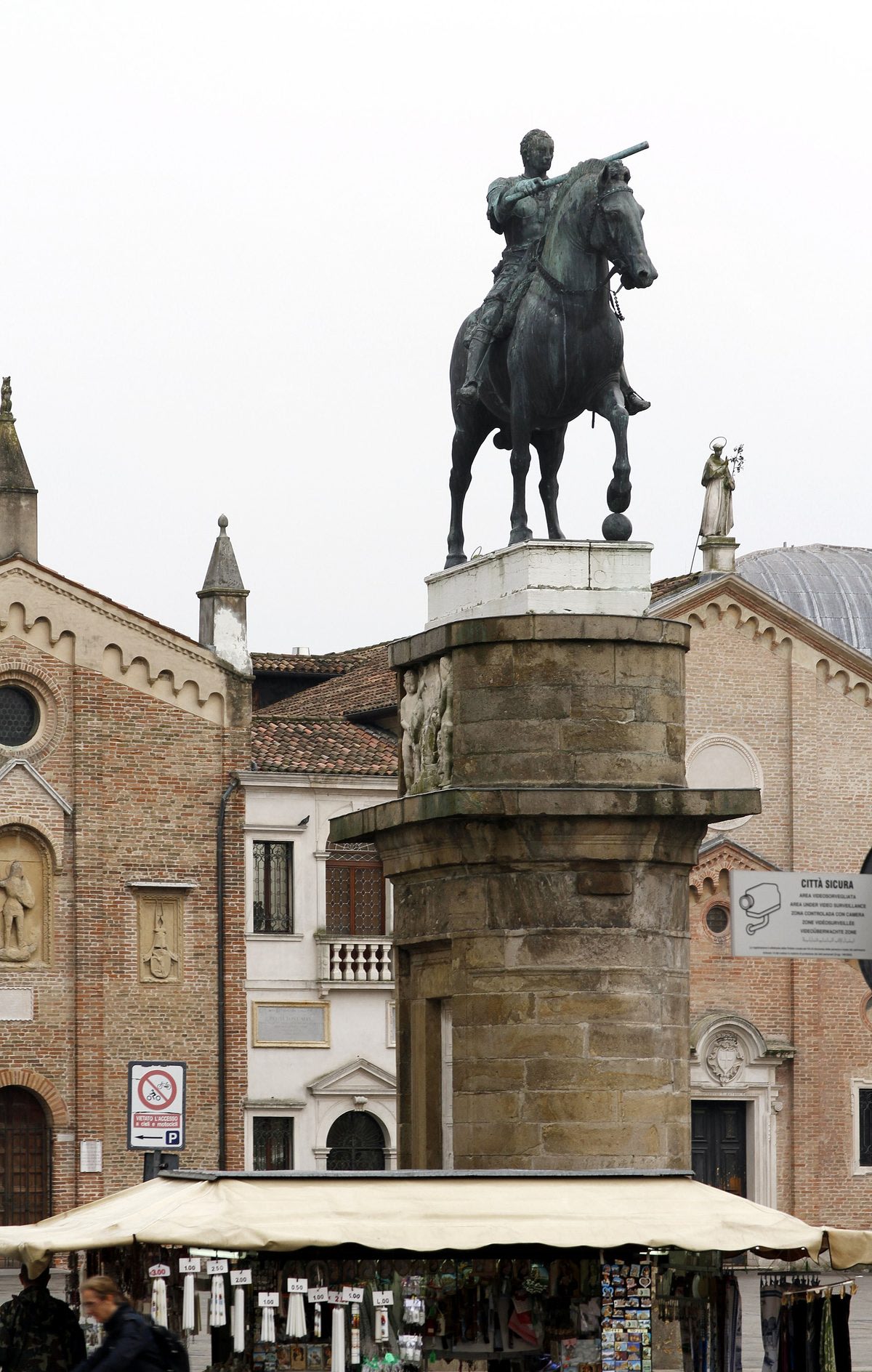
High Altar and Gattamelata Equestrian Statue
Gattamelata equestrian statue — Donatello, 1447-1453
Donatello, Public domain, via Wikimedia Commons
Donatello's decade in Padua (1443-1453) produced two of the defining works of Renaissance sculpture: the High Altar of the Basilica of St Anthony (the Santo) and the equestrian statue of the condottiere Erasmo da Narni, called Gattamelata, in the piazza in front of the basilica. The High Altar is a complex multi-figure programme in bronze — seven large statues (the Virgin and Child, four saints, and two archangels), twenty-one bronze reliefs of miraculous scenes from the life of St Anthony, four large reliefs of the Evangelists' symbols, and a stone-and-marble architectural frame (substantially reconstructed in the 17th-19th centuries). The Gattamelata is the first equestrian bronze of the Renaissance — the first monumental free-standing bronze equestrian statue since Roman antiquity, made without the benefit of seeing Marcus Aurelius's equestrian statue in Rome.
Donatello moved to Padua at the invitation of the Venetian government and the Santo chapter in 1443. The High Altar commission gave him the opportunity to work at monumental scale in bronze and to invent new narrative and devotional forms.
The altar's reliefs are among the most important sculptural narratives of the 15th century — the four large Miracle reliefs (the Miracle of the Mule, the Miracle of the Repentant Son, the Miracle of the Irascible Son, and the Miracle of the Newborn Child) develop the spatial and psychological achievements of Ghiberti's Gates of Paradise into something more dramatic and more emotionally extreme. The Gattamelata commission (from the Venetian Senate, honouring Gattamelata posthumously) required Donatello to solve technical problems in casting and engineering that no contemporary had attempted.
For the High Altar: the seven bronze figures in the reconstructed altar setting demonstrate Donatello's ability to give each bronze saint a specific character — the Virgin and Child, the central group, has a quality of tender interaction that was new in Italian sculpture; St Francis to the left and St Anthony to the right are powerfully specific presences. For the Gattamelata: the equestrian statue stands on a large stone base in the piazza outside the basilica.
Look at the horse's right foreleg, raised in movement, supported by a cannonball (a technical necessity — the single-point support for the enormous weight). The rider's face — specific, commanding, resolved — is a portrait of particular determination. The comparison with Marcus Aurelius (which Donatello had not yet seen) is instructive: both share the quality of an individual in command of both horse and history.
When standing before this work, look carefully: Gattamelata equestrian statue — Donatello, 1447-1453. Give it time — what seems decorative often carries the central meaning.
When standing before this work, look carefully: High Altar — the Virgin and Child bronze. Give it time — what seems decorative often carries the central meaning.
When standing before this work, look carefully: Miracle of the Mule relief — narrative drama in bronze. Give it time — what seems decorative often carries the central meaning.
When standing before this work, look carefully: Basilica of St Anthony, Padua. Give it time — what seems decorative often carries the central meaning.
Basilica di Sant'Antonio, Piazza del Santo, Padua. The Gattamelata stands in the piazza outside; the altar is inside the basilica, in the main nave. The basilica is also the principal pilgrimage site for St Anthony of Padua, whose relics are in the Chapel of the Ark (Cappella dell'Arca) — one of the most visited pilgrimage sites in Italy.