
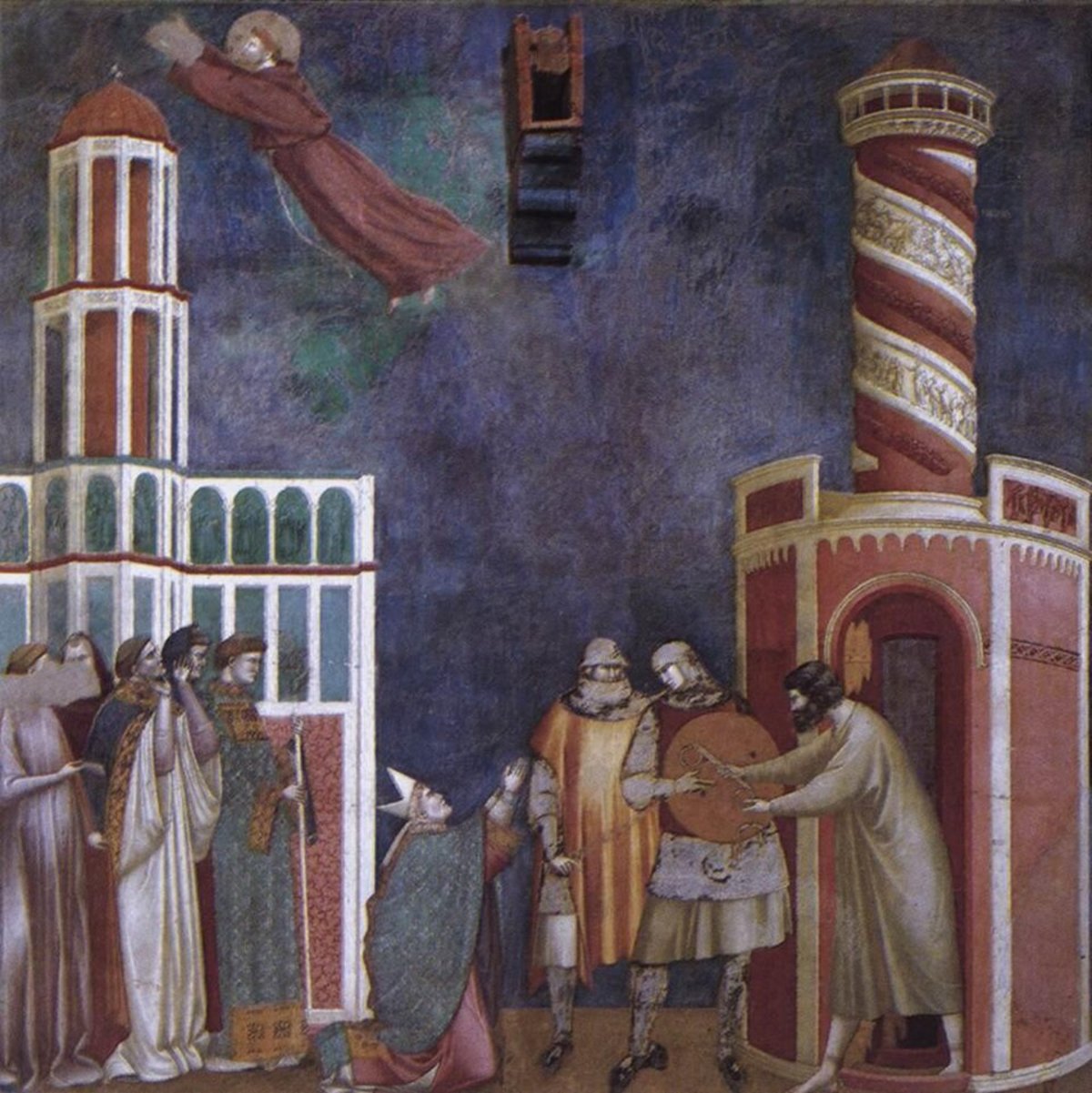
Legend of St Francis (28 frescoes)
Preaching to the Birds — Upper Basilica, Assisi
Giotto (attributed), Public domain, via Wikimedia Commons
The twenty-eight frescoes depicting the Legend of St Francis in the Upper Basilica of Assisi are among the most debated and most visited artworks in Italy. They are universally attributed to Giotto in the older literature (based on Ghiberti's early 15th-century attribution) and debated or denied in more recent scholarship (which assigns them to the 'Master of the Legend of St Francis' and his workshop).
Regardless of attribution, they are supreme examples of late 13th-century narrative fresco — each of the twenty-eight scenes, reading from the nave's high windows around the lower register, depicts an episode from Bonaventure's Legenda Maior (c.1263), the official Franciscan life of St Francis. The scenes range from the Renunciation of Worldly Goods and the Stigmatization to the Preaching to the Birds and the Death and Ascension of St Francis.
The Upper Basilica of Assisi was decorated in two phases. The upper register (above the windows) was painted by Roman masters including Cimabue; the lower register (the St Francis cycle) followed, probably between 1296 and 1304.
Whether Giotto directed the programme is uncertain; what is certain is that the stylistic influence of the Arena Chapel (which Giotto undeniably painted c.1304-1306) runs through the Assisi frescoes in a way that makes chronological attribution complex — did Assisi precede Padua, or does Padua precede Assisi? Most current scholarship places the Assisi cycle slightly earlier, suggesting that the workshop that produced it (in which Giotto may or may not have been the directing hand) developed the narrative-spatial vocabulary that reached its fullest expression in Padua.
The most famous individual scene is the Preaching to the Birds: Francis kneels before a tree full of birds, making a gesture of blessing toward them, while a companion watches from behind. The composition is simple, tender, and precisely observed — the birds are specifically distinguished species, the tree is a believable Italian oak, the gesture of Francis is that of a man speaking rather than performing a miracle.
The Stigmatization of St Francis (Francis receiving the wounds of Christ from a winged seraph on La Verna) and the Death of St Francis (the mourning friars, the ascending soul received by angels) are equally powerful narratives. All twenty-eight scenes should be read in sequence around the nave.
When standing before this work, look carefully: Preaching to the Birds — Upper Basilica, Assisi. Give it time — what seems decorative often carries the central meaning.
When standing before this work, look carefully: The Stigmatization of St Francis. Give it time — what seems decorative often carries the central meaning.
When standing before this work, look carefully: The Upper Basilica nave with the fresco cycle. Give it time — what seems decorative often carries the central meaning.
When standing before this work, look carefully: St Francis Renouncing Worldly Goods. Give it time — what seems decorative often carries the central meaning.
Basilica di San Francesco, Via San Francesco, Assisi. The Upper Basilica (where the St Francis cycle is) and the Lower Basilica (with Cimabue and Simone Martini frescoes) are both part of the same complex.
Entry is free. The basilica is one of the most visited pilgrimage sites in Italy; quieter viewing is possible in the early morning or late afternoon.