
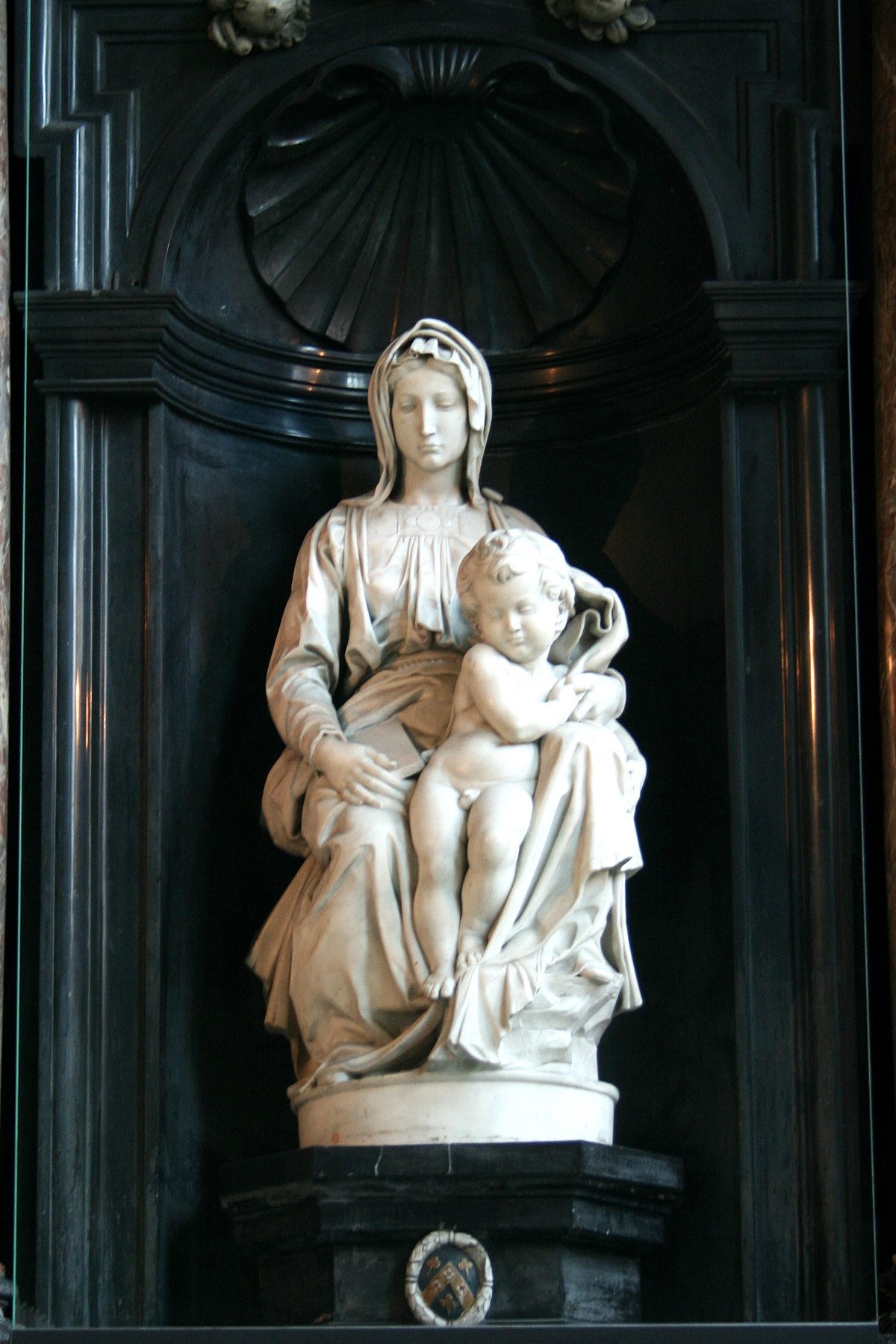
Madonna of Bruges
The only Michelangelo sculpture to leave Italy during his lifetime — the Virgin and Child in marble at the Church of Our Lady in Bruges, 1501–1504.
Michelangelo, Public domain, via Wikimedia Commons
Michelangelo's Madonna of Bruges is the only work by him to leave Italy during his lifetime — sold to a Flemish merchant in 1506 and subsequently donated to the Church of Our Lady in Bruges. It shows the Virgin seated, the Christ child standing between her knees with his left foot forward as if about to step away from his mother — a pose of independence rather than the conventional clinging infant.
The Virgin looks downward with an expression of melancholy foreknowledge (she knows what awaits this child); the child's forward posture suggests his willingness to enter the world. The formal qualities of the marble — the polished surfaces, the deeply cut drapery, the anatomical precision of the child — are those of the approximately contemporary David, with a different emotional register.
Michelangelo carved the Madonna of Bruges simultaneously with (or just after) the Vatican Pietà, between 1501 and 1504. It represents his first sustained engagement with the seated Madonna and standing Child format — a challenge to Donatello's earlier Bruges Madonna (Donatello had also made a bronze Madonna for Bruges) and to the classical sculptural tradition.
The commission came from the Bruges merchant family of Mouscron, who purchased it directly from Michelangelo's workshop; it was installed in their chapel in Bruges by 1506. It was stolen twice: by Napoleon's troops in 1794 (returned 1815) and by the Nazis in 1944 (recovered by the Monuments Men from a salt mine in Austria in 1945, along with the Ghent Altarpiece panels).
The child's posture — right foot on the step, left foot forward, one hand grasping the Virgin's robe lightly — is technically complex: the weight distribution of a standing child is precisely observed, and the relationship between the standing child's movement and the seated mother's stillness creates a compositional tension that expresses the theological relationship (the active Redeemer, the passive accepting Mother). The Virgin's downward gaze is one of Michelangelo's most restrained and moving expressions: she does not look at us, or at the Christ, but inward — absorbed in a foreknowledge she cannot share. Look at the quality of the cloth across her knees — the same deep undercutting of drapery that characterises the Vatican Pietà.
When standing before this work, look carefully: Madonna of Bruges — Michelangelo, 1501-1504. Give it time — what seems decorative often carries the central meaning.
When standing before this work, look carefully: The Christ child — stepping forward from his mother. Give it time — what seems decorative often carries the central meaning.
When standing before this work, look carefully: The Virgin's face — melancholy foreknowledge. Give it time — what seems decorative often carries the central meaning.
When standing before this work, look carefully: Church of Our Lady, Bruges — the tower and entrance. Give it time — what seems decorative often carries the central meaning.
Church of Our Lady (Onze-Lieve-Vrouwekerk), Mariastraat, Bruges. The Madonna is in the Mausoleum Chapel (left transept).
The chapel also contains the painted-marble tombs of Charles the Bold and Mary of Burgundy (superb examples of Flemish tomb sculpture). Entry to the Mausoleum Chapel requires a ticket.