
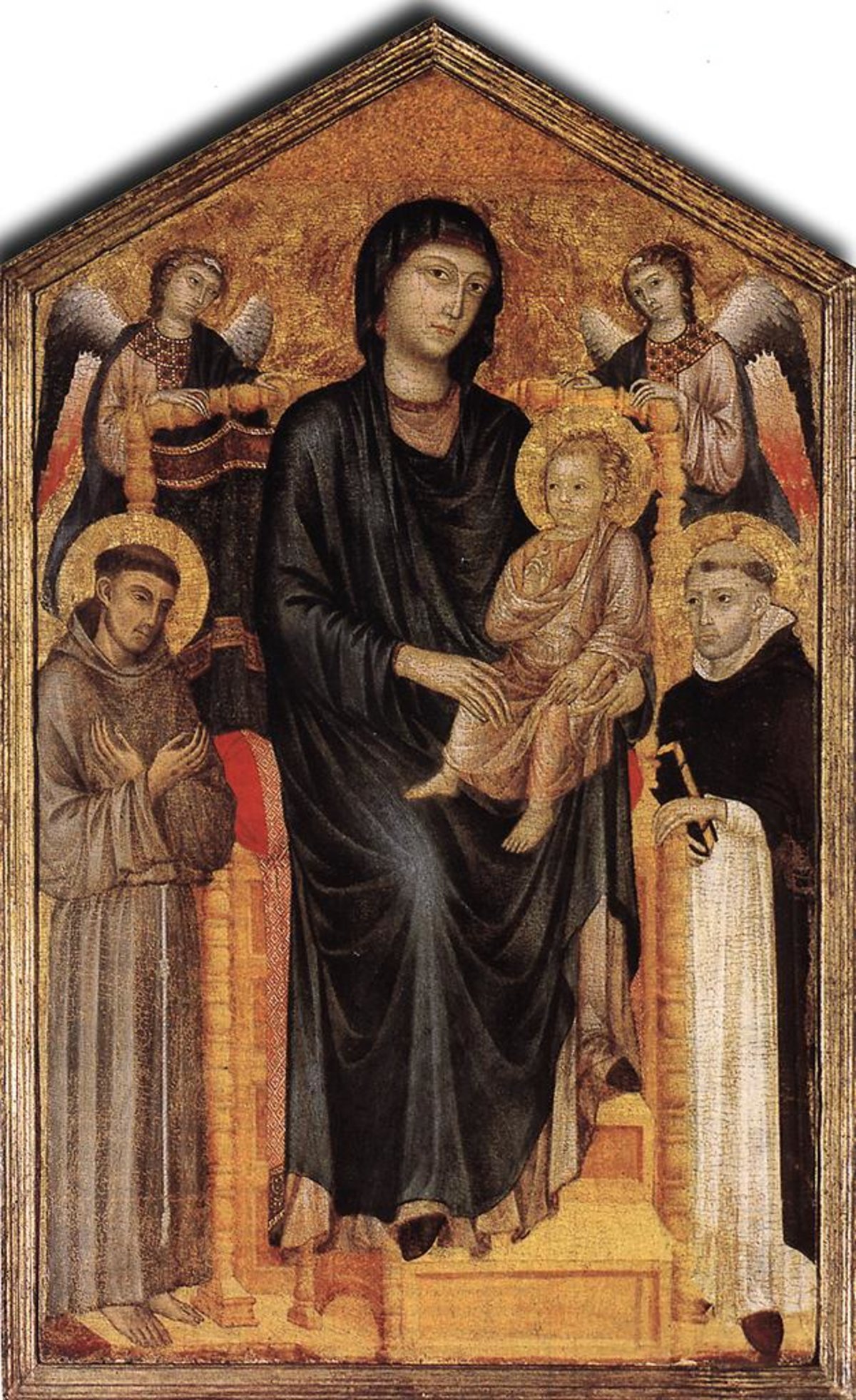
Maestà (Madonna with St Francis)
Cimabue's Maestà with St Francis — Lower Basilica, Assisi
Cimabue, Public domain, via Wikimedia Commons
Cimabue's Maestà in the Lower Basilica of Assisi is one of his earliest documented major works and one of the most evocative survivals of 13th-century Italian art. It shows the Virgin enthroned with four angels, and at the lower left corner, the unmistakable kneeling figure of St Francis — one of the earliest known portraits of Francis after his death (he died in 1226).
The fresco is severely damaged: Cimabue's original technique (which used lead white for highlights, now oxidised to black) has caused a reversal of tones that gives his frescoes an eerie photographic-negative quality — dark where they were once light, light where they were once dark. But even in its damaged state, the Maestà retains the quality of one of the founding documents of Italian devotional art.
The Lower Basilica of Assisi contains frescoes by multiple hands from the 13th and 14th centuries. Cimabue's work in the transepts includes the celebrated Crucifixion (whose tonal reversal is particularly dramatic — the white horses of the fleeing soldiers are now black, the dark sky now pale).
The Maestà in the right transept is in better condition. The kneeling Francis at the lower left is the key element for art historians: it is one of the first depictions of the saint in a monumental devotional painting, and it establishes the convention of representing the patron saint in a smaller scale than the divine figures — a spatial humility that implies theological hierarchy.
The kneeling Francis figure is small and specifically observed — his habit, his tonsure, the stigmata on his hands and feet. Though the tonal reversal makes the original colour difficult to read, the drawing beneath is clearly visible: the profile of the face, the posture of the hands.
The four angels around the throne are more conventional Byzantine types; it is the lower Francis that makes the composition a specifically Franciscan document. Compare this figure with the more elaborate treatments of Francis in the Upper Basilica cycle above, painted two decades later.
When standing before this work, look carefully: Cimabue's Maestà with St Francis — Lower Basilica, Assisi. Give it time — what seems decorative often carries the central meaning.
When standing before this work, look carefully: The kneeling St Francis — one of the earliest portraits. Give it time — what seems decorative often carries the central meaning.
When standing before this work, look carefully: Cimabue's Crucifixion — with characteristic tonal reversal. Give it time — what seems decorative often carries the central meaning.
When standing before this work, look carefully: The Lower Basilica of St Francis, Assisi. Give it time — what seems decorative often carries the central meaning.
Lower Basilica of St Francis, Assisi. The right transept contains the Cimabue frescoes. The Lower Basilica also contains important frescoes by Simone Martini (Cappella di San Martino) and Giotto's pupils (the vault of the nave), and is the site of the Tomb of St Francis in the crypt below.