
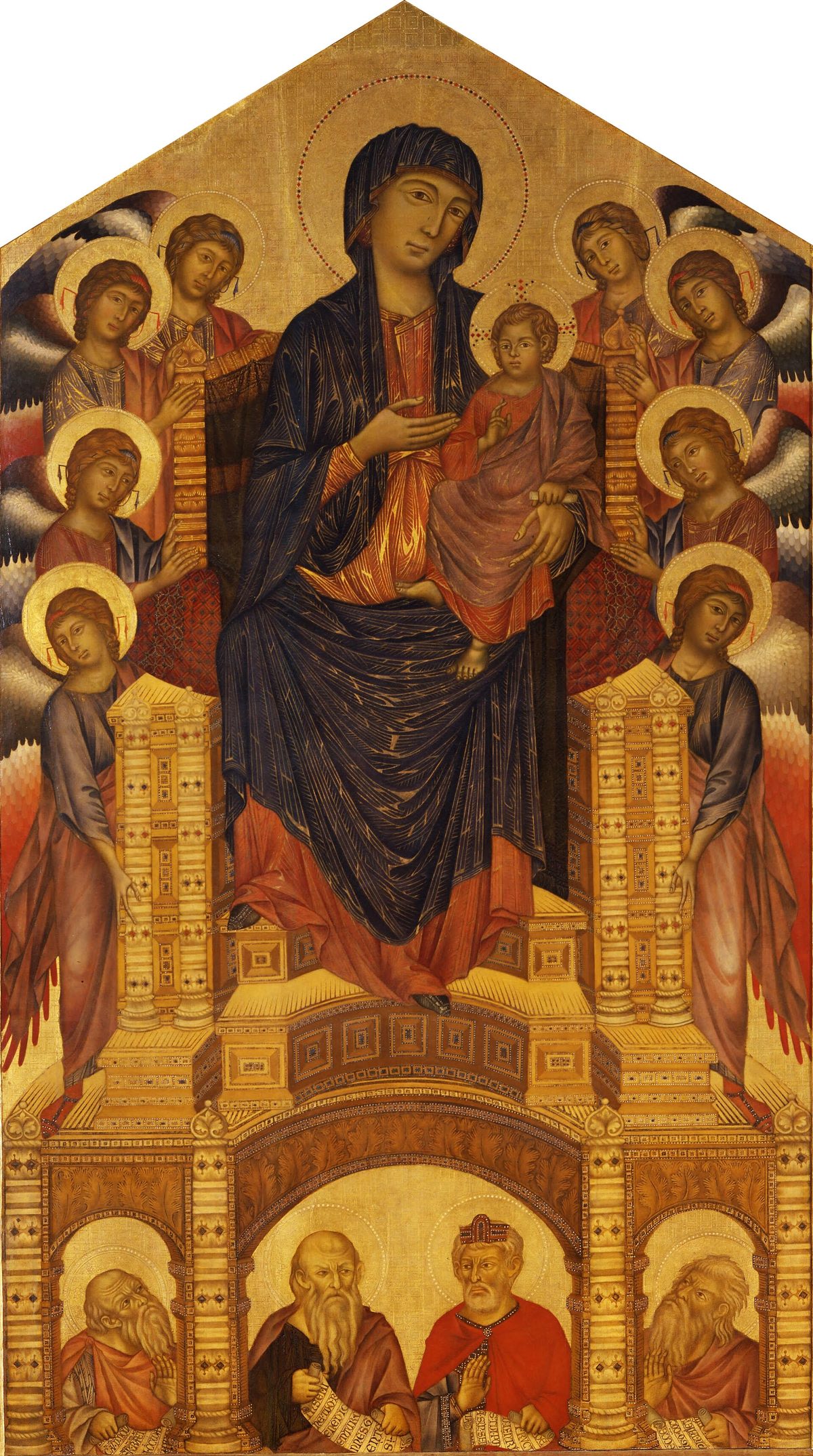
Maesta (Rucellai Madonna) / Maesta of Cimabue
Maesta (Santa Trinita) — Cimabue, c.1280-1285, Uffizi
Cimabue, Public domain, via Wikimedia Commons
Cimabue's two surviving Maesta panels represent the immediate precursor of Giotto's revolution in Italian painting. The Louvre Maesta (the 'Rucellai Madonna', now reattributed to Duccio by most scholars) was traditionally associated with Cimabue; the Maesta by Cimabue most securely attributed to him is the large panel (approximately 385 by 223 cm) in the Uffizi Gallery, Florence, which was originally the altarpiece of the Badia in Florence (or the church of Sta Trinità). Both works show the enthroned Virgin and Child with angels — the formal Maesta type — but Cimabue's treatment introduces a new interest in three-dimensionality, spatial depth (the throne is shown in perspective), and physical presence that distinguishes his work from the Byzantine models he was working within and that made him, in Dante's words, the greatest painter in Italy before Giotto surpassed him.
Cimabue (c.1240-c.1302) is the transitional figure between the Byzantine tradition and the revolution of Giotto — the painter who, working within the gold-background iconic tradition, began to push toward spatial realism and physical weight. Dante's famous lines in the Purgatorio — 'Cimabue believed that he held the field in painting, and now Giotto has the cry, so that the other's fame is dimmed' — place Cimabue in the history of Italian art as the master who prepared the way for Giotto. The Uffizi Maesta is a work of extraordinary scale and quality, displayed in the same room as Duccio's Rucellai Madonna and Giotto's Ognissanti Madonna — the three great Maesta panels that constitute a summary of 13th-century Italian painting.
The Uffizi Room 2 (the 'Sala di Cimabue') displays these three great Maesta panels side by side — Cimabue, Duccio, and Giotto. The comparison is the most instructive exercise in the whole gallery: standing in front of these three works, you can see the development of Italian painting from Byzantine formalism through Duccio's lyrical surface beauty to Giotto's spatial and physical revolution.
When standing before this work, look carefully: Maesta (Santa Trinita) — Cimabue, c.1280-1285, Uffizi. Give it time — what seems decorative often carries the central meaning.
When standing before this work, look carefully: The throne in perspective — beginning of spatial depth. Give it time — what seems decorative often carries the central meaning.
When standing before this work, look carefully: Room 2 — Cimabue, Duccio, and Giotto side by side. Give it time — what seems decorative often carries the central meaning.
When standing before this work, look carefully: Angels surrounding the throne — hierarchical order. Give it time — what seems decorative often carries the central meaning.
Cimabue's Maesta: Uffizi Gallery, Room 2, Piazzale degli Uffizi, Florence. Open Tuesday-Sunday 8:15-18:50. Admission fee applies; advance booking strongly recommended.