
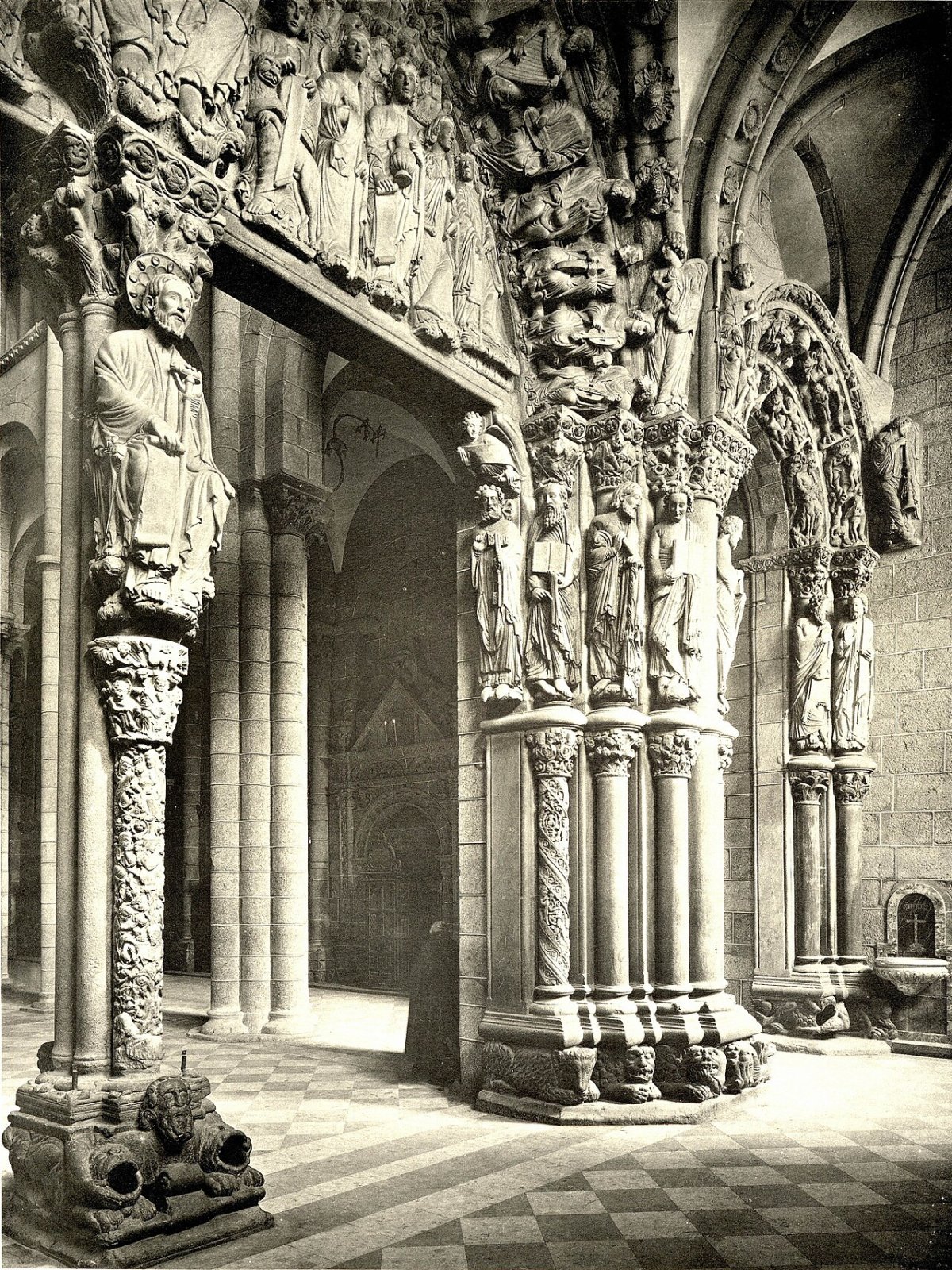
Pórtico de la Gloria
Pórtico de la Gloria — the full entrance portico
Public domain, via Wikimedia Commons
The Pórtico de la Gloria is the main entrance portico of the Cathedral of Santiago de Compostela — a sculpted stone programme of extraordinary richness created by Master Mateo and his workshop between 1168 and 1188. It consists of three arched doorways set into a deep carved vestibule: the central arch carries the Last Judgment (with Christ in Majesty at the apex, the twenty-four Elders of the Apocalypse in the archivolt, and the apostles flanking Christ on the tympanum), the left arch carries the Last Judgment for the Gentiles, and the right arch carries Purgatory.
The central doorpost (trumeau) supports the statue of St James (Santiago) as a seated apostle; below him is a Tree of Jesse (the genealogy of Christ) whose roots rest on a kneeling figure that has been traditionally identified as Master Mateo himself. Pilgrims have touched the Tree of Jesse's roots for centuries — the handprint impressions worn into the stone over 800 years are among the most moving evidences of devotion in Christendom.
Master Mateo received his commission from King Ferdinand II of León in 1168 and completed the programme in 1188. He was a sculptor of exceptional quality — the Pórtico is the masterpiece of Romanesque sculpture in Spain and one of the finest sculptural programmes in medieval Europe.
The figures have an individuality and expressiveness that goes beyond most Romanesque convention: the twenty-four Elders of the Apocalypse in the central archivolt are shown in animated conversation with each other, holding their instruments (violas, citterns, rebecs) and turning toward their neighbours. The tympanum figures have psychological presence; St James's face on the trumeau is composed and specific. Medieval polychromy (now largely gone) would have made the programme even more vivid.
The central tympanum presents Christ in Mandorla at the apex, showing his wounds, surrounded by the four Evangelists' symbols and the apostles flanking the scene. The archivolt carries the twenty-four Elders of the Apocalypse (Revelation 4:4), each one a portrait, each one holding his instrument.
The left archivolt carries angels with the Instruments of the Passion. The central trumeau (the doorpost between the two halves of the main door) carries the seated St James — the pilgrim's destination, carved as the gateway figure. The custom of touching (or kneeling and placing the hand on) the Tree of Jesse beneath St James has been observed by pilgrims for eight centuries; the indentations in the stone are visible evidence of millions of devotional acts.
When standing before this work, look carefully: Pórtico de la Gloria — the full entrance portico. Give it time — what seems decorative often carries the central meaning.
When standing before this work, look carefully: The central tympanum — Christ in Majesty. Give it time — what seems decorative often carries the central meaning.
When standing before this work, look carefully: The twenty-four Elders of the Apocalypse with instruments. Give it time — what seems decorative often carries the central meaning.
When standing before this work, look carefully: The Tree of Jesse trumeau — pilgrims' handprint impressions. Give it time — what seems decorative often carries the central meaning.
Santiago de Compostela Cathedral, Praza do Obradoiro, Santiago de Compostela. The Pórtico is inside the cathedral, behind the 18th-century Baroque facade.
The cathedral also houses the silver reliquary of St James above the high altar. The botafumeiro (giant incense burner) is swung at major feast days.