
Primavera (Spring)
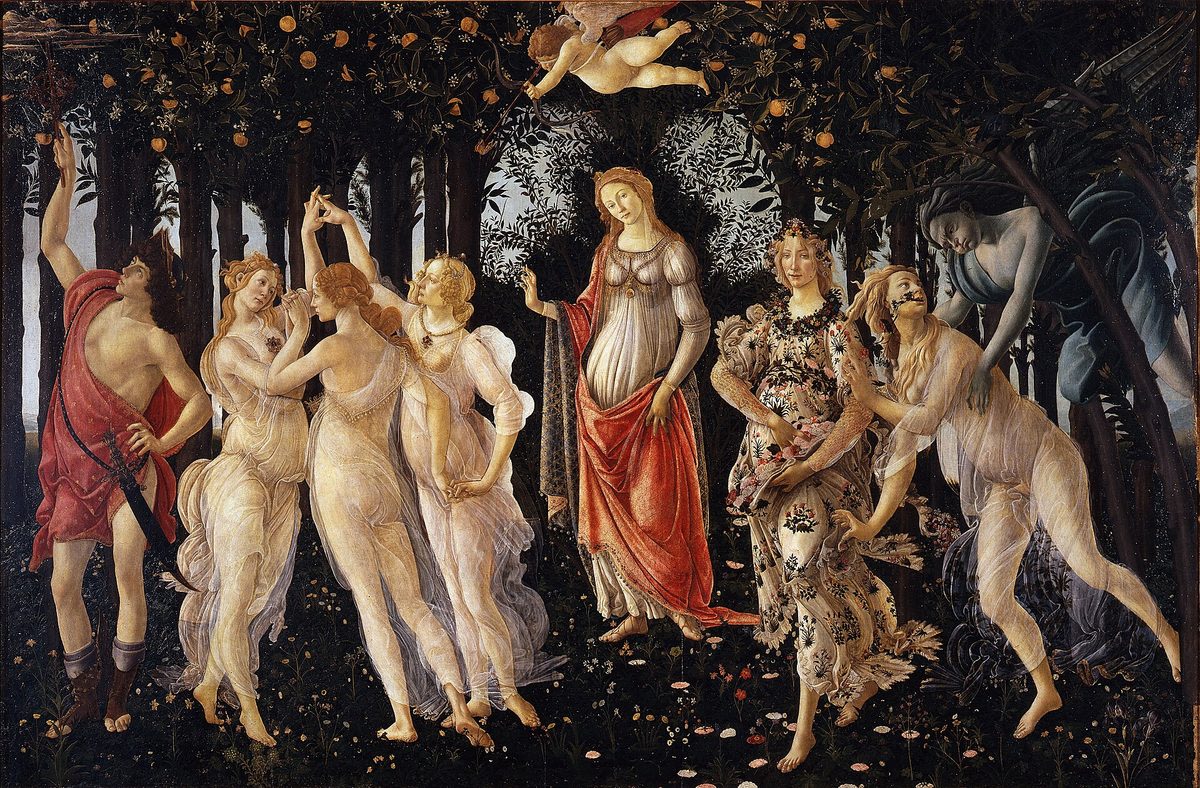
Primavera — Botticelli, c.1477-1482
Sandro Botticelli, Public domain, via Wikimedia Commons
Botticelli's Primavera is one of the most studied and debated paintings in Western art — a mysterious allegory set in an orange grove with nine figures of mythological identity, painted for Lorenzo di Pierfrancesco de' Medici. Despite over a century of scholarly debate, no interpretation commands universal agreement.
The most influential reading identifies (right to left): Zephyr pursuing the nymph Chloris, who transforms into Flora scattering flowers; in the centre, Venus beneath an arch of myrtle; above her, Cupid blindfolded releasing an arrow; to the left, the Three Graces in a transparent dance; at the far left, Mercury dispersing clouds. The programme relates to Neoplatonic ideas of beauty, love, and cosmic harmony circulating in the Medici circle, where Ficino, Poliziano, and Pico della Mirandola were formulating a Christian-Platonic synthesis.
Botticelli (c.1445–1510) worked primarily for the Medici family and their associates throughout his career. The Primavera and the Birth of Venus (see next entry) are his two great mythological paintings and the defining images of the Florentine Renaissance.
The orange grove setting may reference the Hesperides of Greek myth or the Medici estate at Castello, where the painting was inventoried in 1499. The iconographic source is probably Lucretius's De Rerum Natura and Poliziano's Stanze per la Giostra — a poem celebrating a tournament by Giuliano de' Medici. The approximately 190 plant species in the meadow foreground have been botanically identified; the level of natural observation is extraordinary.
The Three Graces, though given in mythological terms as Chastity, Beauty, and Love (or the classical trio of Aglaea, Thalia, and Euphrosyne), are depicted with a lightness of movement — their transparent drapery, their interlaced arms, their delicate steps — that has never been surpassed in the painting of female elegance. Their faces are Botticelli's characteristic type: elongated, slightly melancholy, spiritually absorbed.
Flora's flower-strewn gown is one of the most elaborately observed fabrics in 15th-century painting. Mercury's back-turned pose at the far left creates a compositional framing that prevents the garden from feeling open — he guards a boundary, dissolving clouds above the sacred grove with his caduceus.
When standing before this work, look carefully: Primavera — Botticelli, c.1477-1482. Give it time — what seems decorative often carries the central meaning.
When standing before this work, look carefully: The Three Graces — transparency and elegance. Give it time — what seems decorative often carries the central meaning.
When standing before this work, look carefully: Flora scattering flowers — the floral gown. Give it time — what seems decorative often carries the central meaning.
When standing before this work, look carefully: Venus at the centre of the composition. Give it time — what seems decorative often carries the central meaning.
Uffizi Gallery, Room 41 (Botticelli Rooms). The Primavera and Birth of Venus hang in proximity — they are two of the most visited paintings in the world. The Uffizi is open Tuesday through Sunday; advance booking strongly recommended.