
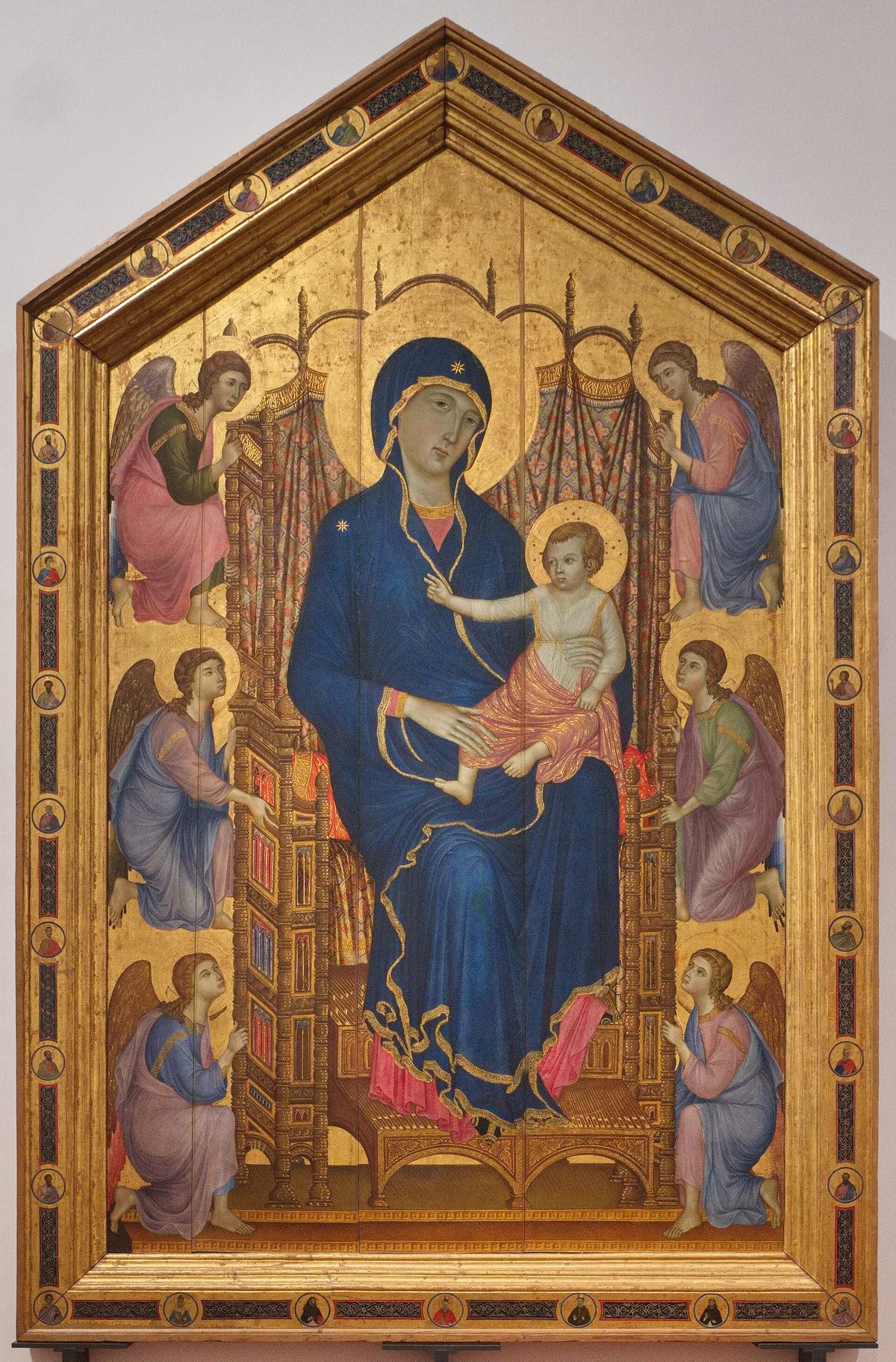
Rucellai Madonna
Rucellai Madonna — Duccio di Buoninsegna, c.1285
Duccio di Buoninsegna, Public domain, via Wikimedia Commons
Duccio's Rucellai Madonna, painted around 1285 for the Laudesi confraternity in Santa Maria Novella, is the greatest surviving work of 13th-century Italian painting and the foundation on which the Sienese school was built. Larger than Giotto's Ognissanti Madonna (approximately 450 by 290 cm), it depicts the Madonna and Child enthroned with six flanking angels in the Byzantine Maestà tradition — but with a refinement of line, colour, and emotional expression that goes well beyond the Byzantine workshop conventions. Duccio's Virgin has a tenderness in her relationship to the Child, a softness of drapery folds, and a spatial suggestion in the throne that prefigure the naturalism of the next century without yet achieving it.
Duccio di Buoninsegna (active c.1278-1319) is the founder of the Sienese school and the great contemporary of Giotto in Florentine painting. The two represent the twin roots of the Italian Renaissance tradition — Siena (line, colour, gold, refinement) and Florence (volume, space, narrative).
Duccio's supreme achievement was the Maestà altarpiece for Siena Cathedral (1308-1311), which survives in fragments in the Museo dell'Opera del Duomo in Siena. The Rucellai Madonna predates it and shows Duccio in his earlier style — still close to the Byzantine tradition in the gold patterning of the drapery but departing from it in the psychological relationship between Mother and Child.
Compare the Rucellai Madonna with Giotto's Ognissanti Madonna in the same room. Duccio's angels are more stylized — their faces are more formulaic, their arrangement more symmetrical.
But the Virgin's face has a quality of tender human attention that anticipates the 14th-century development. The gold striations on the Virgin's cloak (the chrysography, or gold-line technique inherited from Byzantine painting) create a decorative surface that catches light throughout the day — this is one reason Byzantine-descended paintings were placed in church interiors where natural light would animate their surfaces. The child reaches toward the Virgin's face in a gesture of human intimacy that is new in Italian painting.
When standing before this work, look carefully: Rucellai Madonna — Duccio di Buoninsegna, c.1285. Give it time — what seems decorative often carries the central meaning.
When standing before this work, look carefully: The Virgin and Child — Byzantine tenderness. Give it time — what seems decorative often carries the central meaning.
When standing before this work, look carefully: The flanking angels. Give it time — what seems decorative often carries the central meaning.
When standing before this work, look carefully: The gold-decorated throne. Give it time — what seems decorative often carries the central meaning.
Uffizi Gallery, Room 2. The Rucellai Madonna hung in Santa Maria Novella from 1285 until 1948, when it was transferred to the Uffizi. Its enormous scale dominates the room.