
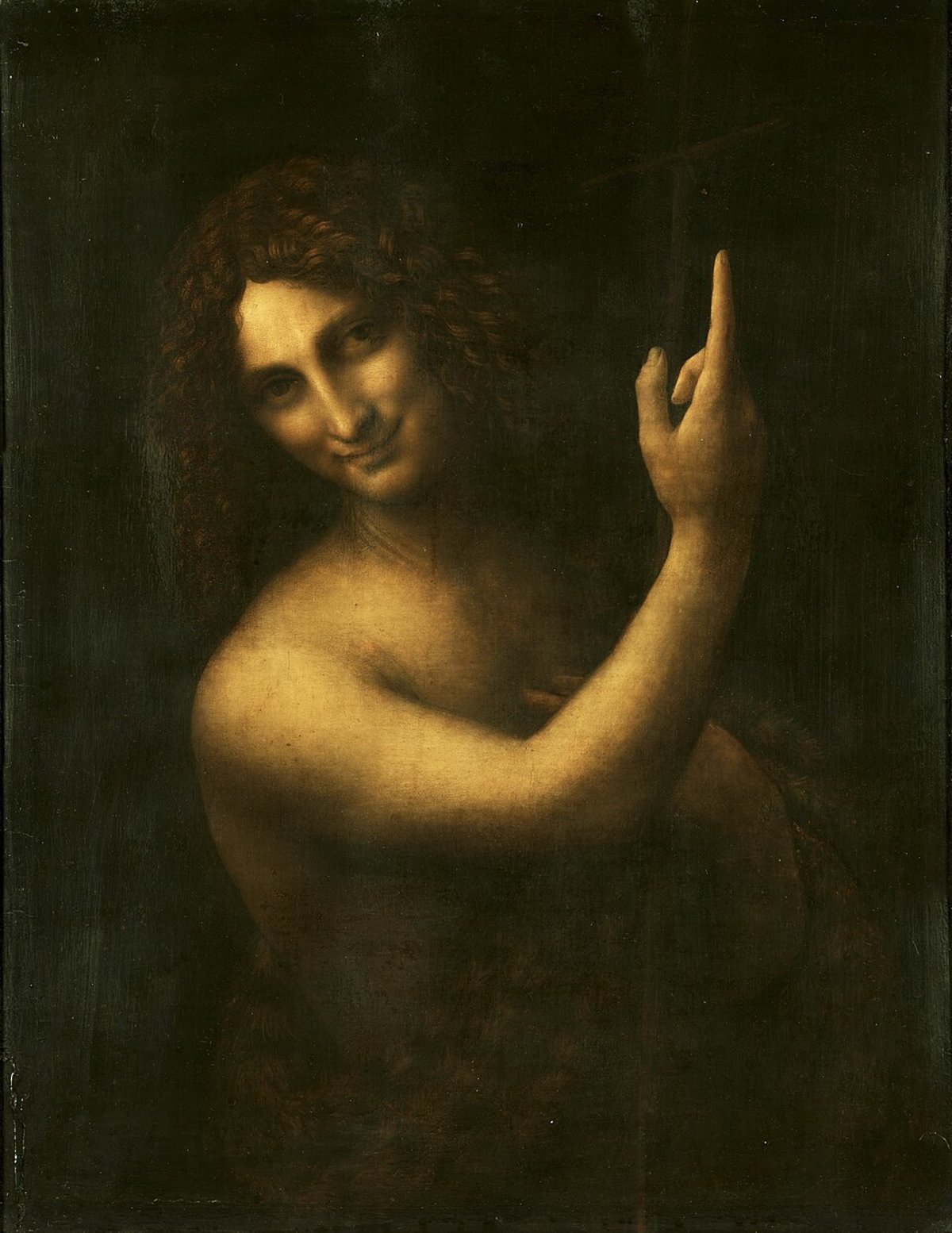
Saint John the Baptist
Saint John the Baptist — Leonardo da Vinci, c.1513-1516
Leonardo da Vinci, Public domain, via Wikimedia Commons
Leonardo's Saint John the Baptist is his last surviving painting — completed in Milan or Rome in the final years of his life, and taken to France when Leonardo moved to Amboise in 1516. The painting shows St John from the waist up, emerging from darkness, pointing upward with his right index finger — the gesture that means 'prepare the way of the Lord.' His expression is a smile that has been compared to (and is clearly related to) the Mona Lisa. The figure's androgynous beauty, the extreme chiaroscuro (the figure emerges from pure black), and the pointing gesture that leads the eye up into darkness (not light) make this the most mysterious and unsettling of Leonardo's surviving works.
Leonardo da Vinci (1452-1519) was the paradigm case of the Renaissance universal man — painter, sculptor, architect, engineer, scientist, anatomist, musician. His surviving paintings are few (approximately fifteen to seventeen are accepted as autograph, depending on attribution decisions), but each is a breakthrough: the Virgin of the Rocks, The Last Supper, the Mona Lisa, the Lady with an Ermine, and this St John the Baptist.
The St John was painted in Rome (c.1513-1516) and brought to France as part of Leonardo's baggage when he accepted Francis I's invitation to Amboise. It remained in the French Royal Collection and entered the Louvre at the Revolution.
The pointing finger — pointing up and to the viewer's left — is the key gesture. It is the gesture of prophecy and preparation: John points toward the coming of Christ. But Leonardo makes the gesture ambiguous: the figure emerges from absolute darkness, and the pointing finger leads the eye into the painting's upper region, which is also darkness.
Is John pointing toward heaven, or into the void? The smile — echoing the Mona Lisa's sfumato mystery — is neither entirely masculine nor feminine. The camel-hair cloak (John's traditional attribute) is indicated by a fur wrap over the shoulder.
When standing before this work, look carefully: Saint John the Baptist — Leonardo da Vinci, c.1513-1516. Give it time — what seems decorative often carries the central meaning.
When standing before this work, look carefully: The pointing finger — gesture of prophecy. Give it time — what seems decorative often carries the central meaning.
When standing before this work, look carefully: The androgynous face — sfumato mystery. Give it time — what seems decorative often carries the central meaning.
When standing before this work, look carefully: Emergence from darkness — extreme chiaroscuro. Give it time — what seems decorative often carries the central meaning.
Musée du Louvre, Sully Wing, Room 710. Open Wednesday-Monday 9:00-18:00 (21:45 on Wednesdays and Fridays).
Admission fee applies. The painting is usually displayed near the other Leonardo works (including the Virgin of the Rocks and the Mona Lisa).