
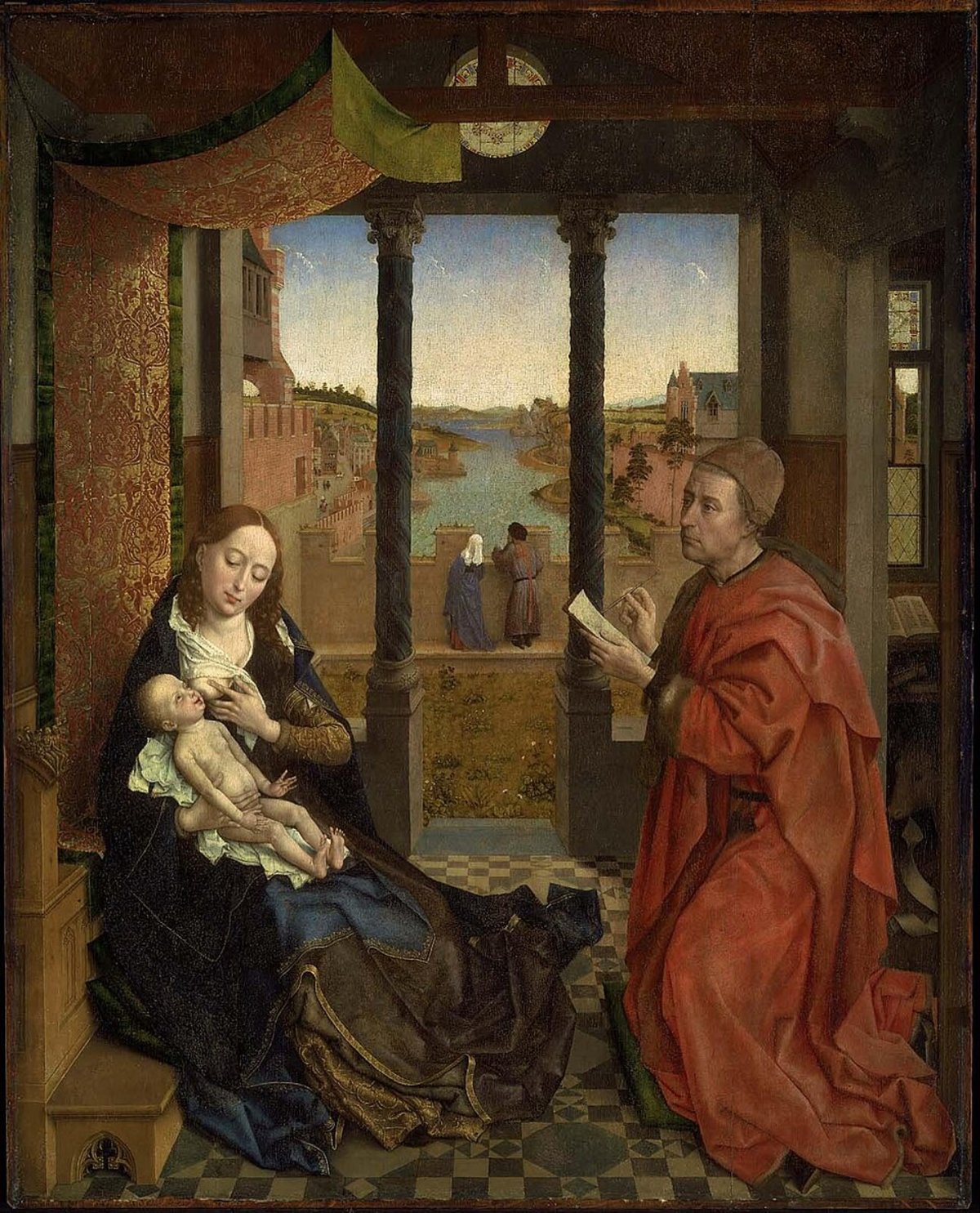
Saint Luke Drawing the Virgin
St Luke Drawing the Virgin — Rogier, c.1435-1440, Boston MFA
Rogier van der Weyden, Public domain, via Wikimedia Commons
Saint Luke Drawing the Virgin is one of the most important surviving altarpiece compositions by Rogier van der Weyden, existing in four versions (Boston, Munich, Bruges, and St Petersburg) — a reflection of the painting's enormous popularity and the demand from workshop copies. The Boston version is generally considered the primary autograph version.
The subject shows St Luke (traditionally identified as the author of the only Gospel account of the Nativity and as a painter who made a portrait of the Virgin from life) kneeling to draw or paint the seated Virgin and Child. The setting is a domestic Flemish interior opening onto a garden and a broad river landscape — the same compositional type as Jan van Eyck's Rolin Madonna. Luke is simultaneously worshipper and artist, observer and creator; the image meditates on the act of devotional image-making itself.
The painting was the property of the Painters' Guild of Brussels (which venerated St Luke as its patron) before its dispersal in the 16th century. Rogier was dean of the Brussels guild, and the painting's subject — Luke drawing the Virgin — is a meditation on the role of the artist as devotional image-maker, created by the most important Flemish painter of his generation for the professional organisation he led.
St Luke's posture — kneeling, stylus in hand, looking at the Virgin and Child with an expression that combines devotional concentration and artistic attention — is Rogier's most complex psychological portrait. The Virgin nurses the Child in an attitude of maternal tenderness. The landscape visible through the colonnade behind them is the same wide river valley visible in the Rolin Madonna — a shared Flemish compositional convention of the mid-15th century.
When standing before this work, look carefully: St Luke Drawing the Virgin — Rogier, c.1435-1440, Boston MFA. Give it time — what seems decorative often carries the central meaning.
When standing before this work, look carefully: Virgin nursing the Child — tender maternity. Give it time — what seems decorative often carries the central meaning.
When standing before this work, look carefully: Luke kneeling — devotion and artistic attention. Give it time — what seems decorative often carries the central meaning.
When standing before this work, look carefully: River landscape background — Flemish convention. Give it time — what seems decorative often carries the central meaning.
Museum of Fine Arts, Boston, 465 Huntington Avenue, Boston, MA 02115. Open Tuesday-Sunday 10:00-17:00 (21:00 Thursdays-Fridays). Admission fee applies.