
The Life
Anne and Joachim do not appear in the canonical Gospels at all. Their names, their story — the elderly couple praying for a child, the angel announcing that their prayer was heard, the birth of the girl who would become the Mother of God — come from the Protoevangelium of James, a second-century apocryphal text. And yet they are among the most universally venerated saints in the Catholic Church, the subject of pilgrimage shrines that draw millions, because they represent something the canonical Gospels don't address: the generation before Mary, the faith that produced the faith that produced the Incarnation.
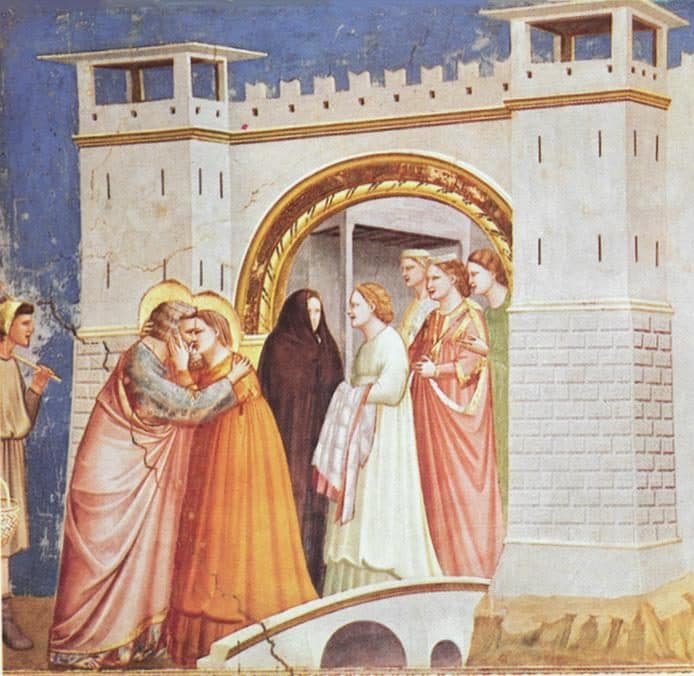
Anne and Joachim were childless — the most painful condition in their cultural context, where barrenness was sometimes interpreted as divine punishment. They prayed. They were ridiculed. Joachim, deeply ashamed, went into the desert and fasted for forty days. Anne wept at home. Angels appeared to both of them separately, announcing that their prayer had been heard and that the child they would conceive would be spoken of throughout the world. They met at the Golden Gate of Jerusalem and embraced — an embrace that has been depicted in hundreds of paintings across Christian history.
The child born of that embrace was Mary. The theology embedded in this story is important: Mary's holiness was not accidental. It was prepared for by the faith of her parents, by their decades of prayer, by their willingness to live with unanswered prayer and to keep praying anyway. The grandparents of Jesus are the people who made possible the conditions in which the Incarnation could happen — not by any supernatural gift but by the ordinary, sustained, unspectacular fidelity of a long marriage lived in faith.
Anne is particularly venerated in Quebec, where the great shrine of Sainte-Anne-de-Beaupre on the St Lawrence River has been a pilgrimage centre since 1658, drawing over a million visitors per year and associated with thousands of documented healings. She is also deeply venerated in Brittany, in Turkey (at Seljuk, near Ephesus, where a house is associated with her memory), and across the Catholic world as the grandmother of God — the woman who held Mary in her arms, who taught her to walk and to pray, who prepared the ground in which the seed of the Incarnation could grow.
The Meeting at the Golden Gate
The most famous image of Anne and Joachim is their meeting at the Golden Gate of Jerusalem after the angelic announcements. Both had received separately the news that their prayer for a child was answered. They met at the gate — the old man from the desert, the old woman from the house — and embraced. Giotto's fresco of this meeting in the Scrovegni Chapel in Padua (c.1305) is one of the most famous images in Western art history. The embrace of two elderly people whose impossible prayer has just been answered: it is the beginning of the Incarnation. The Childhood of Mary — Anne as teacher Anne raised Mary. The tradition, elaborated in the Protoevangelium, says that Mary was presented to the Temple at age three and spent her childhood there. But before the Temple, there were three years with Anne and Joachim: three years of first words and first steps and first prayers, three years of the grandmother of God holding the mother of God in her arms and teaching her the psalms and the traditions of Israel. What Anne gave Mary in those first years is part of what Mary gave Jesus. The grandmother's faith is in the grandson. Sainte-Anne-de-Beaupre — the Canadian shrine In 1658, Breton sailors caught in a storm on the St Lawrence River prayed to St Anne and survived. They landed on the shore and built a chapel. The shrine of Sainte-Anne-de-Beaupre grew around that chapel and has been one of North America's great pilgrimage centres for four centuries. The current basilica (1926) is the fifth church on the site. Over a million pilgrims per year, many of them seeking healing. The crutches, braces, and wheelchairs left behind by those who have been healed fill the walls of the basilica entrance. The Patience of Unanswered Prayer Joachim was turned away from the Temple when he came to offer gifts because he was childless — considered unworthy, unblessed. He retreated in shame to the desert. Anne remained at home, mourning. Neither of them abandoned their prayer or their faith. They continued to wait. This is the theological content of Anne and Joachim's witness: the long obedience in the same direction, the refusal to interpret silence as absence, the willingness to keep praying when the prayer has not been answered for decades. They are the patrons of those who are still waiting.
Walk in Their Footsteps
Pilgrimage sites connected to St Anne (and Joachim)
Ask St Anne (and Joachim) to Intercede
Bring these intentions to this saint in prayer:
Anne and Joachim prayed for decades before they received what they prayed for. Their patience was not passive — it was the active, sustained holding of the prayer in the face of everything that suggested the prayer would not be answered. What they received when the answer finally came was not just a child. It was Mary. And through Mary, the Incarnation. The long delay was part of the preparation, not an obstacle to it. The most important things often take the longest to arrive.
“He settles the childless woman in her home as a happy mother of children. Praise the Lord.”
St Anne and St Joachim, grandparents of God — pray for those of us who are still waiting. Pray for those whose prayer for a child has not yet been answered, and for those whose prayer for any apparently impossible thing remains unanswered. Give us your patience, your refusal to stop praying, your trust that the silence is not the final word. And when the answer comes, let us recognise it. Amen.