
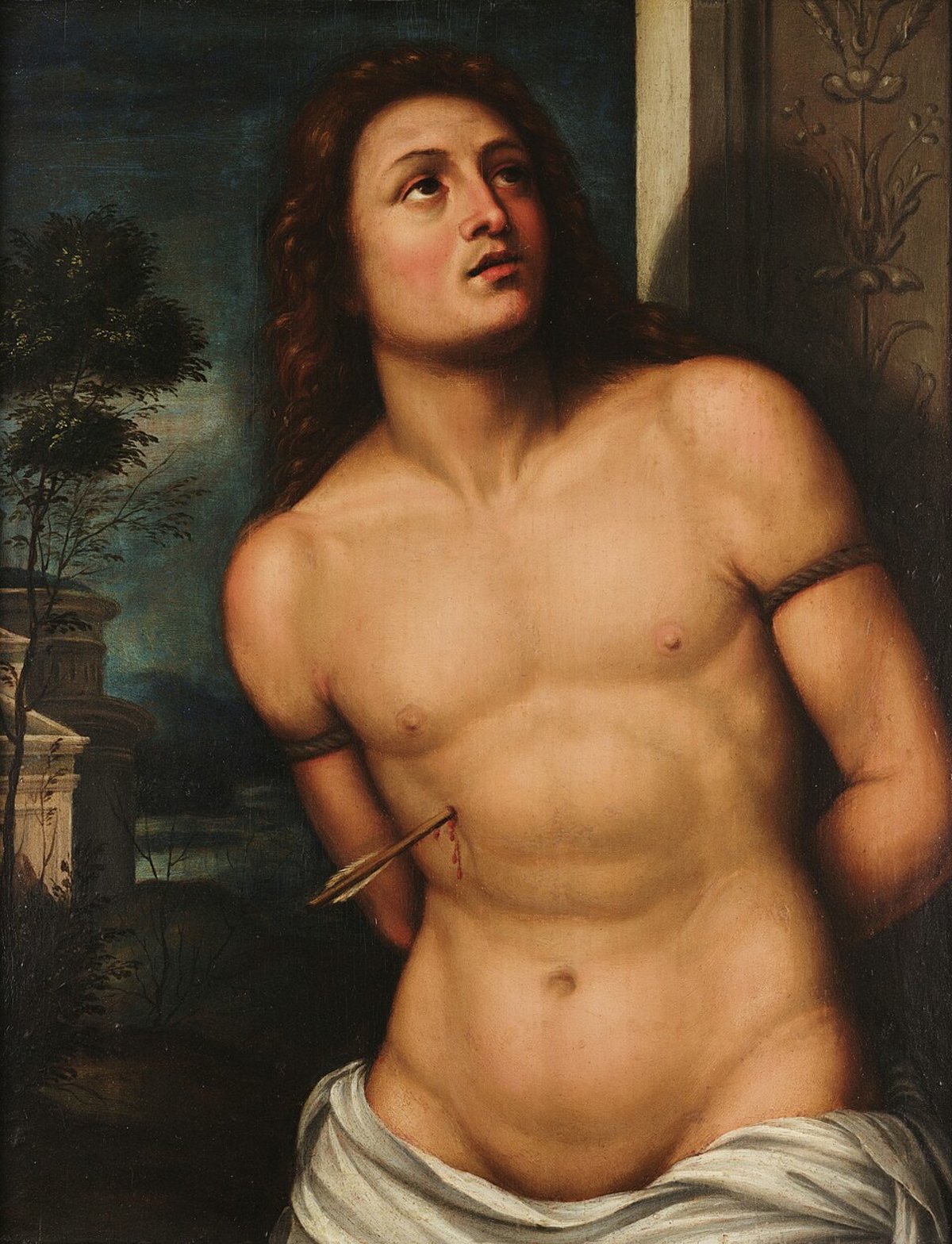
Saint Sebastian
Saint Sebastian — Antonello da Messina, c.1476-1477, Dresden
Antonello da Messina, Public domain, via Wikimedia Commons
Antonello da Messina's Saint Sebastian in Dresden is one of the most beautiful and formally inventive Renaissance paintings of the human body in extremity. The tall, narrow panel (approximately 171 by 85 cm) shows Sebastian at the moment of his martyrdom: bound to a column, pierced by arrows, but not yet dead — his face turns upward with an expression of spiritual transcendence rather than physical agony.
The setting is a perspectivally constructed Venetian piazza, with figures going about their ordinary business in the middle and background while the martyrdom takes place in the foreground — a characteristic Northern and Netherlandish approach to the holy event within the ordinary world. The painting was made just after Antonello's transformative Venetian visit (1475-1476).
The Saint Sebastian was probably painted for a Venetian or North Italian patron in 1476-1477. The architectural setting — a loggia with arches opening onto a wide piazza, with a hill town visible in the distance — is Venetian in character.
The figure of Sebastian is one of the finest nude male figures in 15th-century Italian painting: the anatomy is observed and convincing, the posture combines physical vulnerability (the bound arms, the wounds) with spiritual serenity. The arrows are minimal — Antonello does not dwell on the gore of martyrdom but on the beauty of the martyr.
The urban setting — with ordinary figures (a sleeping man, figures on a balcony, distant street scenes) going about their daily lives while Sebastian is martyred in the foreground — is one of the most striking compositional choices in 15th-century painting. The city does not notice the martyr. This indifference of the world to the sacred event in its midst is a recurring theme in Flemish and Italian painting of the period.
When standing before this work, look carefully: Saint Sebastian — Antonello da Messina, c.1476-1477, Dresden. Give it time — what seems decorative often carries the central meaning.
When standing before this work, look carefully: Sebastian's face — spiritual transcendence, not agony. Give it time — what seems decorative often carries the central meaning.
When standing before this work, look carefully: The Venetian piazza — ordinary life during martyrdom. Give it time — what seems decorative often carries the central meaning.
When standing before this work, look carefully: Full panel — tall format, architectural setting. Give it time — what seems decorative often carries the central meaning.
Gemäldegalerie Alte Meister, Theaterplatz 1, 01067 Dresden. Open Tuesday-Sunday 10:00-18:00. Admission fee applies.