
The Life
Sebastian was a Roman soldier — an officer in the Praetorian Guard, the imperial bodyguard — who was a secret Christian during the reign of Diocletian. He was apparently in the perfect position for covert Christian ministry: his rank gave him access to prisoners, he could arrange conditions of confinement, he could speak with condemned Christians without arousing suspicion. He used this access extensively, encouraging imprisoned Christians, reportedly healing people, and making conversions in prison.
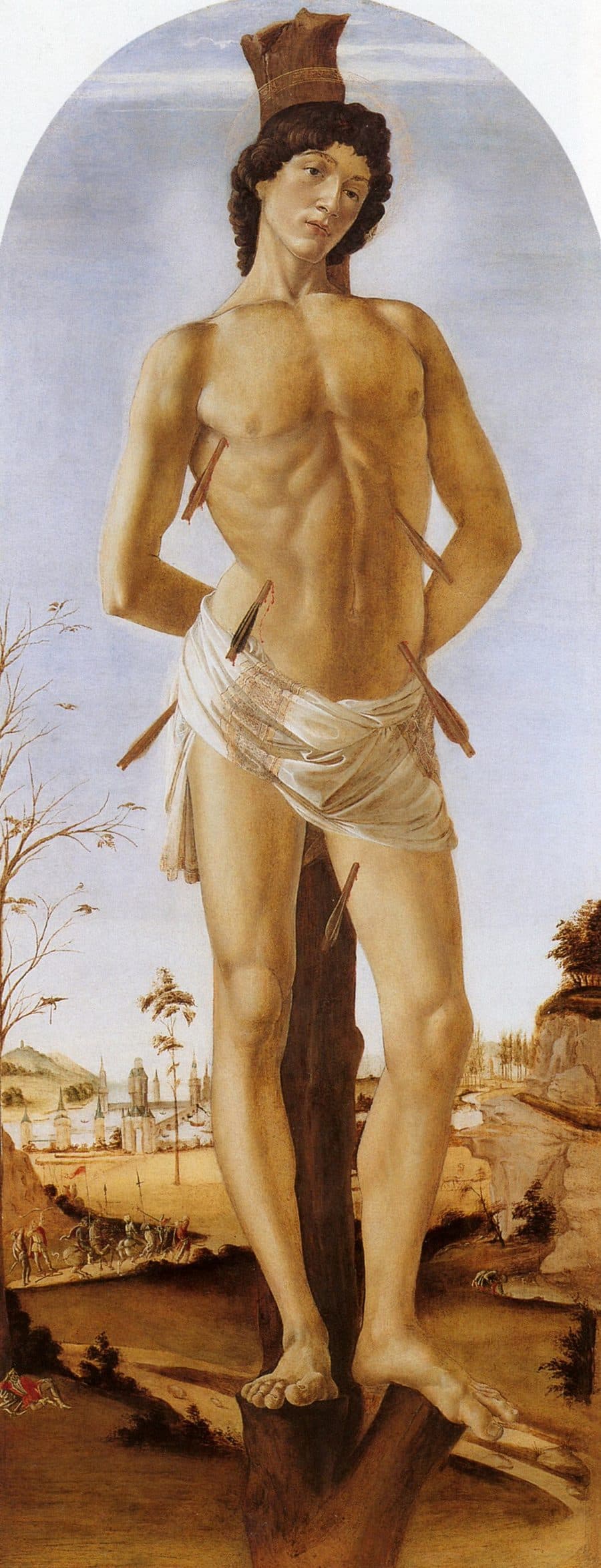
His Christianity was discovered. Diocletian, outraged at the betrayal by an officer he trusted, ordered Sebastian tied to a stake and shot with arrows by archers of the Mauritanian cohort. Sebastian survived the arrows — the archers, who knew him as a colleague, may have deliberately aimed to wound rather than kill; the traditional iconography, showing him pierced by multiple arrows but clearly alive, captures this ambiguity. He was left for dead, taken down by a widow named Irene who intended to bury him, and found to be still alive. She nursed him back to health.
Sebastian's response to recovery was theologically striking: he went directly to Diocletian and confronted him publicly, rebuking the emperor for his persecution of Christians. Diocletian, now genuinely enraged, ordered him beaten to death and his body thrown in the sewer. A Christian woman, Lucina, was told in a vision where to find the body; she buried it on the Appian Way, in the catacomb that bears his name to this day.
His patronage of athletes comes from the arrow imagery — the athletic, muscular body pierced by arrows but not defeated — and from the association of his soldier's physique with physical prowess. His patronage of those suffering from plague comes from the medieval interpretation of plague as God's arrows shot at sinners (following Psalm 91's imagery), and from the observation that invoking Sebastian seemed to help. His image — the beautiful young man pierced by arrows — is one of the most depicted in the entire history of Christian art.
The Arrow Martyrdom — and the survival
Sebastian was tied to a stake in a field and shot with arrows. The archers, who knew him, may have aimed deliberately away from the vital organs. The traditional image — multiple arrows penetrating the body of a young, athletic man who nevertheless remains alive and alert — captures the ambiguity of a martyrdom that failed. Sebastian was not killed by the arrows. He survived, was nursed back to health, and then deliberately chose to complete what the arrows had started. He went back to Diocletian. The Return to Diocletian After his recovery, Sebastian went directly to the imperial palace and confronted Diocletian publicly. This act of voluntary return to the danger that had nearly killed him is one of the most striking acts of witness in the early martyr tradition. He had escaped. He could have gone underground or fled Rome. Instead, he went back to the source of the persecution and rebuked the emperor face to face. Diocletian's response — order him beaten to death and thrown in the sewer — was more effective than the arrows. Rio de Janeiro — the city of Sebastian The city of Rio de Janeiro was founded on January 20, 1565 — the feast of Saint Sebastian — and named after him: Sao Sebastiao do Rio de Janeiro. Sebastian is the patron saint of Rio, and the city's oldest church (the church of St Sebastian) is one of the historic centres of Catholic devotion in Brazil. The January 20 feast day is a public holiday in Rio. The combination of Sebastian's athletic imagery with Rio's famous beach culture and sporting tradition gives the patronal connection a particular resonance. The Artistic Legacy — the most depicted martyr Sebastian is arguably the most depicted male martyr in the history of Western art, particularly from the Renaissance onward. Botticelli, Mantegna, Titian, Raphael, Rubens, Reni, and hundreds of other artists painted him. The image of the beautiful young man pierced by arrows but alive, often depicted with a serenity that transcends suffering, became one of the primary vehicles for the exploration of the male body in Western art. It is a specifically Christian image that has generated enormous artistic energy across five centuries.
Walk in Their Footsteps
Pilgrimage sites connected to St Sebastian
Ask St Sebastian to Intercede
Bring these intentions to this saint in prayer:
Sebastian survived the arrows and went back. This is the structure of his sanctity: not the capacity to endure martyrdom but the free choice to complete it when survival was possible. He could have lived. He chose to witness. The arrows that should have killed him gave him the opportunity to choose — and he chose the same thing he had already chosen, with full knowledge of what it would cost. The second death was the deliberate death. The first had been imposed.
“I consider that our present sufferings are not worth comparing with the glory that will be revealed in us.”
St Sebastian, soldier and martyr — give me the courage to go back. I have survived something. Give me the courage to face it again — not recklessly, but with the clarity you had when you walked back to Diocletian. Help me use the survival for the witness it was given to me for. Amen.