
Santa Trinita Madonna
Santa Trinita Madonna — Cimabue, c.1280-1290
Cimabue, Public domain, via Wikimedia Commons
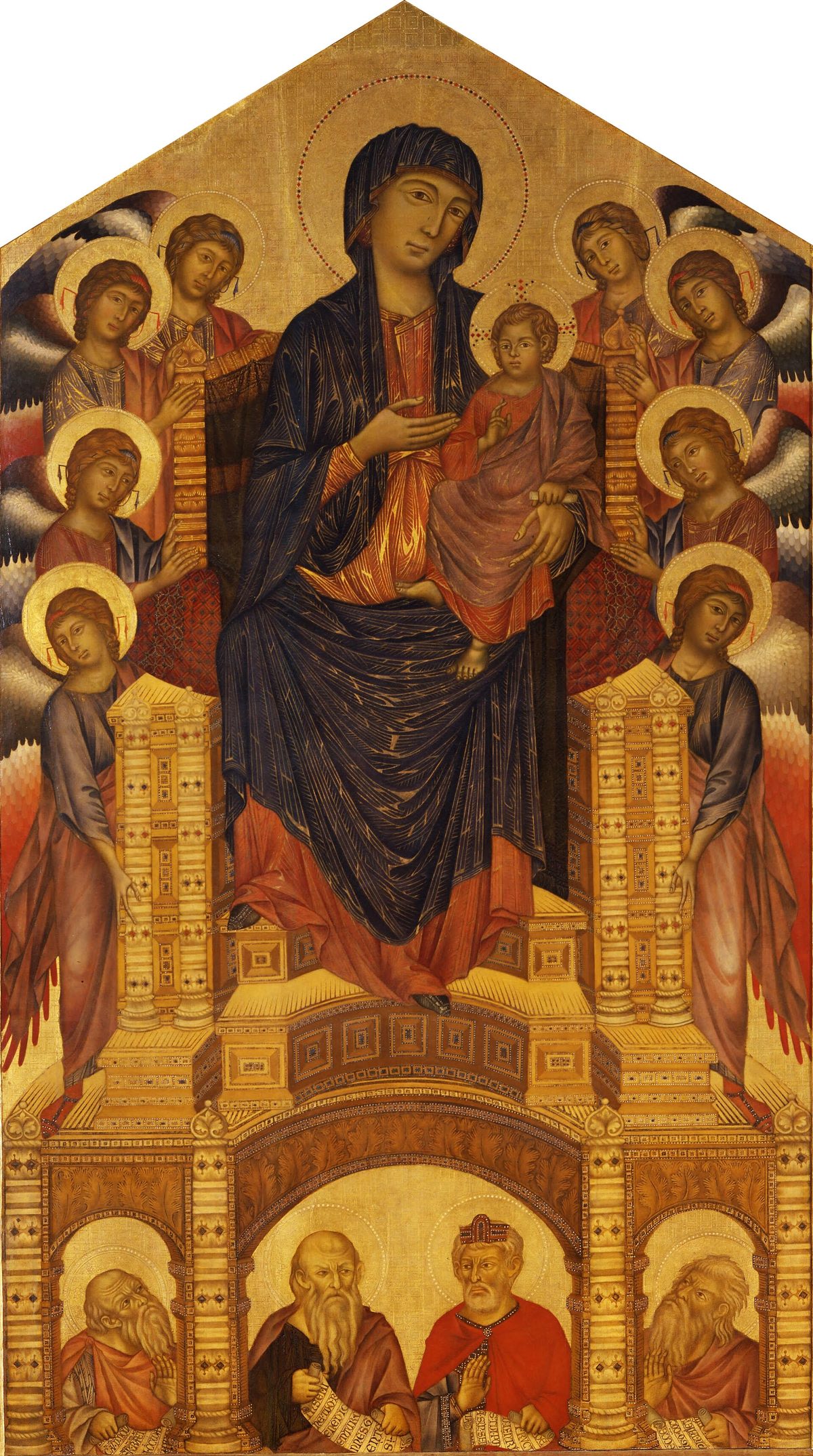
Cimabue's Santa Trinita Madonna (also called the Maestà di Santa Trinita) is the earliest of the three great Maestà paintings in the Uffizi's Room 2 and the most explicitly Byzantine in style. Painted for the high altar of Santa Trinita in Florence around 1280-1290, it shows the Virgin and Child enthroned with four angels on either side and four Old Testament prophets in the arcade beneath the throne.
The frontal, hieratic quality of the figures — the gold background, the flat treatment of drapery, the symmetrical arrangement, the absence of spatial depth in the throne — all belong to the Italo-Byzantine tradition. Yet Cimabue's work also shows the beginning of a humanising impulse: the Christ child is slightly more childlike, the Virgin's face somewhat less formulaic than in earlier Byzantine work.
Cimabue (active c.1272-1302) was the leading painter in Florence in the generation before Giotto. Vasari's famous anecdote describes Giotto as Cimabue's pupil who surpassed his master — a story that may or may not be historically accurate but captures the sense of a generational rupture.
Cimabue's other major surviving works include the Crucifixes in Santa Croce (Florence) and San Domenico (Arezzo) and the apse mosaics of Pisa Cathedral. The Santa Trinita Madonna is his most monumental surviving panel painting.
The painting's gold background is of a richness that Giotto's Ognissanti Madonna, nearby, does not attempt to match — Giotto replaces the gold field with a sky blue that admits depth. In Cimabue, the gold is absolute: the background is not a space but a surface of sacred light.
The prophets in the arcade beneath the throne (Isaiah, Jeremiah, Abraham, and David) are depicted in poses that show awareness of the figures above — they gesture upward, toward the Incarnation they prophesied. The throne's painted marble and carved decoration is among the most elaborate of any 13th-century Italian altarpiece.
When standing before this work, look carefully: Santa Trinita Madonna — Cimabue, c.1280-1290. Give it time — what seems decorative often carries the central meaning.
When standing before this work, look carefully: The Virgin's face — between Byzantine formula and humanity. Give it time — what seems decorative often carries the central meaning.
When standing before this work, look carefully: The prophets in the arcade beneath the throne. Give it time — what seems decorative often carries the central meaning.
When standing before this work, look carefully: The gold background — sacred light. Give it time — what seems decorative often carries the central meaning.
Uffizi Gallery, Room 2. Viewing Cimabue, Duccio, and Giotto together in this room is essential art-historical education.