
Sant'Apollinare in Classe Apse Mosaic
Sant'Apollinare in Classe apse mosaic
Public domain, via Wikimedia Commons
The apse mosaic of Sant'Apollinare in Classe is the most serene of Ravenna's Byzantine programmes — a monumental composition (approximately 10 metres wide) in the apse of the suburban basilica built outside Ravenna at the ancient port of Classis, dedicated to the first Bishop of Ravenna. The central composition shows St Apollinaris in the orans position (arms raised in prayer) in the centre of a stylised landscape: green grass, white flowers, twelve sheep arranged symmetrically on either side, and above Apollinaris a large medallion of the Transfiguration — a jewelled golden cross in a field of stars, the hand of God above, and the figures of Moses and Elijah on either side.
Three white sheep below the Transfiguration symbol represent the apostles Peter, James, and John at the Transfiguration. The symbolic landscape is a theological image of the Church as a garden of salvation.
Sant'Apollinare in Classe was consecrated in 549 by Bishop Maximianus — the same bishop who appears in the Justinian panel of San Vitale. The mosaic programme represents the Byzantine synthesis of its Ravenna period: the figures are frontal, the gold ground is absolute, the symbolic arrangement (the twelve sheep = twelve apostles; the lamb landscape = paradise; the Cross in the Transfiguration medallion = the theophany) is theologically precise.
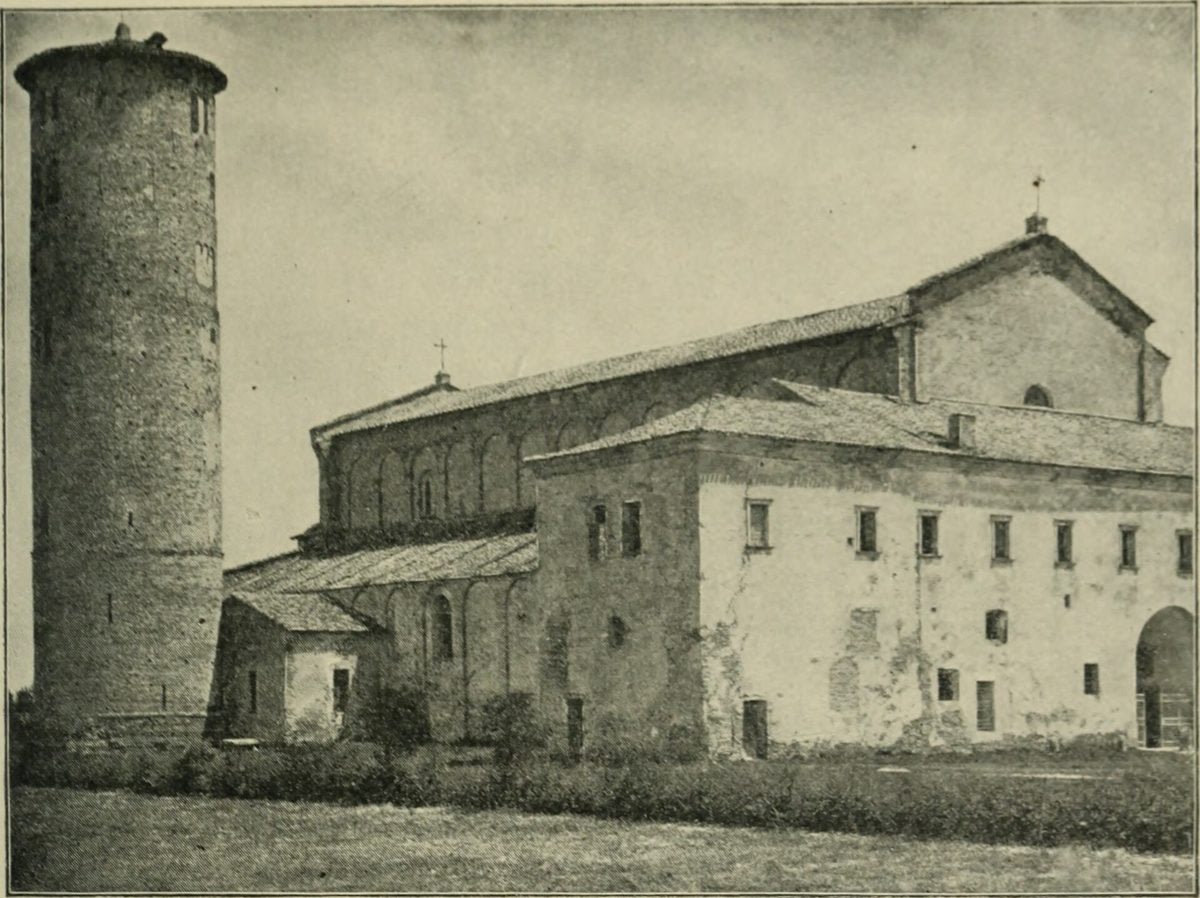
The nave walls carry sixth and seventh-century additions showing later bishops and church dignitaries, and the triumphal arch has an elaborate Transfiguration programme that complements the apse. The building itself — a late Roman basilica with original columns and nave structure — provides one of the most complete experiences of an early medieval church in existence.
The apse mosaic should be read as a symbolic map rather than a narrative scene. The gold background is divine eternity; the green landscape is paradise; Apollinaris in the orans position is the bishop as intercessor, standing in heaven on behalf of his flock.
The twelve sheep, arranged six on each side, represent the universal Church. The Transfiguration medallion above communicates the ultimate destination of those who die in the faith: the vision of Christ in his glory. The composition is symmetrical to a degree approaching mathematical perfection — this symmetry is itself a theological statement about the order and harmony of the divine realm.
When standing before this work, look carefully: Sant'Apollinare in Classe apse mosaic. Give it time — what seems decorative often carries the central meaning.
When standing before this work, look carefully: St Apollinaris in orans — with the symbolic landscape. Give it time — what seems decorative often carries the central meaning.
When standing before this work, look carefully: The Transfiguration medallion — Cross in a field of stars. Give it time — what seems decorative often carries the central meaning.
When standing before this work, look carefully: The basilica exterior — original late Roman structure. Give it time — what seems decorative often carries the central meaning.
Basilica di Sant'Apollinare in Classe, Via Romea Sud, Classe (approximately 5 km south of Ravenna by bus or bicycle). Not included in the standard Ravenna ticket — separate admission. The basilica is magnificent and relatively unvisited; it rewards a dedicated journey.