
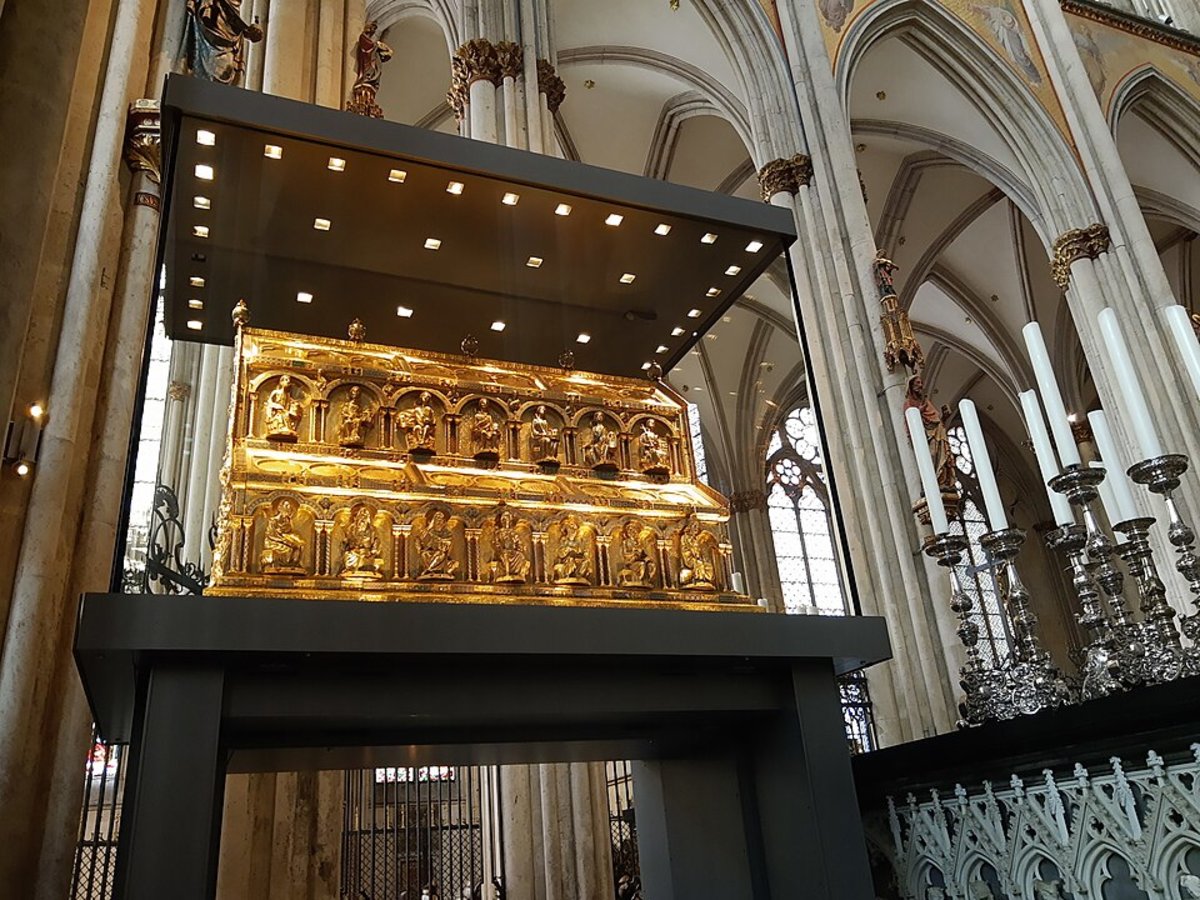
Shrine of the Three Kings
Shrine of the Three Kings — Cologne Cathedral
Public domain, via Wikimedia Commons
The Shrine of the Three Kings (Dreikönigenschrein) in Cologne Cathedral is the largest reliquary shrine in the Western world — a golden casket approximately 220 by 110 by 153 cm, made to house the relics of the Three Magi (brought to Cologne from Milan in 1164). The shrine is an architectural object: shaped like a basilica with nave and two side aisles, with a lower sarcophagus for the Magi relics and an upper body for the reliquary of St Felix.
The exterior surfaces are covered with nearly 1,000 figures in gold, enamel, and gems: the twelve prophets and twelve apostles in the lower register, scenes from the lives of the Magi and from the life of Christ above, and the Christological programme culminating in Christ in Majesty at the apex of the roof. The shrine was made by Nicholas of Verdun (who also made the Klosterneuburg altarpiece) and continued by Cologne goldsmiths over forty years.
Nicholas of Verdun (active c.1180-1210) was the greatest goldsmith of the medieval period — his works (the Klosterneuburg altarpiece enamel panels, the Shrine of Our Lady of Tournai, and the Cologne shrine) represent the transition from Romanesque to Gothic in metalwork and enamel at the highest level of technical achievement. The Shrine of the Three Kings was begun after 1190 and completed around 1220 by Cologne goldsmiths under Nicholas's design direction.
The relics of the Magi had been brought to Cologne in 1164 by Frederick Barbarossa as a political and religious coup; the city became the most important pilgrimage destination in medieval Germany as a result. The shrine was the object for which the enormous Gothic cathedral was built.
The shrine is displayed in the choir of Cologne Cathedral, where it can be seen through the choir screen. Closer examination requires the cathedral treasury ticket.
Look for Nicholas of Verdun's characteristic figures in the lower enamel panels: his figures have a Hellenistic plasticity, a quality of three-dimensional modelling in two dimensions, that is entirely unlike his contemporaries' flatter, more schematic style. The Adoration of the Magi scene on the shrine (one of several) is particularly fine: the three figures in varied postures, the Virgin and Child, the star — all compressed into a panel of approximately 30 cm, each figure given specific psychological individuality.
When standing before this work, look carefully: Shrine of the Three Kings — Cologne Cathedral. Give it time — what seems decorative often carries the central meaning.
When standing before this work, look carefully: Enamel figure detail — Nicholas of Verdun's quality. Give it time — what seems decorative often carries the central meaning.
When standing before this work, look carefully: The full shrine — golden basilica. Give it time — what seems decorative often carries the central meaning.
When standing before this work, look carefully: The choir of Cologne Cathedral. Give it time — what seems decorative often carries the central meaning.
Cologne Cathedral (Kölner Dom), Domkloster 4, Cologne. The shrine is in the Dreikönigenschrein in the choir.
The cathedral is free to enter; the treasury requires a ticket. The cathedral itself is a UNESCO World Heritage Site and the largest Gothic church in Northern Europe.