
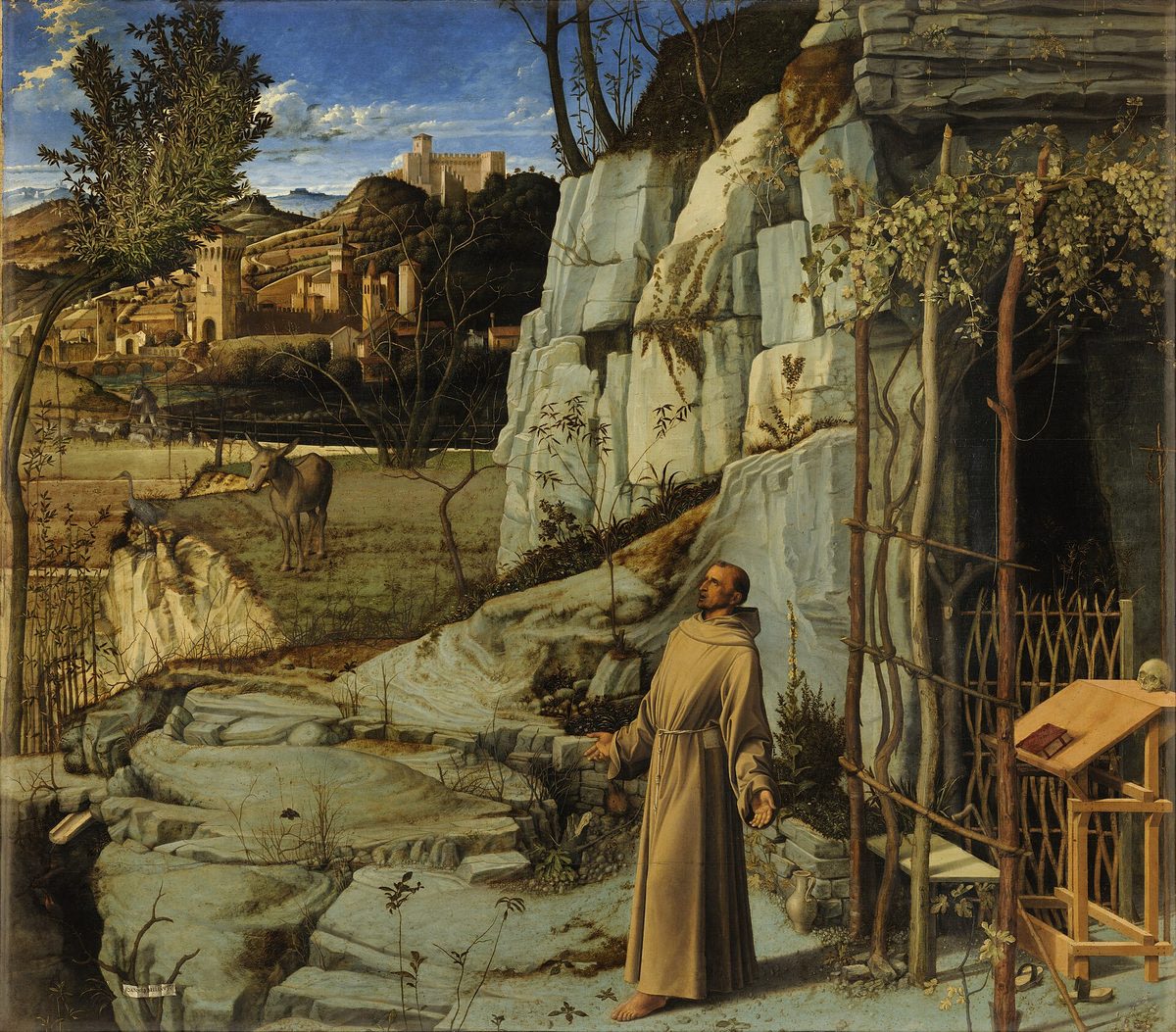
St Francis in the Desert
St Francis in the Desert — Bellini, c.1475-1480
Giovanni Bellini, Public domain, via Wikimedia Commons
Giovanni Bellini's St Francis in the Desert is one of the supreme works of the Venetian Renaissance — a large panel (approximately 124 by 142 cm) showing St Francis of Assisi in an ecstatic state in a rocky Franciscan landscape, apparently receiving the stigmata or experiencing a vision, though neither the stigmata wounds nor a vision source are visible. The figure of Francis, small in relation to the vast landscape behind him, stands before a cave with a lectern (a skull and an open book on it), an ass at the right, a heron and a crane in the grass below, a grapevine growing over a trellis, and behind him a landscape of extraordinary depth: a shepherd with his flock in the valley, a city on a hill (possibly the New Jerusalem), cranes in flight, and above, a sky whose quality of early morning light is unprecedented in Italian painting. The landscape is simultaneously the rocky Apennines of La Verna (where Francis received the stigmata) and a universal landscape of divine creation.
Giovanni Bellini (c.1430-1516) was the founder of the Venetian painting tradition and the teacher of Giorgione and Titian. His approach to light — atmospheric, tonal, unified across the whole picture surface rather than compartmentalised into figure and background — transformed Italian painting and was the direct predecessor of the High Renaissance Venetian school. The St Francis is his masterpiece in small-scale panel painting: the landscape is not a backdrop but the primary subject — a meditation on God's presence in the natural world that anticipates the landscape painting of the following century by several decades.
Start with the landscape, not the figure. Begin at the lower left — the rabbit, the plants, the rock surfaces — and work upward and to the right: the stream, the donkey, the grapevine, the shepherd in the valley, the city on the hill, and finally the luminous sky.
The quality of the early-morning light (the shadows are still long; the sky is pale) creates an atmosphere of absolute stillness and presence. Francis's posture — his arms slightly extended, his face upturned, his feet bare on the rocky ground — suggests reception of the divine rather than stigmatic pain. The lectern's open book and skull are meditative objects: Francis has been contemplating, and something has interrupted his reading.
When standing before this work, look carefully: St Francis in the Desert — Bellini, c.1475-1480. Give it time — what seems decorative often carries the central meaning.
When standing before this work, look carefully: The landscape — shepherd, city on a hill, cranes. Give it time — what seems decorative often carries the central meaning.
When standing before this work, look carefully: The lectern with skull and book. Give it time — what seems decorative often carries the central meaning.
When standing before this work, look carefully: The early-morning sky — Bellini's luminous atmosphere. Give it time — what seems decorative often carries the central meaning.
The Frick Collection, 1 East 70th Street, New York. The Frick occupies the former residence of Henry Clay Frick and is one of the finest small art museums in the world. The Bellini St Francis hangs in the West Gallery, one of the Frick's grandest rooms.