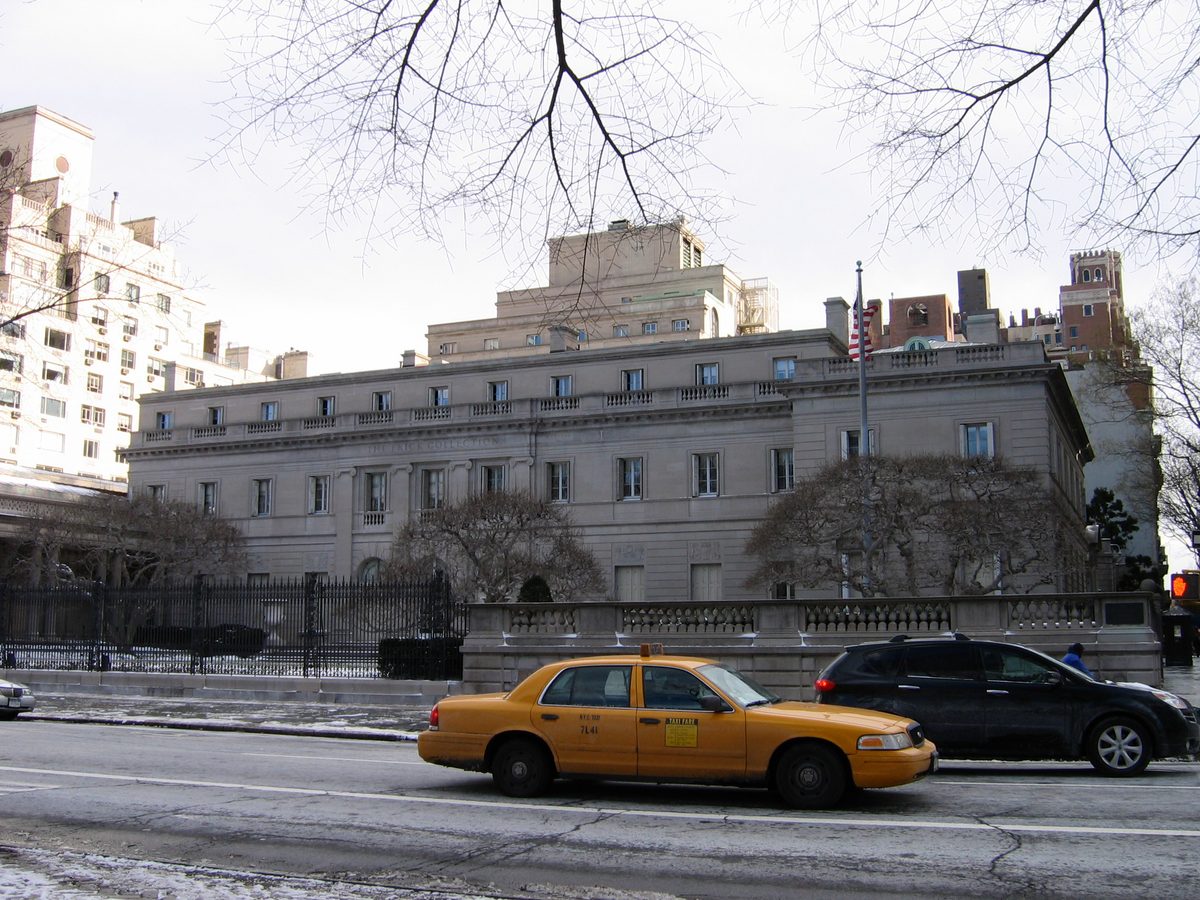
Henry Clay Frick was not a man of obvious culture. Born in 1849 in rural Pennsylvania, he made his first fortune in coke — the fuel essential for making steel — and his second as Andrew Carnegie's partner in US Steel, the largest corporation in the world at the time of its formation in 1901. He was a union-buster of legendary ruthlessness, responsible for the lockout at the Homestead Steel Works in 1892 that left dozens dead and permanently darkened his reputation. Yet the collection he assembled between the 1890s and his death in 1919, and the building on Fifth Avenue in which he housed it, represent one of the most refined acts of private patronage in American history — a connoisseur's collection in every sense, assembled with the advice of the leading experts of the day and installed in a mansion of such elegance that it remains, more than a century later, the most beautiful house-museum in New York. The crown of the Frick's Christian art holdings is Giovanni Bellini's St Francis in the Desert, painted around 1480 and universally regarded as among the most profound religious paintings in the Western canon. The large panel depicts Francis of Assisi at the moment of the Stigmatisation — the miraculous reception of the wounds of Christ upon his own body — in a rocky landscape of extraordinary specificity and spiritual intensity. Francis stands alone at the mouth of a cave, his robe open at the chest, his arms slightly extended, his face raised toward a source of light invisible to the viewer. The landscape around him — every leaf, every lizard, every distant town on the hillside — is painted with Bellini's incomparable attention to the natural world as a manifestation of divine presence. The painting synthesises two traditions that rarely coexisted so completely: Flemish naturalism and Italian humanism, the love of observable creation and the love of its Creator. Around Bellini's masterpiece hang works by Vermeer, Rembrandt, Titian, El Greco, Holbein, Velázquez and a dozen other masters, many of them with explicitly religious subjects. The Frick is one of those rare collections where great art is displayed in domestic scale — rooms furnished as rooms, paintings hung at eye level, the proportions of a great private house preserved intact — and where the encounter with a Bellini or a Vermeer has the intimacy of a private conversation rather than the anonymity of a museum corridor.
Giovanni Bellini's St Francis in the Desert, painted around 1480, is among the most profound religious paintings in the Western canon — the natural world made luminous with divine presence.
Henry Clay Frick assembled the collection with exceptional discrimination, consulting the leading experts of the Gilded Age and rejecting all but the finest works.
Religious masterworks by El Greco, Holbein, Rembrandt and others complement the Bellini in rooms that preserve the domestic scale of Frick's Fifth Avenue mansion.
The building, designed by Carrère and Hastings and completed in 1914, is among the most beautiful house-museums in the United States.
Reopened in 2025 after extensive renovation, the Frick offers a transformed visitor experience while preserving the intimate character of the original interiors.
Henry Clay Frick and the Formation of the Collection
Frick began collecting seriously in the 1880s, initially following the fashion for Barbizon School landscapes and Dutch masters popular among American industrialists of his generation. A transformative trip to Europe in 1896, during which he visited the great European museums and consulted with the dealer Joseph Duveen, broadened his ambitions and sharpened his taste. Frick came to concentrate on the Italian Renaissance, the Dutch Golden Age and eighteenth-century British portraiture — a programme that gave the collection both art historical coherence and an atmosphere of aristocratic grandeur appropriate to the mansion he was building on Fifth Avenue. He bought with exceptional discrimination, rejecting many works that lesser collectors would have eagerly acquired, and the collection that resulted is unusually free from the second-rate acquisitions that characterise most great private holdings.
Giovanni Bellini's St Francis in the Desert
Giovanni Bellini painted St Francis in the Desert around 1480, probably for a member of the Venetian patriciate with a devotion to Franciscan spirituality. The large panel — 124 by 142 centimetres — shows the saint at the moment described in the hagiographic tradition as the Stigmatisation, when he received the wounds of Christ on Mount La Verna in 1224. Bellini sets this supernatural event in a Venetian landscape of extraordinary naturalistic specificity: the rocky hillside behind Francis is rendered with a botanist's care for species and texture; the distant town glows in early morning light; a donkey is tethered to a wooden fence to the right; a heron stands in a shallow pool to the lower left. Every detail carries symbolic weight — the vine trained on the desk beside the cave alludes to the Eucharist, the skull to mortality, the laurel to the classical tradition of sacred groves — but the symbolism is never separate from the sheer sensory richness of the observed world. Bellini's innovation was to make the natural world itself the vehicle of divine revelation.
Religious Works Across the Collection
The Frick holds several other works with religious subjects of the highest quality. Hans Holbein the Younger's Sir Thomas More, painted in 1527, depicts the great Catholic humanist — the man who chose death rather than acknowledge Henry VIII's supremacy over the Church — with a psychological gravity that makes the portrait itself an act of religious witness. El Greco's Purification of the Temple shows Christ driving the money-changers from the Temple in a composition of Mannerist dynamism, the figures twisted and elongated, the colours electric. Rembrandt's Self-Portrait of 1658 — the aged, leonine face confronting the viewer with absolute directness — carries the weight of a lifetime's engagement with Old Testament narrative and with the Calvinist tradition of unflinching self-examination.
The Building
The Frick mansion was designed by the firm of Carrère and Hastings and completed in 1914. Frick intended it from the outset not merely as a residence but as a future public museum — his will specified that it should become a museum after the death of his wife — and its planning reflected this dual purpose. The principal rooms are of exceptional proportions: the Garden Court, with its central fountain and glass ceiling, was designed to evoke an Italian palazzo loggia; the Fragonard Room, hung with Fragonard's Progress of Love panels, is among the great decorative ensembles in any American building; the East and West Galleries provide generous wall space for the largest paintings in the collection. After extensive renovation completed in 2025, the building has been expanded and its public facilities transformed while preserving the domestic character of the original interiors.
The 2025 Reopening
The Frick Collection closed to the public in 2020 for a major renovation and expansion project that added new gallery space, improved visitor facilities, and restored the historic interiors with exceptional care. The reopening in 2025 allowed the display of works that had been in storage for decades and introduced new conservation science to the understanding of Bellini's St Francis and other key works. The renovation was accompanied by controversy — some art historians and preservationists objected to certain changes to the domestic character of the house — but the result has been broadly praised as a successful enhancement of one of New York's most beloved cultural institutions.
Visiting
The Frick Collection is located at 1 East 70th Street, on the corner of Fifth Avenue, directly across from Central Park. It is open Tuesday through Sunday, with admission charged. The collection is most easily reached from the 68th Street Hunter College station on the 6 line, or from the 72nd Street station on the express lines. The Frick garden is accessible from the sidewalk and provides a moment of quiet in the busy Upper East Side streetscape. Audio guides are available and strongly recommended for first-time visitors.