
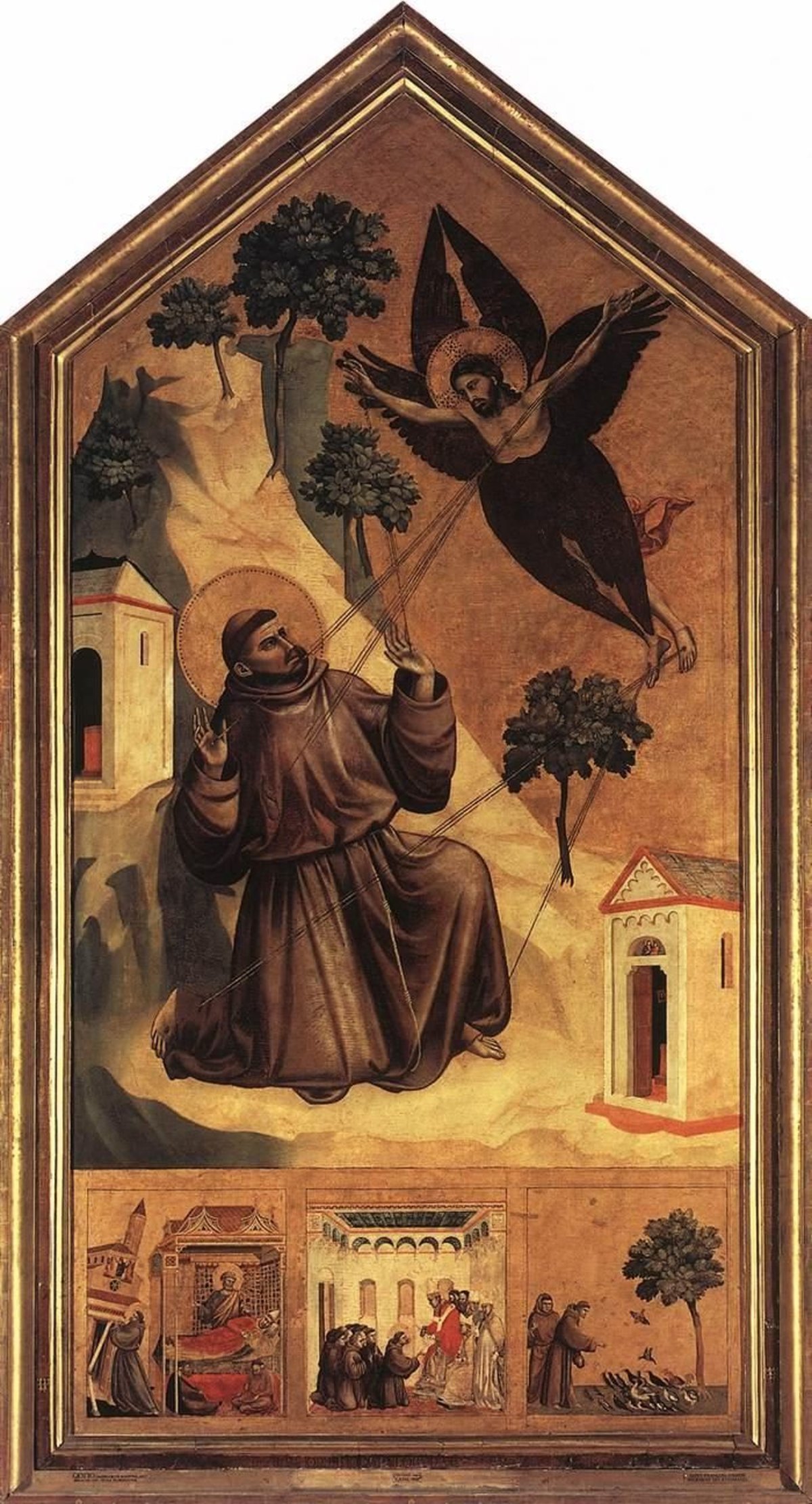
St Francis of Assisi Receiving the Stigmata
St Francis Receiving the Stigmata — Giotto, Louvre
Giotto di Bondone, Public domain, via Wikimedia Commons
The Louvre's St Francis Receiving the Stigmata is one of Giotto's earliest surviving panel paintings and the first representation of the stigmatization on a predella panel with a separately functioning narrative. The central panel shows Francis at La Verna, kneeling with arms slightly raised as the seraph-Christ above him sends rays of light to the five wounds (the stigmata — hands, feet, and side).
The three predella panels below show three miracles of St Francis. The painting was probably made for a Franciscan church and represents Giotto's transition from the Byzantine conventions of his training to the more naturalistic approach he would develop fully in the Arena Chapel frescoes (entry 69). The rocky landscape of La Verna, the quality of the seraph figure, and the expressive posture of Francis already show the spatial and psychological innovation that would define the Renaissance.
Giotto made several panel paintings in addition to the large fresco cycles — the Ognissanti Madonna (entry 41), the Badia Polyptych (Uffizi), and this Louvre Francis panel are the principal survivors. The Francis stigmatization was a supremely popular subject in the generation after Francis's death (1226) and official canonisation (1228); dozens of representations were made in the 13th and 14th centuries.
Giotto's innovation was to place Francis in a specific, believable landscape rather than against a gold background, and to show the intensity of the physical experience (the wounds entering his body from the rays of light) through posture rather than facial expression. The chapel of the Porziuncula (at the lower left of the central panel) and the mountain setting of La Verna are both geographically specific references.
The central panel is the main viewing focus: Francis kneels on a rocky outcrop, the seraph (Christ in wings, a conventional iconographic element) above and to the right sending golden rays to the five wound points. The companion friar at the lower left turns away — the convention of the witness who cannot bear the sight. The three predella panels (the Dream of Innocent III, the Stigmatization of Francis, and the Death of Francis — or alternatively, the Apparition of Francis to Gregory IX, the Healing of a Wounded Man, and the Resurrection of a Girl) are each small but demonstrate Giotto's narrative compression.
When standing before this work, look carefully: St Francis Receiving the Stigmata — Giotto, Louvre. Give it time — what seems decorative often carries the central meaning.
When standing before this work, look carefully: The seraph-Christ sending rays to the wounds. Give it time — what seems decorative often carries the central meaning.
When standing before this work, look carefully: The predella panels — three Franciscan miracles. Give it time — what seems decorative often carries the central meaning.
When standing before this work, look carefully: The rocky landscape of La Verna. Give it time — what seems decorative often carries the central meaning.
Musée du Louvre, Room 3 (Italian Primitives), Denon Wing, Paris.