
The Life
Giovanni di Pietro di Bernardone — known as Francesco, Francis — was born in Assisi in 1181 or 1182, the son of a wealthy cloth merchant. He grew up in comfort and aspired to military glory: his first biography describes him as generous, fashionable, and fun, the life of every party in Assisi. He went to war, was captured and imprisoned for a year, fell ill, and during his illness began to experience a profound disorientation with the life he had been living. He turned from partying to prayer and from military glory to poverty. He embraced a leper on the road outside Assisi — the thing he was most afraid of — and found in the leper's face something that transformed him. He heard a voice from the crucifix at the ruined church of San Damiano: Francis, go repair my house, which as you see is falling into ruin. He took the command literally, sold his father's cloth to raise money for the repairs, was publicly disinherited by his furious father, and stood in the bishop's court and stripped off his fine clothes, returning everything to his father and declaring: From now on, I will call no man father but our Father in Heaven.
He rebuilt San Damiano with his own hands, stone by stone. He embraced the most literal possible interpretation of the Gospel: no money, no property, complete dependence on God's providence, the preaching of penance and peace. Other young men came to join him. He sent them to Rome in 1209 to seek papal approval for his simple rule of life: three Gospel texts (Matthew 19:21, Luke 9:3, Matthew 16:24) applied without gloss or mitigation. Pope Innocent III had a dream the night before his audience with Francis: a poor little man was holding up the Lateran Basilica on his shoulders. Innocent approved the rule.
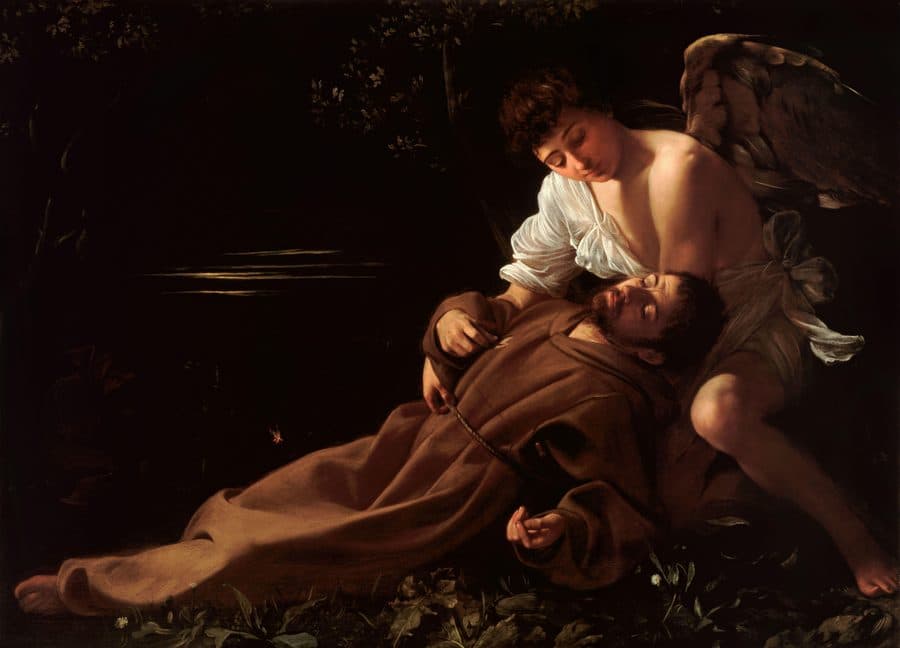
The order that grew from this approval — the Order of Friars Minor, the Franciscans — became one of the most transformative forces in the history of Western Christianity. Francis sent his brothers across Europe and to Morocco and the Holy Land. He went to Egypt during the Crusades and walked, unarmed, through the battle lines to meet Sultan al-Kamil and preach to him. He received the stigmata — the wounds of Christ in his hands, feet, and side — on Mount La Verna in 1224, two years before his death. He died in 1226, lying on the bare earth of the Porziuncula, the tiny chapel in Assisi that was his spiritual home, singing Psalm 142. He was canonised two years later.
The Embrace of the Leper
Before his conversion was complete, Francis encountered a leper on the road and was overwhelmed by disgust — the visceral reaction that anyone of his time and class would have felt. Then he did what he had never done before: he dismounted from his horse and embraced the leper. He kissed the leper's hand. The leper returned the kiss. When Francis looked back down the road, there was no one there. He later wrote that this encounter — the act of embracing what he most feared — was the beginning of his conversion. Everything else followed from that embrace. The Stripping in the Bishop's Court When Francis's father dragged him before the Bishop of Assisi to recover the money Francis had used to repair San Damiano, Francis stripped off his fine clothes in the bishop's court, placed them at his father's feet, and said: From now on I will call no one father but our Father in Heaven. The bishop put his own cloak around the young man. Francis walked out in that cloak — borrowed, not owned, the perfect Franciscan symbol — and went to work rebuilding the church by hand. The stripping is the founding moment of Franciscan poverty: the deliberate, public, irreversible renunciation of wealth and social standing. The Mission to Sultan al-Kamil During the Fifth Crusade in 1219, with the Crusaders and Egyptian forces locked in bloody combat near Damietta in Egypt, Francis crossed the battle lines, unarmed, to meet Sultan al-Kamil of Egypt. He was not killed. The Sultan received him, spoke with him for several days, and returned him safely to the Christian camp — reportedly saying that he wished all Christians were like this man. Francis did not convert the Sultan; he did not expect to. What he did was preach the Gospel face to face, without weapons or political power, to the most powerful Muslim ruler of his era. The encounter is one of the most remarkable moments in the history of Christian-Muslim relations. The Stigmata — La Verna In September 1224, Francis was on Mount La Verna, a rocky mountain in Tuscany given to the Franciscans as a place of prayer. While praying, he saw a vision of a seraph with six wings and the figure of Christ crucified. When the vision passed, he found that he bore the five wounds of Christ — in his hands, his feet, and his side. He bore these wounds for the remaining two years of his life, suffering from them and concealing them as best he could. He is the first recorded recipient of the stigmata in Christian history. The wounds are the physical seal of his identification with Christ's passion.
Walk in Their Footsteps
Pilgrimage sites connected to St Francis of Assisi
Ask St Francis of Assisi to Intercede
Bring these intentions to this saint in prayer:
Francis rebuilt a ruined church with his own hands, stone by stone. He thought the voice from the crucifix was telling him to repair a building. It was telling him to repair the Church. The literal interpretation was the beginning of the metaphorical mission. This is how conversion often works: we start by repairing the small, concrete, visible thing in front of us, and discover that we are doing something much larger. The stone by stone is the whole project.
“Jesus answered, If you want to be perfect, go, sell your possessions and give to the poor, and you will have treasure in heaven. Then come, follow me.”
Lord, make me an instrument of your peace. Where there is hatred, let me sow love; where there is injury, pardon; where there is doubt, faith; where there is despair, hope; where there is darkness, light; where there is sadness, joy. Divine Master, grant that I may not so much seek to be consoled as to console, to be understood as to understand, to be loved as to love. For it is in giving that we receive, it is in pardoning that we are pardoned, and it is in dying that we are born to eternal life. Amen.