
St George and the Dragon
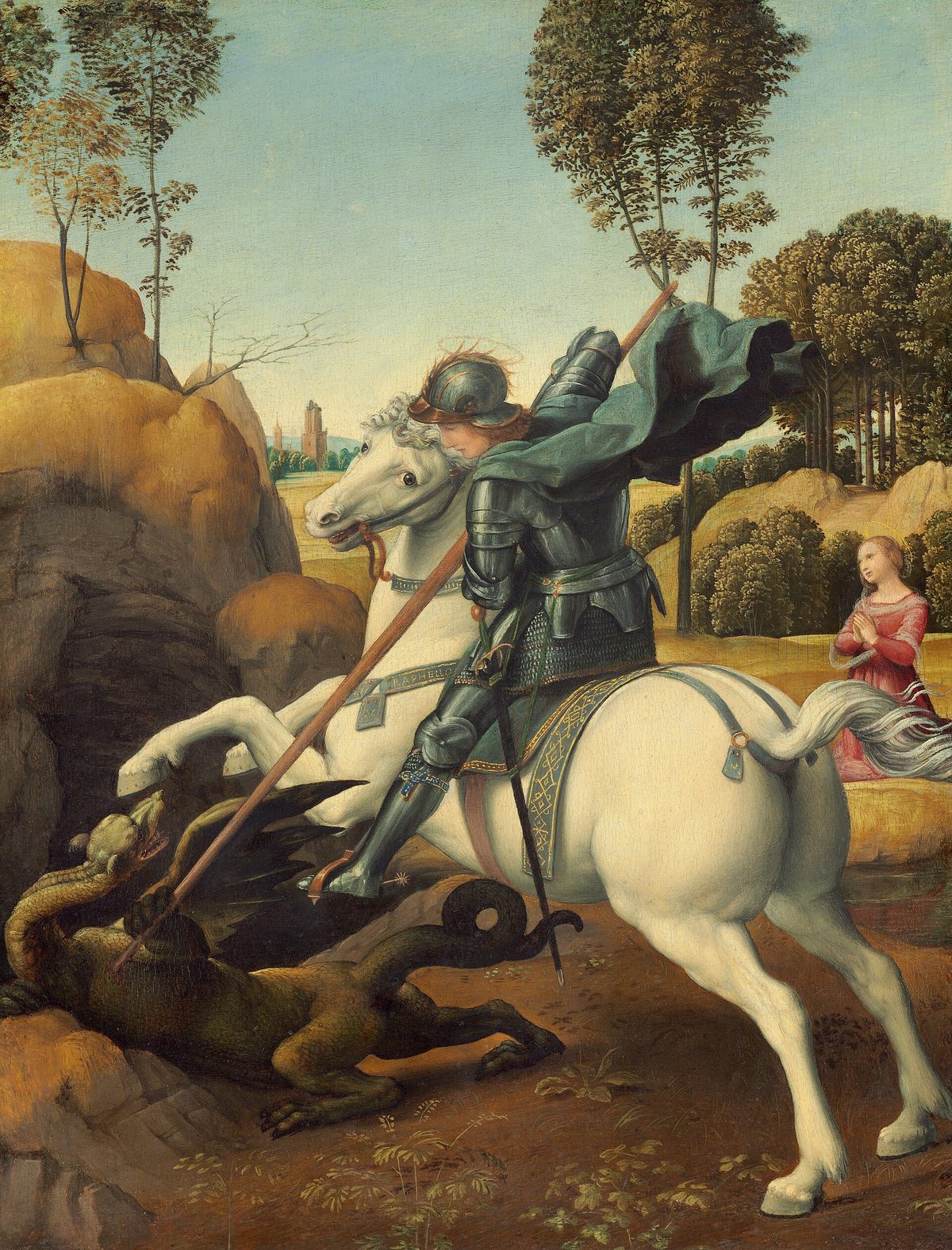
St George and the Dragon — Raphael, c.1505-1506
Raphael, Public domain, via Wikimedia Commons
Raphael's St George and the Dragon in Washington is a small cabinet painting (approximately 28.5 by 21.5 cm) made around 1505-1506 for Guidobaldo da Montefeltro, Duke of Urbino — probably given to Henry VII of England as a diplomatic gift. The subject shows the moment of St George's decisive strike: his lance has broken on the dragon's body; he has drawn his sword and is about to deliver the killing blow; the princess flees in the background; the dragon writhes in its death agony at the lower right.
The composition is compressed and energetic — the horse rearing, the knight leaning forward, the circular dynamic of the figures creating a sense of violent motion within a very small format. The landscape behind the figures is a calm blue-green Umbrian landscape entirely at odds with the violence in the foreground — a characteristic Raphaelite contrast between serene background and active foreground.
Raphael painted two versions of St George — the Washington panel and a slightly larger version now in the Louvre (c.1504-1505). Both were made for Guidobaldo da Montefeltro in the context of his investiture with the English Order of the Garter (whose patron saint is St George).
The Washington version is generally considered the more refined of the two: the horse is more convincingly foreshortened, the dragon more dramatically rendered, and the landscape more atmospherically developed. The work was later in the French Royal Collection (probably acquired by Francis I), and entered the Mellon Collection before being given to the National Gallery at its founding.
The small scale of the painting requires viewing at close range with good lighting — use the NGA's magnifying loupe if available. The quality of the surface is extraordinary at this scale: the horse's muscles are individually rendered, the knight's armour reflects the landscape and sky, the dragon's scales are specifically textured.
The princess in the background (far left, on her knees, her hands clasped in prayer) is a diminutive figure but exquisitely painted. The broken lance at the lower left (its tip still embedded in the dragon's back) is a narrative detail that heightens the drama.
When standing before this work, look carefully: St George and the Dragon — Raphael, c.1505-1506. Give it time — what seems decorative often carries the central meaning.
When standing before this work, look carefully: The rearing horse — foreshortening and armour reflections. Give it time — what seems decorative often carries the central meaning.
When standing before this work, look carefully: The dragon dying — scales and death agony. Give it time — what seems decorative often carries the central meaning.
When standing before this work, look carefully: The princess in the background — diminutive but exquisite. Give it time — what seems decorative often carries the central meaning.
National Gallery of Art, West Building, Washington DC. Free admission.