
The Life
George is the patron saint of England, Georgia, Ethiopia, and several other nations — a soldier-martyr of the early Church whose legend includes the slaying of a dragon and whose cult spread from Palestine across the entire Christian world, East and West, with extraordinary speed and completeness. He is one of the few saints venerated with equal intensity in the Roman Catholic, Eastern Orthodox, and Oriental Orthodox traditions.
The historical George was almost certainly a Roman soldier who was martyred for his Christian faith — most likely during the Diocletianic persecution of 303 AD — at Lydda (modern Lod) in Palestine. Beyond that, the historical record is sparse. The Golden Legend and other medieval hagiographic sources elaborate a rich story: he was a soldier of Cappadocian birth and high rank who tore up the Emperor Diocletian's edict of persecution in a public gesture of defiance. He was subjected to elaborate tortures — multiple executions, each followed by miraculous resurrection — before being finally beheaded. He converted large numbers during his torture, including, according to some traditions, the Empress Alexandra herself.
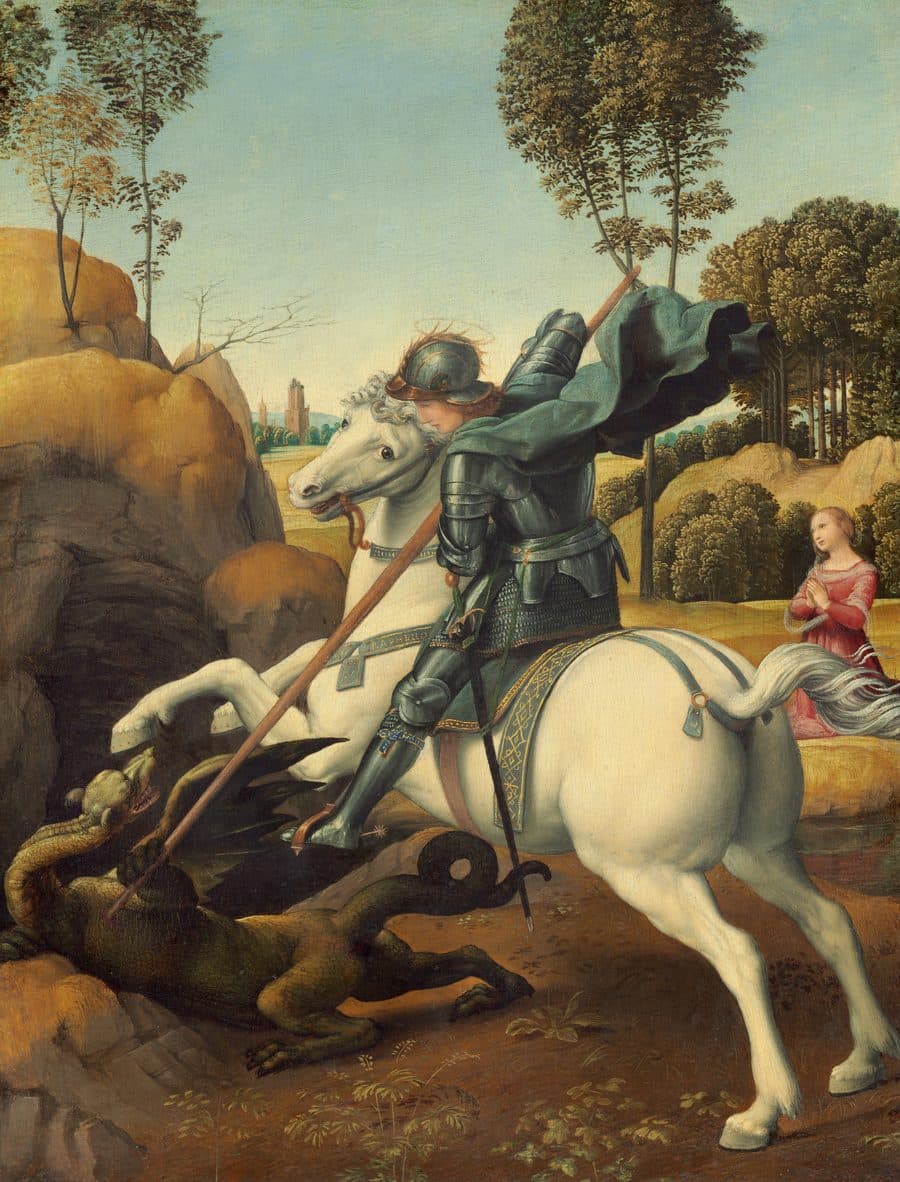
The dragon legend does not appear in the earliest sources about George — it developed in the 11th and 12th centuries and was set in Libya. A town was being terrorised by a dragon that required regular offerings of sheep and then of people. The lot fell on the king's daughter. George arrived, made the sign of the cross, wounded the dragon, tied it with the princess's belt, and led it docilely into the city, where he killed it after the townspeople converted and were baptised. The dragon is understood as the devil or as paganism; George's victory is the victory of faith over the forces of evil.
England adopted George as its patron in the 14th century — Edward III founded the Order of the Garter in 1348 under George's patronage — replacing several earlier patron saints. His red cross on a white field became the flag of England, three of which (with the Cross of Andrew and the Cross of Patrick) compose the Union Jack.
The Tearing of the Edict
George's first act of martyrdom is public and deliberate: learning of Diocletian's edict ordering Christians to sacrifice to the pagan gods, he tears it up in public. This is not a defensive act — it is an aggressive, public, chosen confrontation with imperial authority. He has nothing to gain and everything to lose. The tearing of the edict is the foundation of his military reputation: he is a soldier who knows that some orders must not be obeyed, and who has the courage to say so publicly. The Dragon Slaying The dragon legend — developed in the medieval period — depicts George arriving at a Libyan city that is being terrorised by a dragon, rescuing the king's daughter who has been offered to it, wounding the dragon, leading it into the city on the princess's belt, and killing it after the townspeople are baptised. The theological content of the legend is not primarily about actual dragons but about the pattern of Christian heroism: the champion who intervenes for the vulnerable, defeats the force of evil at personal risk, and makes the victory conditional on the conversion of the community. The dragon is what the community has been appeasing; George is what stops the appeasement. The Patronage of England George's adoption as patron of England in the 14th century (displacing Edmund, Edward the Confessor, and others) was partly pragmatic: he was a soldier-saint at a time of intense military activity (the Hundred Years War), his cross was a simple and distinctive battle emblem, and the Crusaders had encountered his cult intensely in Palestine. Edward III's Order of the Garter (1348) placed the kingdom's highest chivalric order under George's protection. April 23 is Saint George's Day — still celebrated in England with varying degrees of ceremony and nationalism. The Universal Patronage — East and West George is unusual among the major saints in the intensity and breadth of his East-West veneration. In the Orthodox world, he is one of the Great Martyrs, depicted as a soldier on horseback slaying the dragon — one of the most common icons in the Eastern tradition. In Ethiopia, his image is ubiquitous. In Georgia, his name is embedded in the country's name. In Palestine, the Church of St George at Lydda marks his burial site. He is the common patron of nations that have nothing else in common. The soldier-martyr who slew the dragon speaks a language that crosses every cultural boundary.
Walk in Their Footsteps
Pilgrimage sites connected to St George
Ask St George to Intercede
Bring these intentions to this saint in prayer:
George tore up the emperor's edict. This is not heroism in the abstract; it is a specific, chosen, public act of disobedience to unjust authority. He knew what would follow. He did it anyway. The dragon legend elaborates this same pattern: the champion intervenes for the vulnerable at personal risk, defeats the force of evil, and makes his victory conditional on the community's conversion. The pattern of Christian heroism is not strength alone — it is strength in service of the weak, and conversion as the condition of the victory.
“Be alert and of sober mind. Your enemy the devil prowls around like a roaring lion looking for someone to devour.”
Saint George, dragon-slayer and martyr — give me the courage to face what is prowling. I have my own dragons: the specific forces of evil, inside and outside, that are demanding I appease them with sacrifices I should not make. Give me your lance and your faith. Teach me to wound the dragon, lead it on the belt of prayer, and bring it into the city where it can be overcome. Amen.