
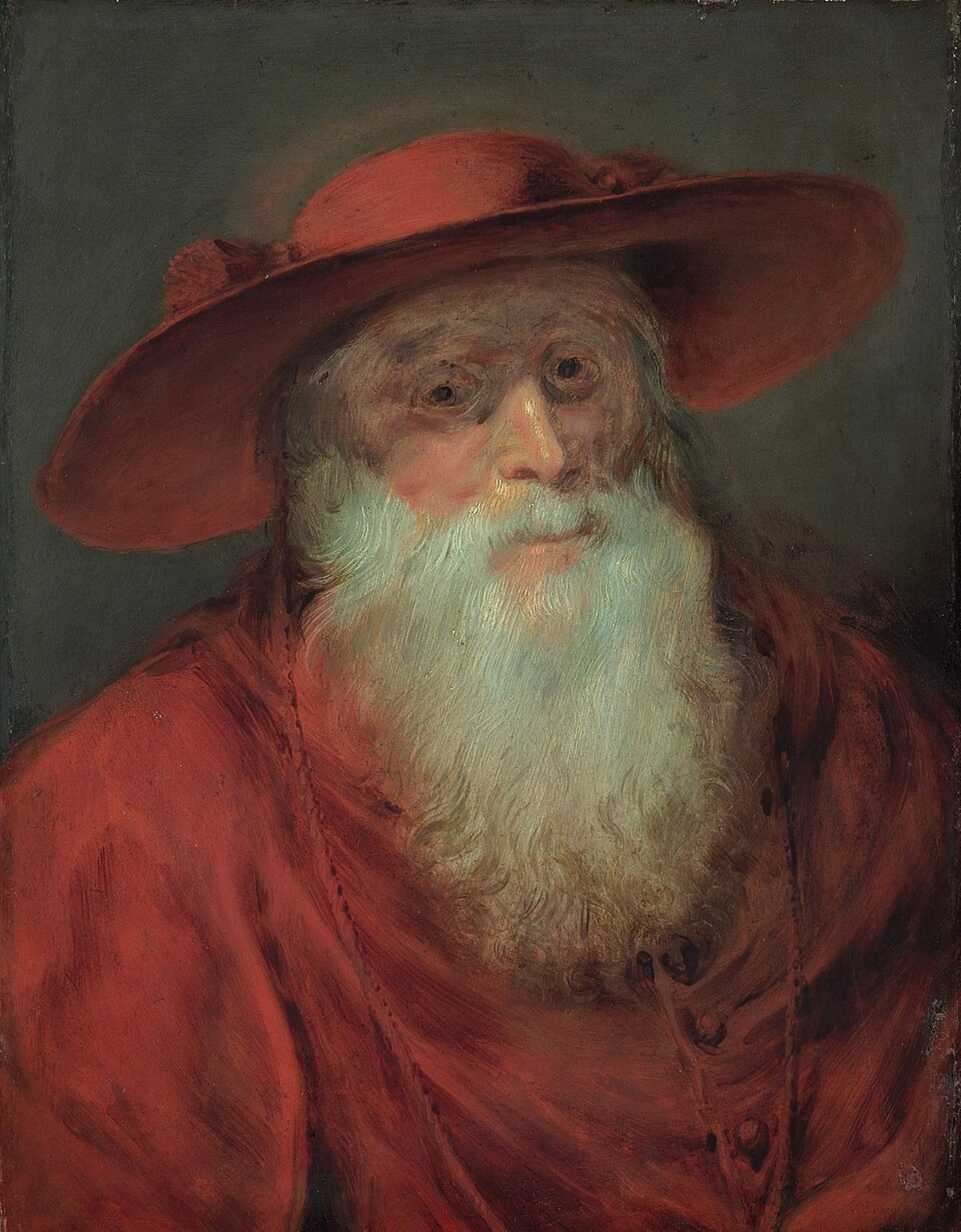
St Jerome as Cardinal
St Jerome as Cardinal — El Greco, c.1600-1610
El Greco, Public domain, via Wikimedia Commons
El Greco's St Jerome as Cardinal in the National Gallery is one of his finest portraits — an image of the Church Father and Bible translator Jerome (c.347-420 AD) depicted in cardinal's red robes with the symbols of his scholarship (a book, a letter, a quill). The painting (approximately 108 by 87 cm) shows Jerome as a strong-featured elderly man with a white beard, his face turned slightly to the left, his expression one of intellectual authority combined with ascetic severity.
The red cardinal's robes (anachronistic, since the office of cardinal did not exist in Jerome's time) were conventional in Baroque representations — they signified Jerome's rank as a Doctor of the Church and his association with Rome. El Greco's treatment transforms the conventional image into a vivid psychological portrait: the face is specific, the eyes sharp, the overall impression of contained intellectual power is overwhelming.
El Greco painted multiple versions of Jerome as Cardinal — at least four are known, the finest being the National Gallery's example and a version in the Frick Collection, New York. The subject was popular in Counter-Reformation Spain because Jerome's scholarship (the Latin Vulgate Bible) was central to the Catholic response to Protestant biblical criticism. For El Greco's biographical context, see entry 185.
The contrast between the red of the cardinal's robes and the pale, modelled face is one of El Greco's finest chromatic achievements: the red is not a simple flat scarlet but a complex surface of scarlet, crimson, and shadow, rendered with the Venetian glazing technique he had learned from Titian. The face is modelled in cool grey-white tones — the skin of an ascetic scholar — against the warm red. The directness of the gaze and the specificity of the features suggest a portrait taken from a living model rather than a purely idealized type.
When standing before this work, look carefully: St Jerome as Cardinal — El Greco, c.1600-1610. Give it time — what seems decorative often carries the central meaning.
When standing before this work, look carefully: Jerome's face — intellectual authority and ascetic severity. Give it time — what seems decorative often carries the central meaning.
When standing before this work, look carefully: The cardinal's red — Venetian glazing technique. Give it time — what seems decorative often carries the central meaning.
When standing before this work, look carefully: Jerome with his book — the symbol of his scholarship. Give it time — what seems decorative often carries the central meaning.
National Gallery, Room 30 (Spanish and French paintings), London.