
The Life
Eusebius Sophronius Hieronymus — known to history as Jerome — was born around 347 AD in Stridon, on the border of Dalmatia and Pannonia (modern Croatia/Slovenia), and became the greatest biblical scholar and most prolific Latin author of the early Church. He is the translator of the Vulgate — the Latin Bible that was the standard biblical text of Western Christianity for fifteen centuries and is still in official use by the Catholic Church. He is also, by considerable consensus, the most difficult, quarrelsome, and irascible of the Doctors of the Church — a man of enormous learning and enormous anger, whose correspondence is a masterclass in the ecclesiastical insult.
He studied in Rome, was baptised there, and then traveled extensively — to Gaul, to Antioch, to the desert of Chalcis in Syria, where he lived as a hermit for several years and began his intensive study of Hebrew. He returned to Rome, where he became secretary to Pope Damasus I, who commissioned him to revise the existing Latin biblical texts. His revision, eventually expanded into a new translation from the Hebrew and Greek originals, became the Vulgate. He fell out with important people in Rome — his correspondence during this period is spectacularly acerbic — and left for Bethlehem in 385, where he founded a monastery and spent the remaining 34 years of his life in a cave next to the grotto of Christ's birth, studying, translating, and writing.
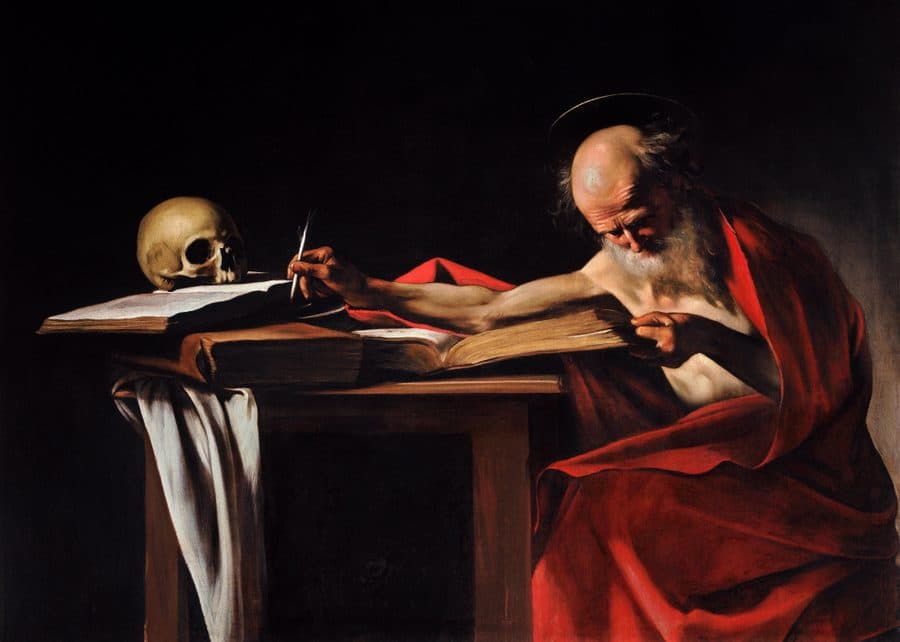
His translation of the Bible was an act of extraordinary scholarship: he learned Hebrew from Jewish teachers (unusual for a Christian scholar), he consulted Greek manuscripts, he compared different textual traditions. His commentaries on the biblical texts are still read by scholars. His letters are literary masterpieces — by turns affectionate, furious, tender, and devastating. He is depicted in art with a lion (a legend says he removed a thorn from a lion's paw, which stayed with him in the cave), with a skull (the memento mori of the desert scholar), and with the Vulgate text.
The Desert of Chalcis — learning Hebrew in the wilderness
Jerome lived in the desert of Chalcis, in Syria, for several years as a young man — practicing an extreme asceticism of fasting, prayer, and study. In the desert, to keep his mind occupied with something other than the temptations he describes with vivid specificity in his letters, he began studying Hebrew with a Jewish teacher. Learning Hebrew was deeply countercultural for a Christian scholar of his era. He did it anyway. The Hebrew studies in the Syrian desert became the foundation of the Vulgate — the translation that shaped Western Christian culture for fifteen hundred years. The Commission of Pope Damasus — the Vulgate begins Pope Damasus I commissioned Jerome to revise the existing Latin New Testament in 382 AD. Jerome eventually went further: he translated the Old Testament afresh from the Hebrew (the Hebraica veritas — the Hebrew truth — rather than the Greek Septuagint), producing a Latin Bible that was systematically superior to anything that had existed before. The project took decades. The resulting Vulgate was not immediately accepted — conservative Christians resisted the displacement of the familiar Greek and Latin texts they knew — but it eventually became the official Bible of Western Christianity. The Cave of Bethlehem — scholarship as prayer For the last 34 years of his life, Jerome lived in a cave next to the grotto of Christ's birth in Bethlehem, leading a monastic community of men and women and producing an extraordinary literary output. He is traditionally depicted in this cave with his lion, his skull, and his texts. The image of the irascible scholar in the desert — reading by lamplight, arguing with correspondents in his letters, studying the original Hebrew, producing commentaries — is one of the great images of Christian intellectual life: scholarship as an act of devotion to the God who became the Word. The Irascible Letters — the ecclesiastical insult as art form Jerome's correspondence is a major part of his literary legacy — and much of it consists of attacks on people who had criticized him or whom he considered heretics. His letters to Rufinus of Aquileia, with whom he quarreled bitterly over the Origenist controversy, are masterpieces of sustained invective. His comments on other scholars can be devastating. The combination of enormous learning, genuine holiness, and world-class irascibility makes Jerome one of the most fully human of the saints — and his letters one of the most entertaining corpora in patristic literature.
Walk in Their Footsteps
Pilgrimage sites connected to St Jerome
Ask St Jerome to Intercede
Bring these intentions to this saint in prayer:
Jerome was irascible, quarrelsome, and difficult. He was also the greatest biblical scholar of the ancient Church and the translator of the Bible that shaped Western civilization for fifteen centuries. God uses difficult people for important work. Jerome's anger was part of his energy. His perfectionism drove the precision of the translation. His willingness to fight for what he believed right — including against powerful opponents — is what produced the Hebraica veritas. The lion in Jerome's cave is both the legend and the self-portrait.
“All Scripture is God-breathed and is useful for teaching, rebuking, correcting and training in righteousness, so that the servant of God may be thoroughly equipped for every good work.”
St Jerome, scholar of the Word — give me your love for Scripture and spare me your temper. Let me read the text with the same devotion you brought to translating it: word by word, in the original, without flinching from what it says. Ignorance of Scripture is ignorance of Christ. Lead me into the knowledge that is also love. Amen.