
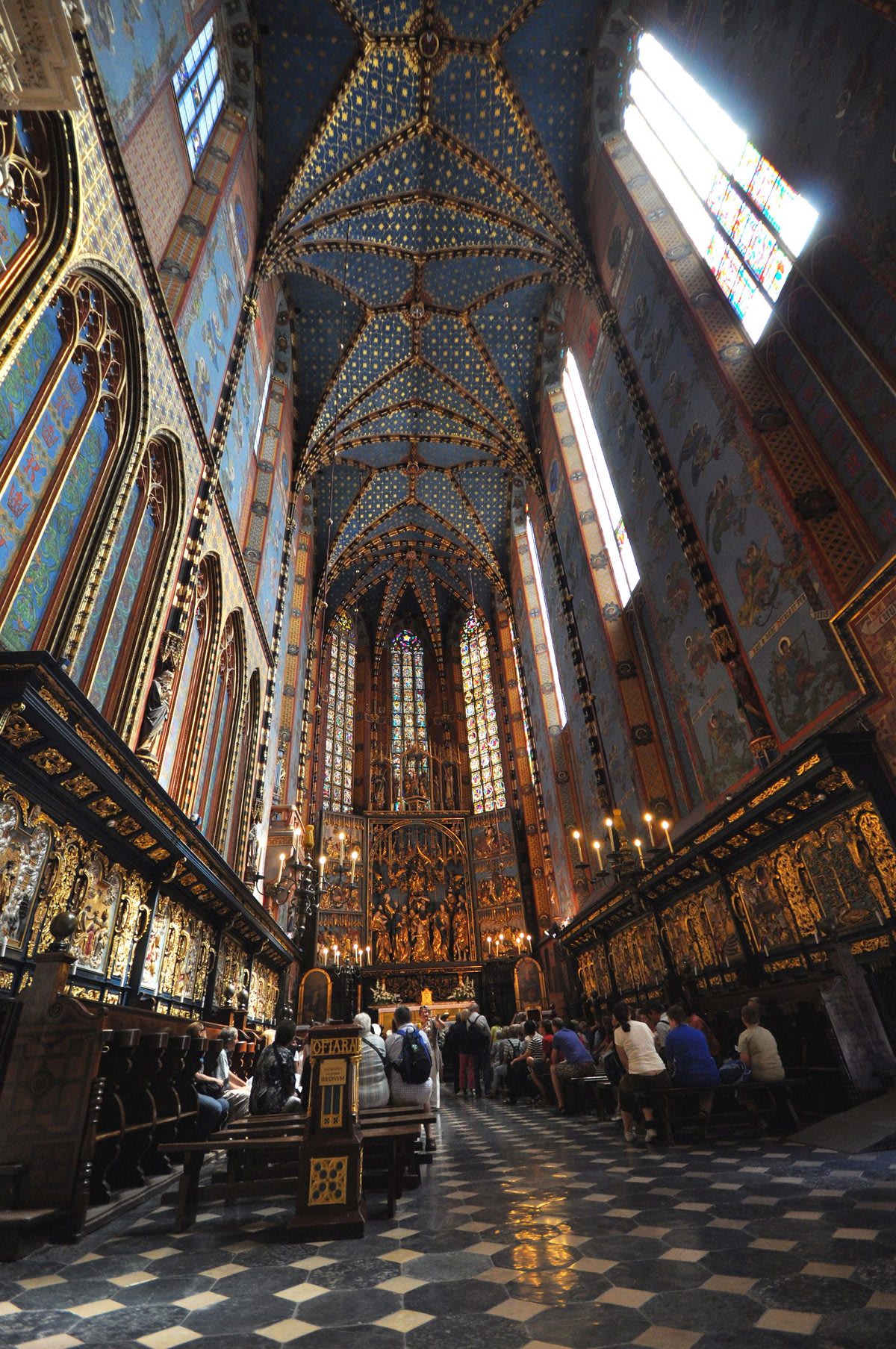
St Mary's Altarpiece (High Altar)
St Mary's High Altar — Veit Stoss, 1477-1489
Veit Stoss, Public domain, via Wikimedia Commons
Veit Stoss's High Altar of St Mary's Basilica in Kraków is the largest Gothic polyptych altarpiece in the world — a carved and painted limewood structure approximately 13 metres tall and 11 metres wide when open, depicting in the central shrine the Dormition of the Virgin (Mary falling asleep, her body supported by the twelve apostles, each one approximately life-size) with the Assumption and Coronation above. The twelve apostles surrounding the dying Virgin are individually characterised to a degree unprecedented in German late Gothic sculpture: each face is a specific individual, each posture communicating specific emotion, and the quality of carving — in deeply undercut, dynamically twisted figures — demonstrates Veit Stoss at the peak of his powers. The altarpiece is the artistic and devotional centrepiece of one of the most important Gothic churches in Central Europe.
Veit Stoss (c.1445/50-1533) was the greatest German late Gothic sculptor — a master of limewood carving who brought the expressiveness of late Gothic figure style to a level of psychological and technical complexity that had no precedent. He made the Kraków altarpiece between 1477 and 1489, working in Kraków as a German emigrant (he subsequently returned to Nuremberg, where his other major works are).
The commission came from the city of Kraków — the cultural capital of Poland under the Jagiellonian kings — and the scale and quality of the work reflect the ambitions of a city at the height of its influence. The altarpiece was dismantled and taken to Germany by the Nazis in 1939, returned to Poland in 1946, and restored to its place in St Mary's Basilica.
The central shrine (open for high feast days, and at 11:50 each day by tradition when the hinged panels are opened to the sound of a trumpet) shows the Dormition scene at approximately life scale: the Virgin in the centre, her eyes closing, supported by apostles ranging from the youthful John (serene, absorbed) to the old Peter (dignified, weeping). The faces are carved with the same observation of aged skin, the same anatomical precision of hand and posture, that Veit Stoss deployed in his Kraków workshop portrait sculptures. The golden network of painted drapery against the red and green of the interior creates a colour composition of extraordinary richness.
When standing before this work, look carefully: St Mary's High Altar — Veit Stoss, 1477-1489. Give it time — what seems decorative often carries the central meaning.
When standing before this work, look carefully: The Dormition — the central shrine scene. Give it time — what seems decorative often carries the central meaning.
When standing before this work, look carefully: The apostles — individually characterised faces. Give it time — what seems decorative often carries the central meaning.
When standing before this work, look carefully: St Mary's Basilica interior, Kraków. Give it time — what seems decorative often carries the central meaning.
St Mary's Basilica (Kościół Mariacki), Plac Mariacki, Kraków. The altarpiece is visible from the nave; a closer approach (choir access) requires a separate ticket. The trumpet call from the tower (the hejnał) signals midday in Kraków each day — a tradition associated with the medieval history of the church.