
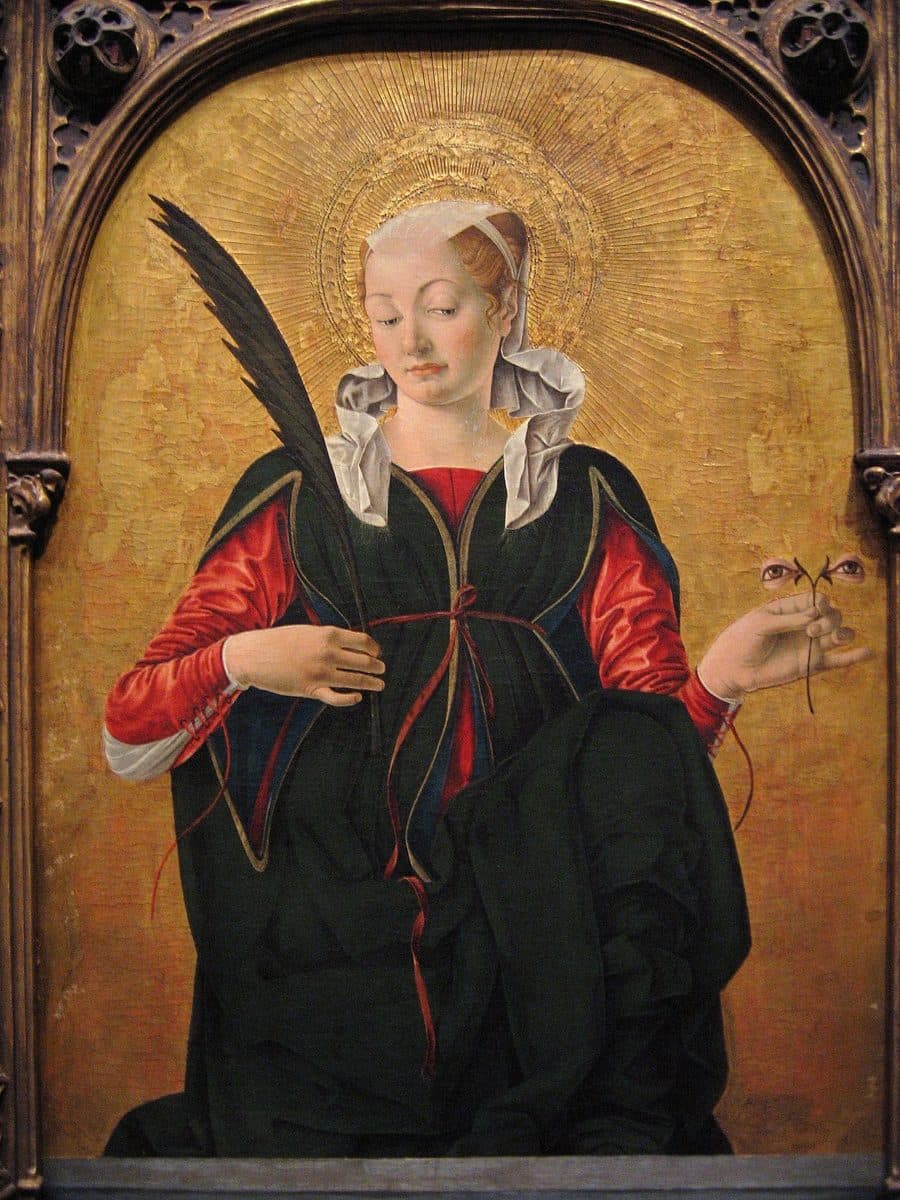
The Life
Lucy of Syracuse is one of the most beloved of the early Christian martyrs and one of the few whose feast has been celebrated continuously since the early Church — she appears in the Roman Canon of the Mass, in the earliest martyrologies, and in the oldest liturgical calendars. Her name means light (Latin: lux, lucis), and she is venerated as a bringer of light in the darkest days of the year — her feast falls on December 13, which in the pre-Gregorian calendar was close to the winter solstice, the longest night. In Scandinavian countries, particularly Sweden, the feast of Saint Lucia is one of the most important festivals of the year: a young girl dressed in white, wearing a crown of candles, leads a procession of singers in the pre-dawn darkness of December 13, bringing light to the darkest morning of the year.
Her Acts — a 5th or 6th-century text — describe her as a Christian noblewoman in Syracuse during the Diocletianic persecution who had consecrated her virginity to God. Betrothed against her will, she refused to marry. Her rejected suitor denounced her to the Roman governor. She was ordered to sacrifice to the gods and refused. The tradition says she was condemned to a brothel, but that when the guards tried to move her, she was immovable — a crowd of men and a pair of oxen could not shift her. Bundles of wood were piled around her feet and set alight; she did not burn. Eventually she was killed by a sword thrust to the throat.
The association with eyes came later: one tradition says she tore out her own eyes and sent them to her suitor when he praised the beauty of her eyes; another says her eyes were torn out by her persecutors and miraculously restored. Whether literally true or not, the image of Lucy holding a plate with her eyes on it is one of the most distinctive pieces of iconography in the calendar of saints, and her patronage of the blind and of those with eye diseases follows from it.
The Candles Crown — light in darkness
The Scandinavian Lucia tradition — the white-robed girl with a crown of lit candles leading the procession of singers in the pre-dawn darkness — is one of the most beautiful expressions of Christian seasonal devotion. In Sweden, Norway, and Finland, December 13 is celebrated with Lucia processions in schools, churches, hospitals, and homes. The tradition began in the 18th century in Sweden and has spread to Swedish communities worldwide. The symbolism is precise: the darkest morning of the year is met with a girl bringing light, whose name means light, whose feast has been celebrated since the first centuries of the Church. The Refusal and the Martyrdom Lucy's refusal to marry the suitor, to sacrifice to the gods, to be moved by the crowd and the oxen, to burn — the entire sequence of her martyrdom is a story of unmovability. She cannot be shifted from her position by any force that can be brought to bear on her. The immovability is the miracle: the body that will not go where it does not choose to go. The Gospel resonance is with the woman who cannot be compelled, who says no to every pressure, whose no is the foundation of her sanctity. The Eyes on the Plate The image of Lucy holding a plate or dish with two eyes on it — the eyes torn out by her persecutors, or torn out by herself and sent to the suitor who praised their beauty — is one of the most striking images in the entire Catholic iconographic tradition. It is also one of the most theologically interesting: she holds what was taken from her. She carries her loss as her offering. The eyes she gave up are the eyes by which she is recognised. She is the patron of the blind because she knows what it costs to lose sight. The Swedish Lucia Tradition In Sweden, the feast of Saint Lucia is a national celebration of light in darkness. On December 13, the eldest daughter of each household traditionally wears a white robe and a crown of candles and serves saffron buns (lussekatter) and coffee to the family before dawn. In churches and public spaces, Lucia processions feature a Lucia and her attendants singing the traditional Sankta Lucia hymn. The tradition was exported to Sweden's diaspora communities worldwide. The combination of a Christian feast, a pre-Christian solstice celebration, and a modern national identity has created one of the most distinctive and beautiful December traditions in the world.
Walk in Their Footsteps
Pilgrimage sites connected to St Lucy (Lucia)
Ask St Lucy (Lucia) to Intercede
Bring these intentions to this saint in prayer:
Lucy's name means light and she was martyred in the darkest month. The Scandinavians understood this when they made her the bearer of light in the longest night. She comes before dawn, she comes into darkness, she wears fire on her head, she brings the promise of light even before the sun rises. This is the Christian theology of martyrdom in its most beautiful form: the one who is killed for the light becomes the light. The darkness cannot contain her.
“When Jesus spoke again to the people, he said, I am the light of the world. Whoever follows me will never walk in darkness, but will have the light of life.”
Saint Lucy, light-bearer in the darkest morning — bring your candles into my December. Into the darkness of this season, this struggle, this long night that does not seem to end, bring the procession of light. I follow the light of the world; let me not walk in darkness. Amen.