
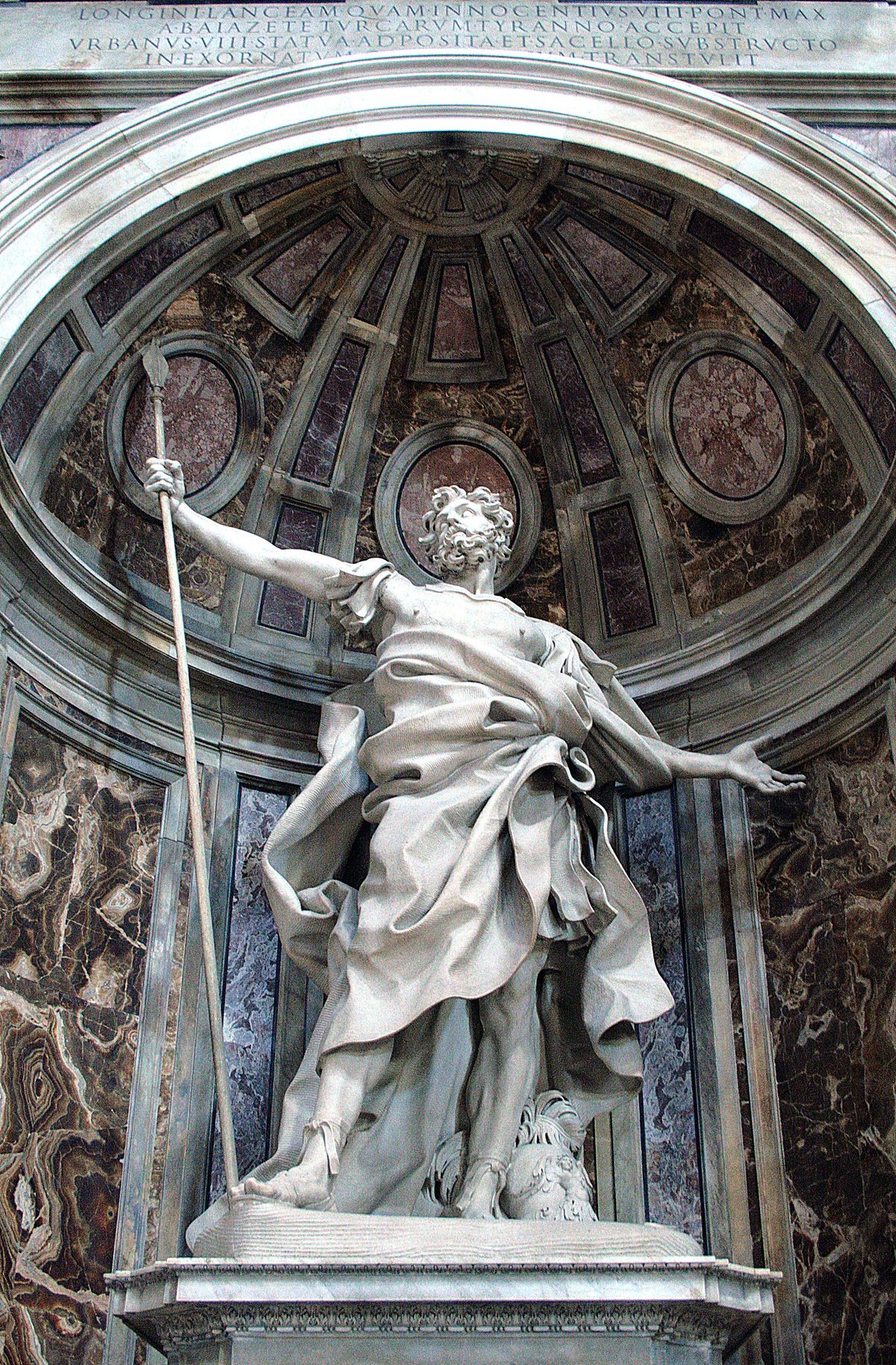
Statue of St Longinus
St Longinus — the full figure
Bernini's St Longinus occupies one of the four enormous niches in the crossing piers of St Peter's Basilica — the piers that support Michelangelo's dome. Longinus is the Roman soldier who pierced Christ's side with a spear at the Crucifixion and, according to tradition, was converted by the blood and water that flowed from the wound.
Bernini depicts him at the moment of conversion: arms spread wide, head thrown back, face upturned — the spear in one hand, the gesture an involuntary response to the divine light pouring down from the dome above. At nearly 4.4 metres tall, the figure has the physical scale to hold its own against the enormous architecture around it.
Bernini carved the Longinus between 1629 and 1638 as one of four colossal statues commissioned for the crossing piers, alongside St Veronica (Mochi), St Helena (Bolgi), and St Andrew (Duquesnoy). The four statues correspond to the four great relics of the Passion housed in the basilica: Longinus's spear, Veronica's veil, Helena's true cross, and Andrew's cross.
Bernini's Longinus is universally acknowledged as the finest of the four — and as one of the founding images of the Baroque style. The spread arms and upturned face pioneered the gesture of ecstatic conversion that would define a century of religious sculpture.
The figure's gesture — arms spread at shoulder height, head thrown back — anticipates the theatrical pose of ecstasy that Bernini would use again in the Ecstasy of St Teresa (see entry 21). In Longinus, however, the emotion is specifically conversion: the Roman soldier is transformed by the event he has participated in.
Look at the face — the mouth slightly open, the eyes rolled upward — and the quality of the drapery, which wraps around the figure in swirling energy as if the wind of the Spirit has just struck him. The spear in his right hand is deliberately underemphasized; it is the open arms and upturned face that communicate the miracle.
When standing before this work, look carefully: St Longinus — the full figure. Give it time — what seems decorative often carries the central meaning.
When standing before this work, look carefully: Face detail — the moment of conversion. Give it time — what seems decorative often carries the central meaning.
When standing before this work, look carefully: The crossing piers with the four niches. Give it time — what seems decorative often carries the central meaning.
When standing before this work, look carefully: The spear and outstretched hands. Give it time — what seems decorative often carries the central meaning.
The niche is in the southeast pier of the crossing, to the right of the Baldachin. Look upward at the dome from the same position — Bernini's intended viewing axis connects the figure below to the lantern above.