
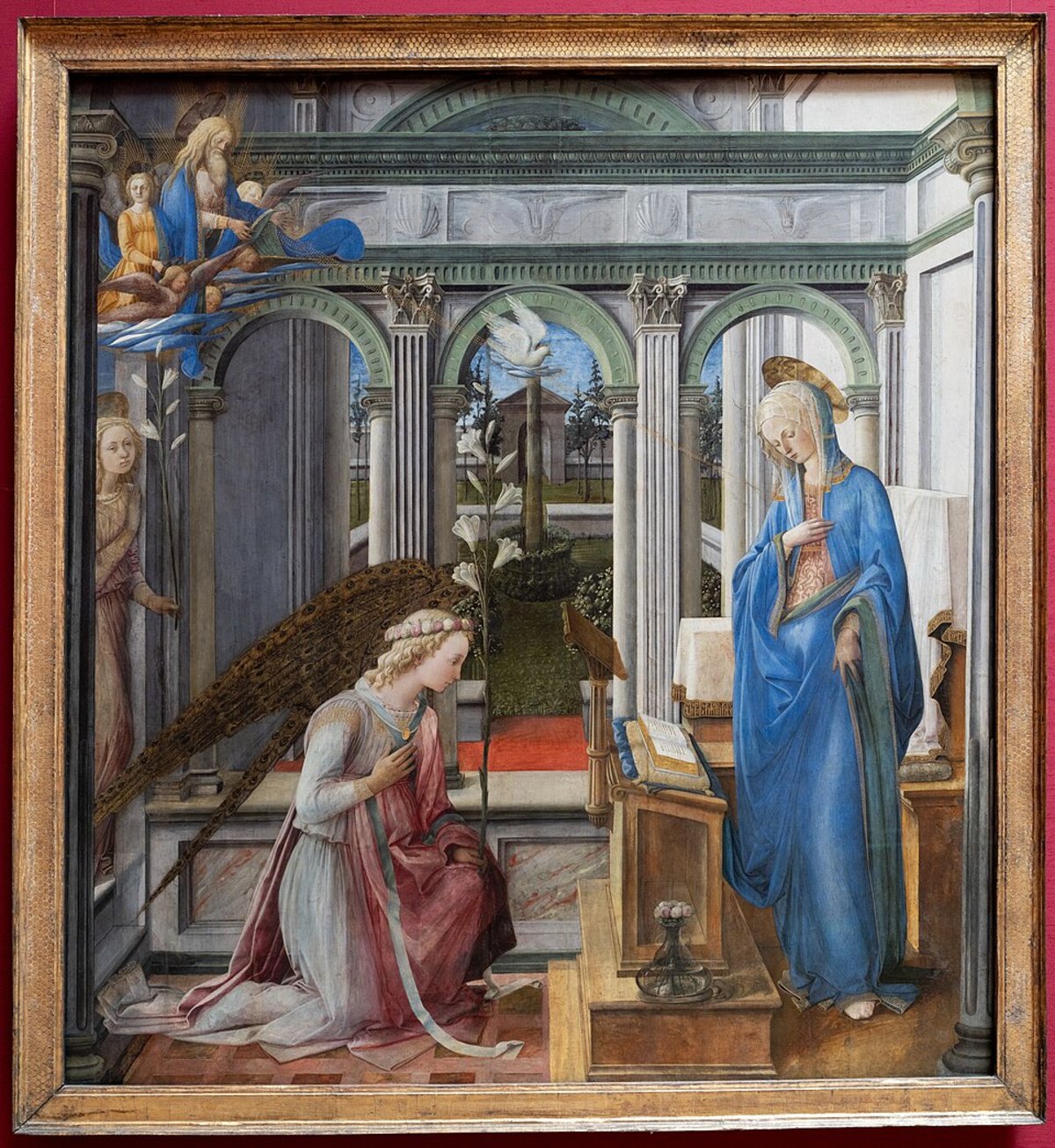
The Annunciation
Annunciation — Fra Filippo Lippi, c.1450-1453, National Gallery
Fra Filippo Lippi, Public domain, via Wikimedia Commons
Fra Filippo Lippi's Annunciation in the National Gallery, London, is a domestic and tender treatment of the subject — one of the most charming Florentine paintings of the mid-15th century. Gabriel kneels at the left; the Virgin kneels at a prie-dieu at the right; between them, God the Father descends from above sending the Holy Spirit.
The scene takes place in a loggia open to a garden — characteristic of Lippi's Florentine domestic realism. The Virgin's response is depicted as a combination of modesty and receptiveness. The painting was almost certainly painted for a private patron (possibly the Medici) and reflects the intimate devotional practice of Florentine humanism.
Fra Filippo Lippi (c.1406-1469) was a Carmelite friar who became one of the most important Florentine painters of the generation between Masaccio (whose influence he absorbed) and Botticelli (whom he trained). His art is characterised by a warm, domestic humanism — the sacred figures are tenderly human, the domestic details (textiles, architecture, gardens) are observed with loving attention. His personal life was scandalous (he eloped with a nun and had a son, Filippino Lippi, also a painter), but his paintings are among the most spiritually serene of the Quattrocento.
The loggia-and-garden setting of Lippi's Annunciations is a distinctive contribution: the open architecture connecting interior and exterior space, the garden visible through the arches, and the descent of God the Father from above create a space that is simultaneously domestic and cosmic. The Virgin's posture — kneeling, hands crossed on breast, eyes downcast — is the standard representation of the Annunciate Virgin from the mid-15th century onward, which Lippi helped establish.
When standing before this work, look carefully: Annunciation — Fra Filippo Lippi, c.1450-1453, National Gallery. Give it time — what seems decorative often carries the central meaning.
When standing before this work, look carefully: Gabriel kneeling — tender and domestic. Give it time — what seems decorative often carries the central meaning.
When standing before this work, look carefully: The Virgin — modesty and receptiveness. Give it time — what seems decorative often carries the central meaning.
When standing before this work, look carefully: Loggia and garden — domestic space opening to heaven. Give it time — what seems decorative often carries the central meaning.
National Gallery, Trafalgar Square, London WC2N 5DN. Free admission.
Open daily 10:00-18:00 (21:00 Fridays). The painting is in the Early Italian rooms.