
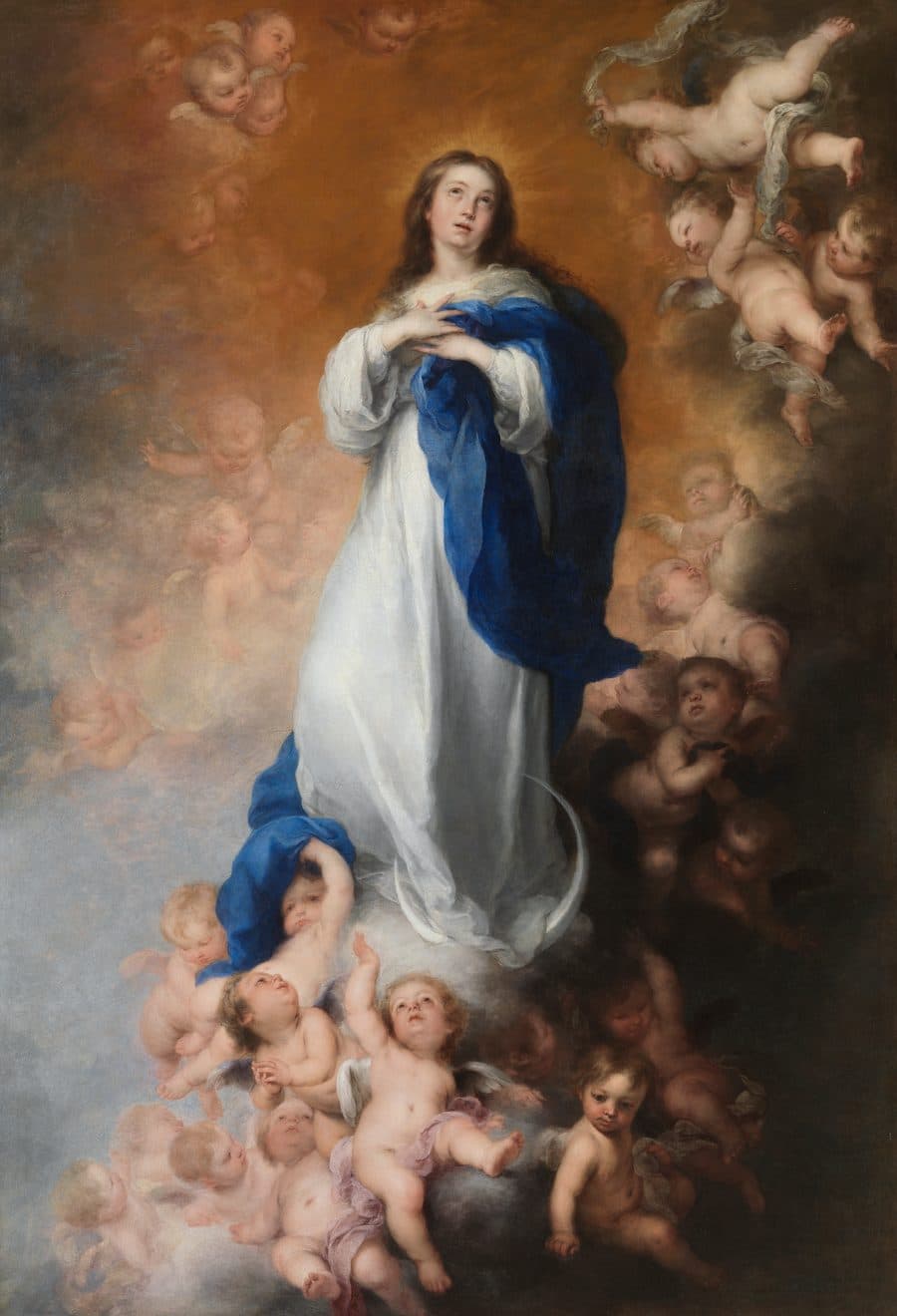
The Life
Mary of Nazareth is the central figure of Christian devotion after her son Jesus Christ — the most prayed-to, most depicted, most pilgrimaged-to person in the history of religion. She is not a goddess in Catholic theology but something arguably more remarkable: a human being who said yes to God so completely that the Word became flesh within her, and who has been saying yes on behalf of the human race ever since. She is the Mother of God (Theotokos — God-bearer — a title confirmed at the Council of Ephesus in 431 AD) and the mother of all who belong to her son.
The Gospels give us surprisingly little detail about Mary's life, but what they give is definitive. At the Annunciation, the angel Gabriel appears to a young woman in Nazareth and announces that she will conceive by the Holy Spirit and bear the Son of God. Mary's response — Be it done unto me according to your word — is the theological hinge of human history. Her yes makes the Incarnation possible. It is not a passive submission but an active, informed consent: she has already asked the key question (How can this be, since I know not man?) and received the answer, and then she chooses. In this she is the model of what it means to receive God's initiative with the whole self.
She is present at every crucial moment of her son's life and mission: the Visitation to Elizabeth, the birth in Bethlehem, the presentation in the Temple, the flight to Egypt, the finding in the Temple, the wedding at Cana (where her intercession initiates his public ministry), the cross (where she stands, does not flee, and is given to John as the mother of the beloved disciple — and through John, to all disciples), and Pentecost (where she is present in the upper room when the Holy Spirit descends on the gathered Church). She is the alpha and omega of the Gospel story: she brings Jesus into the world, she stands at his death, she receives his Spirit at the birth of the Church.
Her theological significance has only grown across twenty centuries. The great Marian apparitions — Guadalupe (1531), Lourdes (1858), Fatima (1917), Knock, Akita — have generated the largest pilgrimage movements in human history. Over 22 million pilgrims come to the Basilica of Guadalupe in Mexico City each year; 6 million to Lourdes; 8 million to Fatima. She is venerated across every continent and in every culture, always appearing with the specific face and language and symbols of the people she visits. She is the most translated, most localised, most inculturated figure in the history of religion.
The Annunciation — the yes that changed everything
A young woman in Nazareth receives the most consequential invitation in human history and says yes. Luke's account is spare and precise: the angel appears, announces the divine intention, and waits. Mary asks her question — not a question of doubt but of practical clarification — and receives the answer. Then she says: Behold the handmaid of the Lord; be it done unto me according to your word. The Incarnation happens in the space of that yes. Every Marian devotion, every apparition, every pilgrimage in her honour traces its origin to this moment of consent. The Magnificat — the revolutionary prayer When Mary visits her cousin Elizabeth — both of them unexpectedly pregnant, both carrying impossible promises — Elizabeth greets her with the first act of veneration (Blessed are you among women, and blessed is the fruit of your womb). Mary responds with the Magnificat: My soul magnifies the Lord, my spirit rejoices in God my saviour. The prayer goes on to proclaim that God has put down the mighty from their thrones and exalted the humble, filled the hungry with good things and sent the rich away empty. The Magnificat is one of the most revolutionary texts in religious literature — a prayer of praise that is simultaneously a programme of justice. The Cross — the sword through her soul At the presentation of the infant Jesus in the Temple, the old man Simeon takes the child and then turns to Mary: A sword will pierce through your own soul also. She does not flee from the sword. At the crucifixion, when almost all the male disciples have abandoned Jesus, Mary is at the foot of the cross — standing, not collapsing. She witnesses everything. The dying Jesus looks down and entrusts her to the beloved disciple: Woman, behold your son. And to the disciple: Behold your mother. This exchange at the cross is the foundation of Marian intercession: the mother given to all disciples. Guadalupe — the apparition that evangelised a continent In December 1531, the Virgin Mary appeared to Juan Diego on the hill of Tepeyac near Mexico City and left her image miraculously printed on his tilma (cloak). The image depicts Mary as a young mestiza woman, using Aztec iconographic language — pregnant, clothed with the sun, standing on the moon, crushing the serpent. Within a decade of the apparition, 9 million indigenous Mexicans had converted to Christianity. The theologians of the day had spent years trying to convert them by argument and authority and largely failed. Our Lady of Guadalupe accomplished it by appearing to one indigenous man, speaking his language, wearing his symbols, and leaving an image on a cloak. She is the greatest missionary in the history of the Americas.
Walk in Their Footsteps
Pilgrimage sites connected to Blessed Virgin Mary
Ask Blessed Virgin Mary to Intercede
Bring these intentions to this saint in prayer:
Mary's yes is the template. She was not asked if she wanted this. She was asked if she was willing. She asked the necessary question. She received the answer. She said yes. What would happen if, in the situation you are currently in — with all its uncertainty, all its difficulty, all its demand — you said the same thing? Be it done unto me according to your word. Not passively. Not without question. But finally, after the question is asked and the answer received, with the whole self: yes.
“I am the Lord's servant. May your word to me be fulfilled.”
Holy Mary, Mother of God — I come to you with what I am carrying. You carried the impossible; help me carry the possible. Intercede for me — for this specific need, in this specific moment — with the one who gave you your yes when you asked. You have never refused a child who came to you. I am coming. Receive me, and pray for me to your son. Amen.