
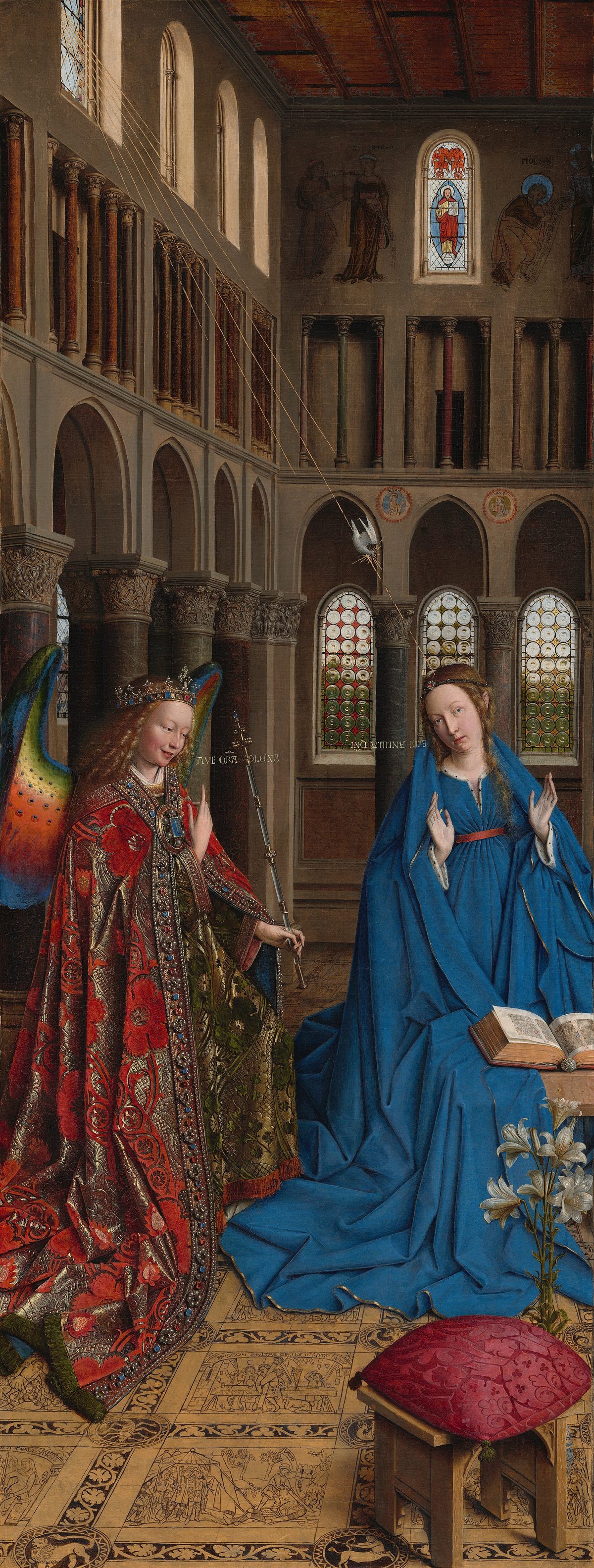
The Annunciation
The Annunciation — Jan van Eyck, c.1434-1436
Jan van Eyck, Public domain, via Wikimedia Commons
Jan van Eyck's Annunciation is one of the supreme works of Early Netherlandish painting in America — a vertical panel depicting the Archangel Gabriel and the Virgin Mary in a church interior, with a complex iconographic programme embedded in every detail of the architecture and the objects depicted. Gabriel stands on the church's mosaic floor (a scene of Samson and the Lion in the floor tiles — a type of Christ's Resurrection) wearing a jewelled crown and robe; the Virgin, standing opposite, receives the Annunciation with a gesture of modesty.
Above them, three windows let in the light of the three persons of the Trinity; Old Testament scenes in the stained glass prefigure the New Testament events depicted. The dove of the Holy Spirit descends toward the Virgin on a golden beam; the tiny image of a Christ child is suspended on the beam, about to enter Mary's womb. Van Eyck's oil medium allows every surface — the floor tiles, the Virgin's embroidered robe, the stained glass windows, the stone columns — to be depicted with a descriptive precision unprecedented in the history of painting.
Jan van Eyck (c.1390-1441) was the greatest innovator in oil painting technique in the history of European art — his development of transparent oil glazes allowed the representation of light and surface that defined Western painting until the 19th century. The Annunciation was probably made as the outer wings of a triptych; when the wings were closed, their grisaille exteriors depicted other figures.
The panel entered the Hermitage and was purchased by Andrew Mellon, eventually entering the National Gallery at the museum's founding in 1941. The transfer from panel to canvas (done in the 18th century) has caused some paint loss but the work remains one of the finest examples of van Eyck's mature style.
Read the painting layer by layer. Floor: the mosaic tiles show Old Testament scenes (Samson and the Lion, David and Goliath) — types of the Resurrection. Columns: three on each side, representing the three persons of the Trinity.
Stained glass: the windows show Old Testament subjects in a style that mimics actual medieval stained glass — van Eyck painted the painted image of a painted window of a stone relief. Gabriel's crown: studded with specific gem species (rubies, sapphires, emeralds) each with symbolic meanings. The Virgin's robe: embroidered with gold thread in a pattern of stylised leaves. The golden beam of the Spirit enters from the upper left through the window.
When standing before this work, look carefully: The Annunciation — Jan van Eyck, c.1434-1436. Give it time — what seems decorative often carries the central meaning.
When standing before this work, look carefully: The mosaic floor tiles — Old Testament typology. Give it time — what seems decorative often carries the central meaning.
When standing before this work, look carefully: The Archangel Gabriel with jewelled crown. Give it time — what seems decorative often carries the central meaning.
When standing before this work, look carefully: The stained glass windows — painted windows of stone reliefs. Give it time — what seems decorative often carries the central meaning.
National Gallery of Art, West Building, Washington DC. Free admission. The NGA holds one of the finest collections of Early Netherlandish painting outside Europe.