
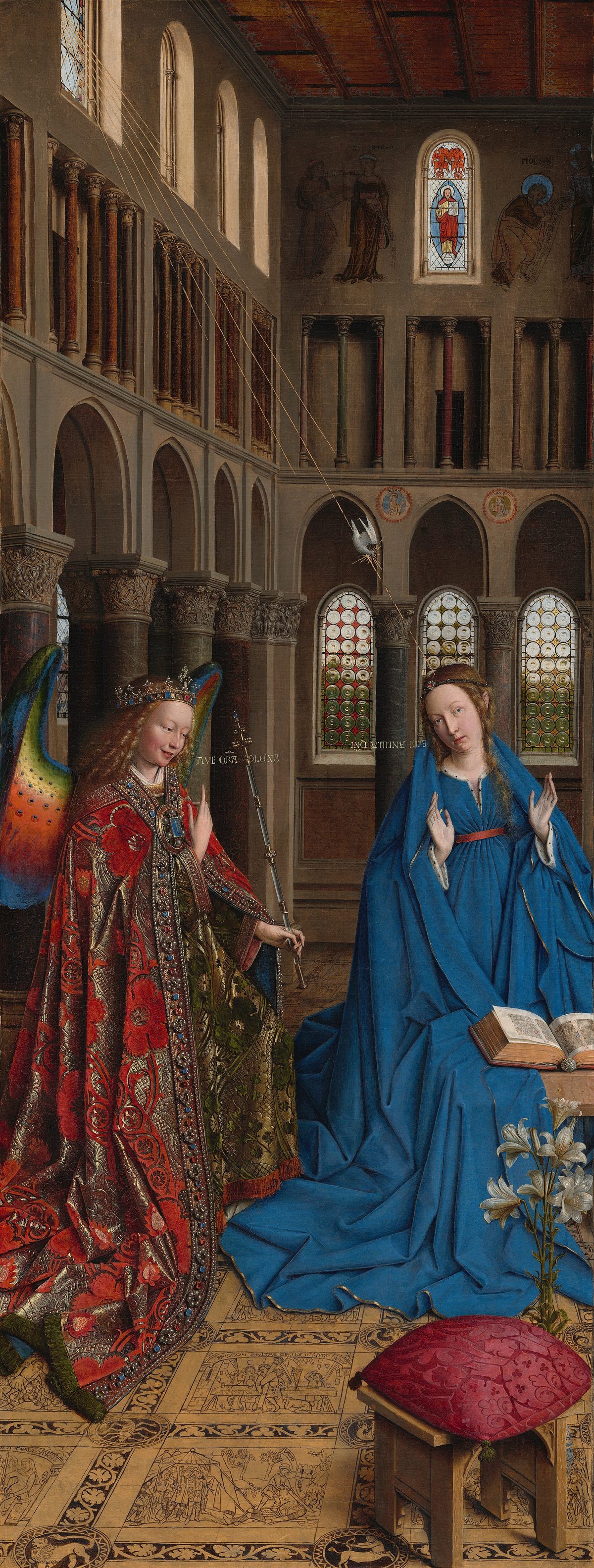
The Annunciation
Annunciation — Jan van Eyck, c.1434-1436, NGA Washington
Jan van Eyck, Public domain, via Wikimedia Commons
Jan van Eyck's Annunciation in the National Gallery of Art Washington is one of the small group of autograph van Eyck paintings outside Europe — a panel of exceptional quality showing Gabriel and the Virgin in the multi-level interior of a Romanesque church. Gabriel kneels at the left, his multi-coloured wings spread, delivering the divine message; the Virgin receives it at the right, her arms crossed on her breast in a gesture of acceptance.
Above them, in the upper zone of the church, three windows with stained glass figures represent the Trinity. On the floor between Gabriel and Mary, the dove of the Holy Spirit descends. The tiled floor bears an inscription from Gabriel's greeting and the Virgin's reply, written in gold — Gabriel's words upright, the Virgin's words inverted (because they are directed upward, toward God).
Jan van Eyck (c.1390-1441) is the paradigm case of the Flemish founder of oil painting — whether he 'invented' the oil medium or perfected an existing technique, his use of it was revolutionary: the precision, the luminosity, the ability to render surfaces (textiles, metalwork, glass, skin) with optical exactness. The Washington Annunciation panel was originally the exterior wing of a triptych (the inner panels are in Dresden). It was acquired by American collector Andrew Mellon and given with his entire collection to found the National Gallery of Art in 1937.
The inscriptions on the floor — Gabriel's greeting ('AVE GRACIA PLENA' — Hail, full of grace) and the Virgin's response ('ECCE ANCILLA DOMINI' — Behold the handmaid of the Lord) — are a van Eyck characteristic: the sacred words embedded in the physical space, as if the language of the Incarnation is written into the very structure of the world. The Romanesque interior (three-aisled, with round arches and clerestory windows) is anachronistic — it is not a 15th-century Flemish church but a representation of the Old Covenant space into which the New Covenant is being announced.
When standing before this work, look carefully: Annunciation — Jan van Eyck, c.1434-1436, NGA Washington. Give it time — what seems decorative often carries the central meaning.
When standing before this work, look carefully: Gabriel with polychrome wings — divine messenger. Give it time — what seems decorative often carries the central meaning.
When standing before this work, look carefully: Floor inscriptions — the language of the Incarnation. Give it time — what seems decorative often carries the central meaning.
When standing before this work, look carefully: The dove descending — Holy Spirit between Gabriel and Mary. Give it time — what seems decorative often carries the central meaning.
National Gallery of Art, 6th and Constitution Avenue NW, Washington DC 20565. Free admission.
Open daily 10:00-17:00 (11:00 Sundays). The van Eyck Annunciation is in the Early Flemish galleries.