
The Battle of San Romano
Battle of San Romano (Uffizi panel) — Uccello, c.1438-1440
Paolo Uccello, Public domain, via Wikimedia Commons
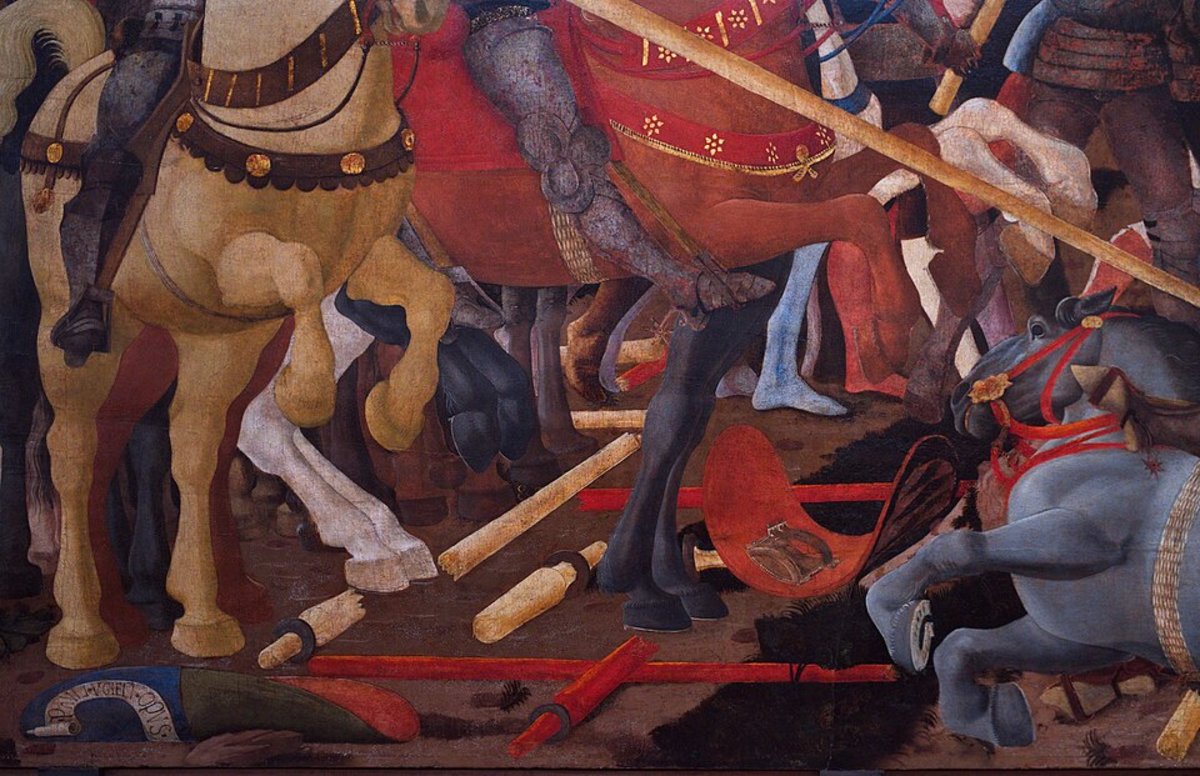
Paolo Uccello's Battle of San Romano is a triptych of three monumental panels (each approximately 182 by 316 cm) originally painted for the Medici Palace in Florence, now divided between the Uffizi (Niccolò da Tolentino directing the battle), the National Gallery London (counterattack), and the Louvre (Bernardino della Ciarda unhorsed). Together they constitute the most extended meditation on perspective and foreshortening in 15th-century painting — Uccello deployed every resource of perspectival construction in the three panels: the lances of fallen soldiers are placed on the ground to create perspectival recession, the horses rear and turn to display foreshortening, the broken lances and fallen figures create a pattern of recession and overlap. The subject (a Florentine victory over the Sienese at San Romano in 1432) is incidental to the formal programme.
The three panels were painted for Cosimo de' Medici (or his son Lorenzo the Magnificent) for the Medici bedroom, where they were described by Lorenzo's Florentine inventory. They were separated from the early 19th century.
The paintings' relationship with actual battle narrative is quite distant — the figures do not bleed, do not die realistically, but move in heraldic patterns, their armour silver and gold, the orange trees of the background decorative. Uccello transforms a historical battle into a tournament of formal invention.
The key formal invention in all three panels is the use of foreshortened lances: broken lances are placed on the ground pointing directly toward the viewer, creating the perspectival recession that the flat gold-leaf background (a Gothic convention that Uccello retains even as he explores perspective) otherwise prevents. The horse falling in the right foreground of the Uffizi panel — seen from above and behind, in a complex foreshortened position — was cited by Vasari as evidence of Uccello's perspectival obsession.
When standing before this work, look carefully: Battle of San Romano (Uffizi panel) — Uccello, c.1438-1440. Give it time — what seems decorative often carries the central meaning.
When standing before this work, look carefully: Battle of San Romano (National Gallery panel) — London. Give it time — what seems decorative often carries the central meaning.
When standing before this work, look carefully: Battle of San Romano (Louvre panel) — Paris. Give it time — what seems decorative often carries the central meaning.
When standing before this work, look carefully: Foreshortened lances — perspectival programme. Give it time — what seems decorative often carries the central meaning.
Uffizi Gallery, Room 8 (Battle of San Romano, Uccello), Piazzale degli Uffizi, Florence. Open Tuesday-Sunday 8:15-18:50. Additional panels at the National Gallery London and Musée du Louvre, Paris.