
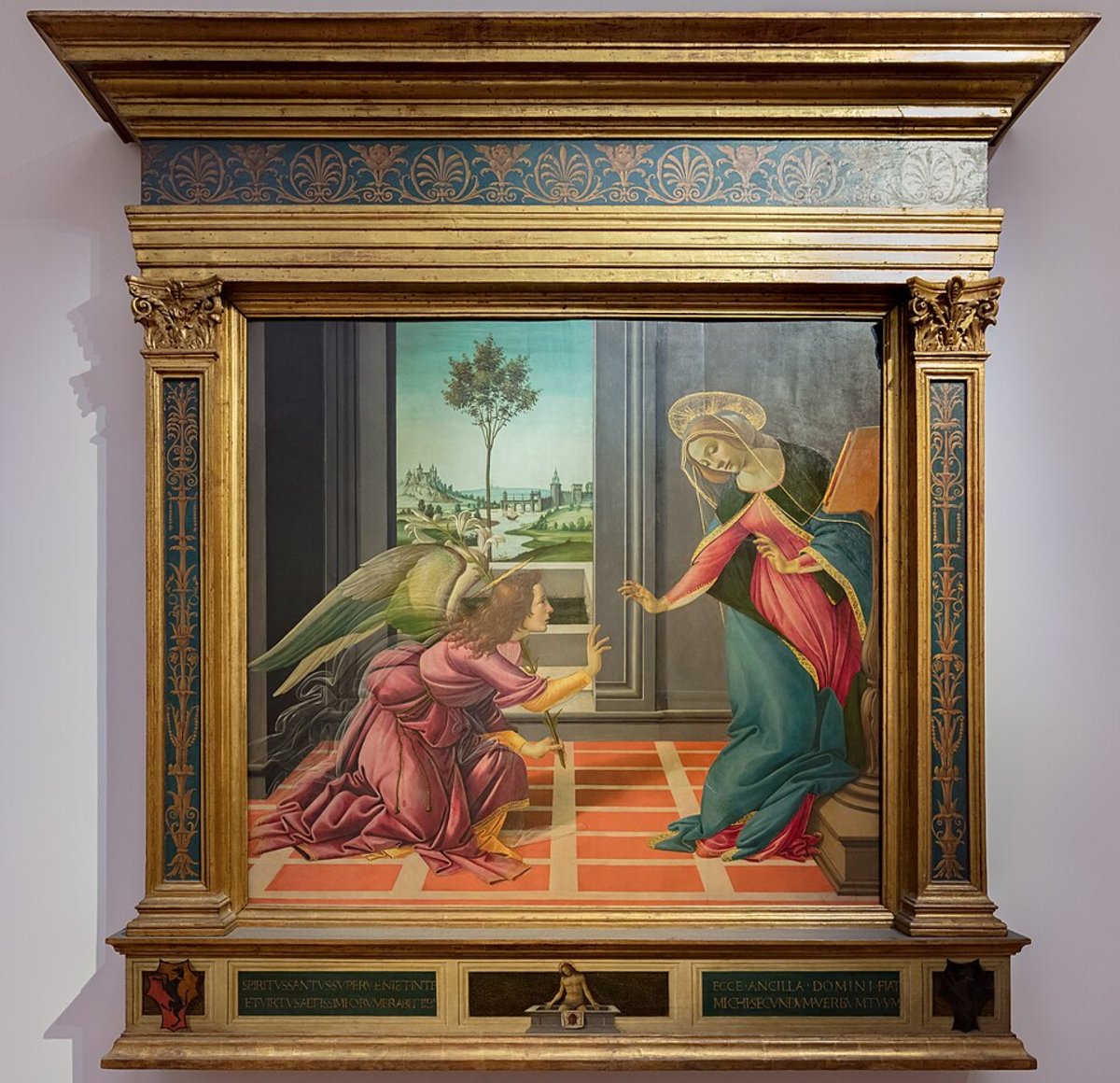
The Cestello Annunciation
Cestello Annunciation — Botticelli, c.1489-1490
Sandro Botticelli, Public domain, via Wikimedia Commons
Botticelli's Cestello Annunciation (from the convent of Cestello, later Santa Maria Maddalena dei Pazzi, in Florence) is the most psychologically intense of his three large Annunciation paintings — the others being the smaller San Martino Annunciation (Uffizi) and the fresco in San Marco (entry 182 for comparison context). The large panel (approximately 150 by 156 cm) shows Gabriel and the Virgin in a loggia opening onto a Florentine river landscape; both figures are in a state of intense physical agitation — Gabriel's garment swirls around him as if he has just landed; the Virgin bends backward from the apparition, her left arm extended in a gesture that combines welcome and alarm, her body almost a double curve of response.
The lily (purity symbol) that Gabriel carries has been set down on the ledge; both figures are entirely focused on each other. The quality of the drapery — its specific flutter and fall — and the psychological intensity of the encounter make this one of the finest devotional paintings of the late 15th century.
The Cestello Annunciation was painted around 1489-1490, during the period of Botticelli's deepest engagement with Savonarola's circle — the sinuous agitation of the figures has been connected to the emotional intensity of Savonarolan preaching. Compared to his earlier Annunciation paintings (the San Martino Annunciation, c.1481) the Cestello version shows a dramatic increase in emotional and physical dynamism: the earlier figure's calm is replaced by this spiral of response and encounter.
The Virgin's posture is the key: she bends backward and to the right, her left arm extended, her right hand at her breast. This posture — a combination of recoil and openness, alarm and acceptance — is unique in the history of Annunciation paintings.
Botticelli gives her a physical response to the divine that is unprecedented in the tradition. The river landscape behind the loggia is a specific Florentine view (the Arno and its hills) rendered in pale afternoon light.
When standing before this work, look carefully: Cestello Annunciation — Botticelli, c.1489-1490. Give it time — what seems decorative often carries the central meaning.
When standing before this work, look carefully: The Virgin's spiral recoil — unique in the tradition. Give it time — what seems decorative often carries the central meaning.
When standing before this work, look carefully: Gabriel — garments still swirling from flight. Give it time — what seems decorative often carries the central meaning.
When standing before this work, look carefully: The Florentine river landscape — pale afternoon light. Give it time — what seems decorative often carries the central meaning.
Uffizi Gallery, Room 10-14 (Botticelli rooms), Florence.