
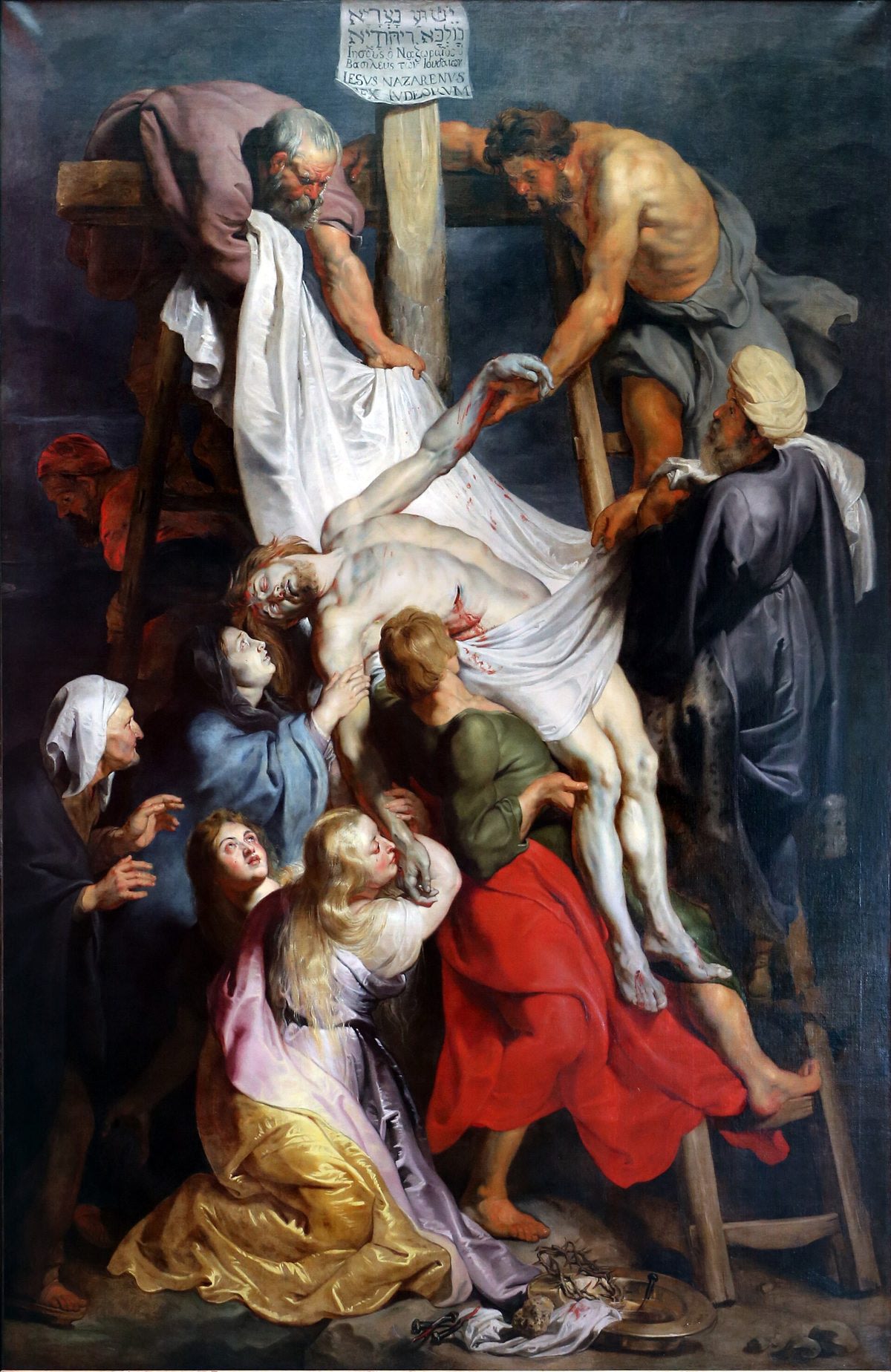
The Descent from the Cross (Rubens)
Descent from the Cross — Rubens, 1611-1614
Peter Paul Rubens, Public domain, via Wikimedia Commons
Rubens's Descent from the Cross faces the Elevation across the transepts of Antwerp Cathedral and is, by nearly universal agreement, his greatest single work. The central panel shows Christ being lowered from the cross by a group of six figures: a strong young man descends from behind the cross holding a white sheet from which Christ's body slides; the Virgin reaches up to receive her son; John the Evangelist at the lower left bears Christ's weight across his body; Mary Magdalene cradles the feet.
The composition is a flowing diagonal from upper left to lower right — the reverse of the Elevation's diagonal — creating a visual conversation between the two triptychs across the transept space. Christ's body, in a white shroud against the red garments of the figures around him, is the painting's formal and theological centre.
Rubens had studied Rogier van der Weyden's Descent from the Cross (entry 80) in Madrid in 1603 and absorbed its compositional strategy — the flowing diagonal, the mirroring of Virgin and Christ, the concentration of emotional intensity in the figures. His version is Italianate where Rogier's is Flemish (the anatomy is more muscular, the space more dimensional, the colour warmer) but shares Rogier's fundamental theological insight: the moment of lowering is a moment of supreme tenderness, the physical transfer of a dead body that is also the transfer of the world's redemption. The Descent was commissioned by the Antwerp guild of arquebusiers (musketeers); the side panels of the triptych show the Visitation (left wing) and the Presentation in the Temple (right wing) — episodes from the lives of John the Baptist and Simeon, both of whom prophesied Christ's passion.
The sheet from which Christ slides — white, luminous, the focus of the composition — is the painting's most observed detail: the figure descending from behind the cross grasps it from above; it gathers around Christ's body; it trails below toward the Virgin's outstretched hands. The sheet is simultaneously a physical object (shroud material) and a compositional device (the white vertical that organises the painting's colour arrangement).
Christ's body has the quality of sleep — not rigidity but the absolute relaxation of death, the limbs loose, the head dropping forward. Look at John the Evangelist at the lower left: his red robe, his young face, his body accepting Christ's weight with a quality of loving physical effort that is deeply human.
When standing before this work, look carefully: Descent from the Cross — Rubens, 1611-1614. Give it time — what seems decorative often carries the central meaning.
When standing before this work, look carefully: The white sheet — compositional and devotional centre. Give it time — what seems decorative often carries the central meaning.
When standing before this work, look carefully: Christ's body — the quality of absolute repose. Give it time — what seems decorative often carries the central meaning.
When standing before this work, look carefully: St John bearing Christ's weight. Give it time — what seems decorative often carries the central meaning.
Cathedral of Our Lady, south transept, Antwerp. Same entry as the Elevation of the Cross. The two Rubens triptychs plus the cathedral's Gothic interior constitute one of the great art-and-architecture experiences in Northern Europe.