
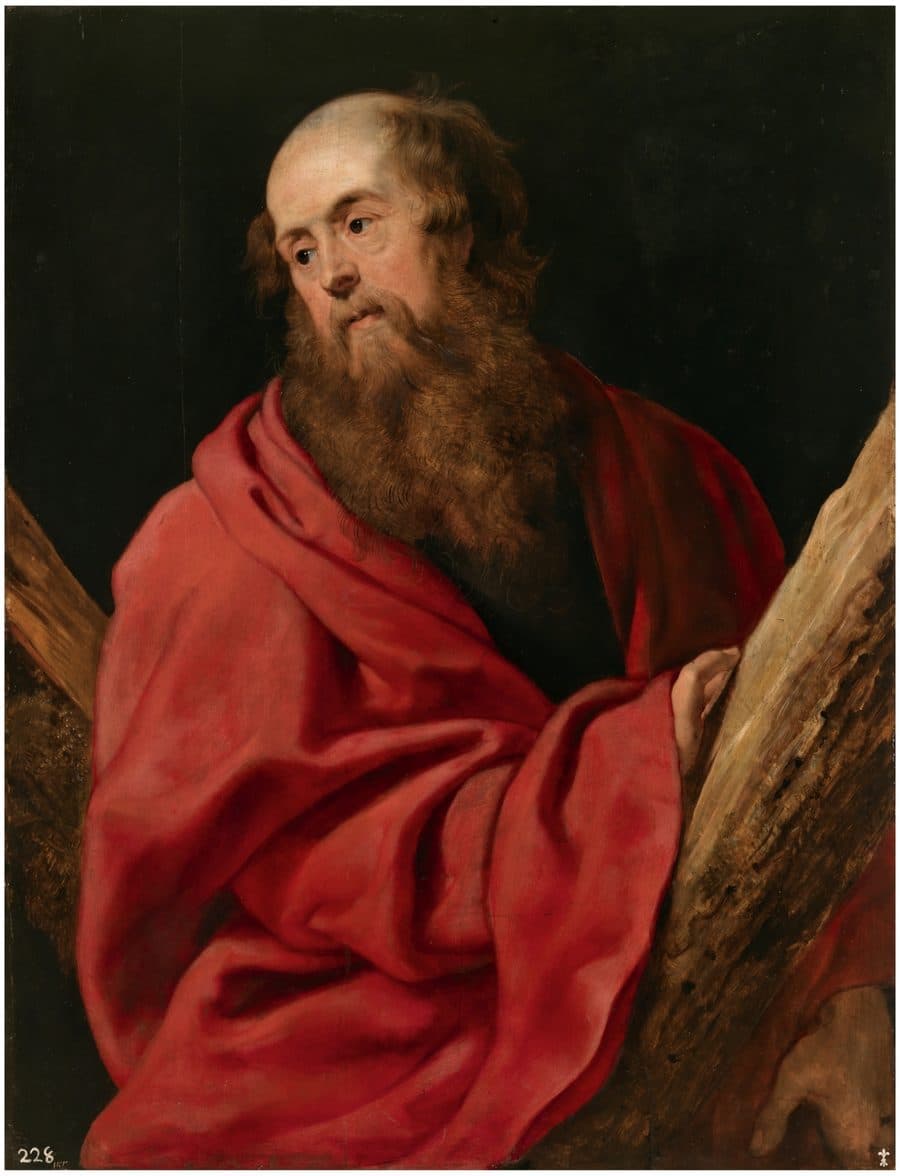
The Life
Andrew of Bethsaida was the first of the twelve apostles to be called by Jesus, and he immediately did the most characteristic thing of his entire apostolate: he found his brother Simon and brought him to Jesus. Andrew is the patron of Scotland, Russia, and Greece — three of the most distinctively different nations in the world — and his cross, the X-shaped saltire (diagonal cross), is on the flags of Scotland, Russia (naval ensign), and the Union Jack.
He was a fisherman from Bethsaida on the Sea of Galilee, the son of Jonah, and the older brother of Simon Peter. He appears in all four lists of the twelve apostles. In John's Gospel, he is identified as a former disciple of John the Baptist who, after hearing the Baptist describe Jesus as the Lamb of God, immediately follows Jesus and asks where he is staying. Jesus invites him: Come and see. Andrew goes and sees. Then — immediately — he finds his brother Simon and says: We have found the Messiah. This is his entire apostolic method, in miniature: encounter, bring another.
He appears again in John's Gospel at the feeding of the five thousand: it is Andrew who finds the boy with the five loaves and two fishes and brings him to Jesus, with the honest observation that this is clearly not going to be enough. And again at the entry to Jerusalem, when Greek-speaking pilgrims want to meet Jesus: they find Philip, who finds Andrew, and together they bring the request to Jesus. Andrew is consistently the connector — the person who brings people to the encounter with Jesus that he himself has already had.
His martyrdom is traditionally placed in Patras, in the Peloponnese — where the proconsul Aegeas had him crucified on an X-shaped cross (the saltire or crux decussata) after he refused to sacrifice to the gods and converted much of Patras to Christianity. He was reportedly tied, not nailed, to the cross, and hung there for two days preaching to the crowd before dying. His relics were taken to Constantinople and later to Amalfi and Bruges, with the head eventually returned to Patras in 1964 by Pope Paul VI as a gesture of reconciliation with the Greek Orthodox Church.
Come and See — the first encounter
Andrew was a disciple of John the Baptist before he became a disciple of Jesus. He heard John say, pointing to Jesus: Look, the Lamb of God. He followed Jesus. Jesus asked: What do you want? He said: Where are you staying? Jesus said: Come and see. Andrew came. He saw. He stayed. And then he immediately found his brother and said: We have found the Messiah. The entire apostolic mission of the Church is compressed into Andrew's response to his encounter with Jesus: he went and found the person closest to him and brought him. The Boy with the Loaves At the feeding of the five thousand, when Jesus asks how they are to feed the crowd of five thousand, it is Andrew who says: There is a boy here who has five barley loaves and two fish, but what are they for so many? Andrew finds the inadequate resource and brings it to Jesus. His observation — this is not going to be enough — is entirely correct as a calculation. As an act of faith it becomes the occasion for a miracle. Andrew's role is to bring what is available, however insufficient, to Jesus and let Jesus deal with the arithmetic. The X-shaped Cross — martyrdom at Patras Andrew was martyred in Patras on a diagonal cross — the X-shaped crux decussata that bears his name (the St Andrew's cross or saltire). He reportedly embraced the cross as he arrived at the place of execution: O good cross, made beautiful by the body of my Lord — receive me from among men and restore me to my Master. He hung on the cross for two days, continuing to preach to the crowd. The X-shaped cross became the symbol of Scotland in the 9th century, when relics were brought to the site of St Andrews in Fife. The Patron of Three Nations The patronage of Andrew in Scotland, Russia, and Greece reflects three distinct historical encounters with his relics and tradition. Scotland received relics in the 9th century and made Andrew its patron at the battle of Athelstane in 832, when the white X-shaped cloud in the blue sky was interpreted as a sign of Andrew's protection. Russia's devotion goes back to Kievan Rus; the legend that Andrew preached at the site of Kiev and prophesied the city's greatness is foundational to Russian Orthodox identity. Greece claims Andrew as its own because he was martyred in Greek territory and the Greek Orthodox Church of Patras holds his skull.
Walk in Their Footsteps
Pilgrimage sites connected to St Andrew
Ask St Andrew to Intercede
Bring these intentions to this saint in prayer:
Andrew's entire apostolate was the act of bringing people to Jesus. Find someone. Tell them. Bring them. He found his brother first, then the boy with the loaves, then the Greeks who wanted to meet Jesus. He is the patron of the person who says: I know someone you need to meet. The apostolic method has not changed in two thousand years.
“The first thing Andrew did was to find his brother Simon and tell him, We have found the Messiah. And he brought him to Jesus.”
Saint Andrew, first-called and first to bring another — teach me your method. I have encountered Jesus. Now help me find the person closest to me and bring them. Not by argument, not by pressure, but by the simple act of saying: Come and see. Who should I bring today? Amen.