
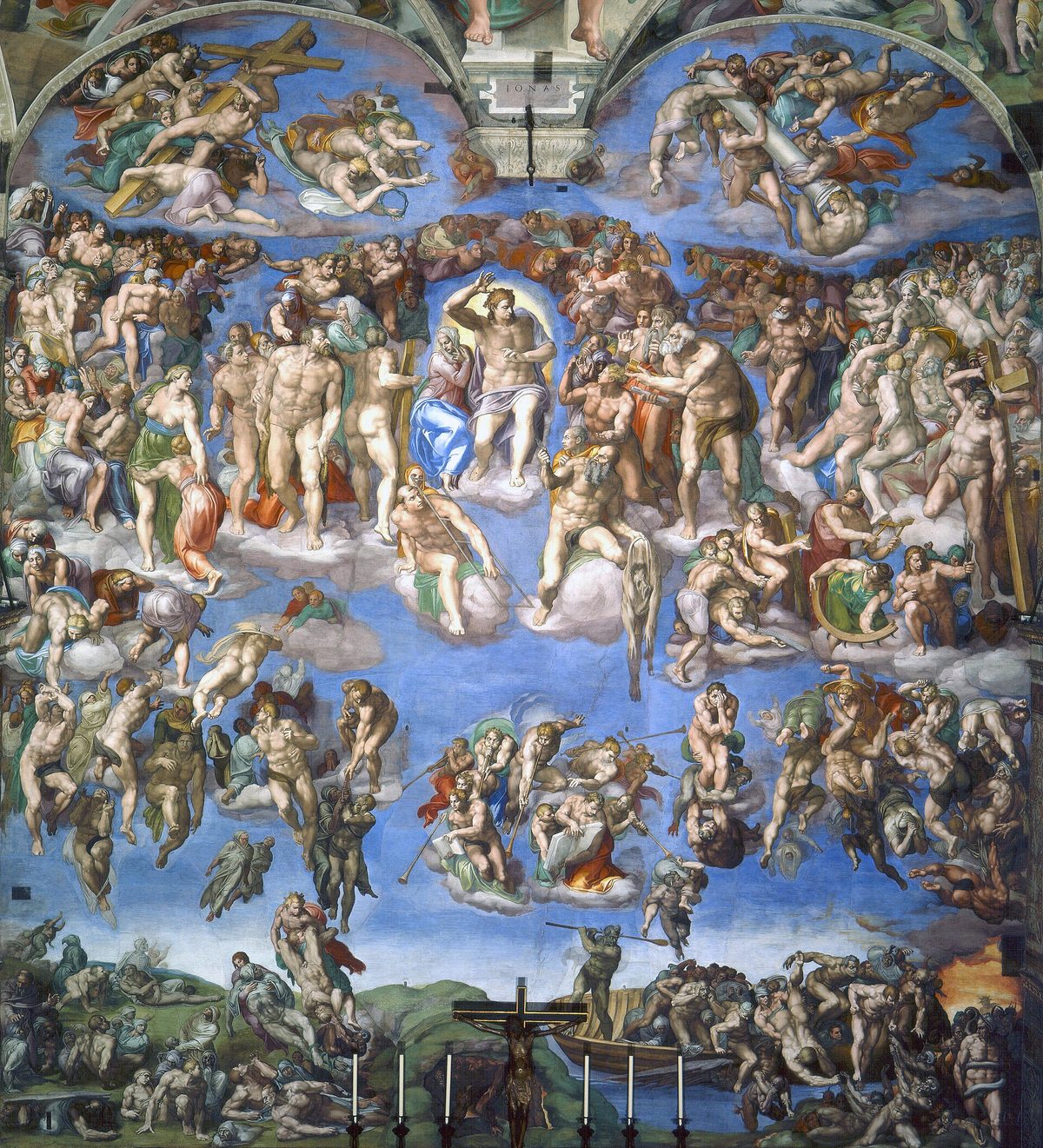
The Last Judgment
Michelangelo's largest fresco — 300 figures on the Sistine Chapel altar wall, Christ as stern judge, the blessed ascending, the damned falling to hell.
Michelangelo, Public domain, via Wikimedia Commons
The Last Judgment covers the entire altar wall of the Sistine Chapel — a wall 13.7 metres wide and 12 metres high — and is the largest fresco of the Renaissance, containing over 300 figures. Painted twenty-four years after the ceiling at the commission of Pope Paul III, it depicts the Second Coming in terrifying grandeur: Christ at the centre as stern judge, the blessed rising on his right, the damned falling to hell on his left, saints clutching the instruments of their martyrdoms, and Charon ferrying the damned across the Styx. It was unveiled in 1541 and immediately recognised as both sublime and controversial — its many nude figures were considered indecent by some, and after Michelangelo's death the Council of Trent ordered loincloths painted over many of them (by Daniele da Volterra, mockingly nicknamed Il Braghettone — the Breeches Maker).
Michelangelo was 61 when he began the Last Judgment and 66 when he unveiled it. He had spent his intervening years in Florence and on the tomb of Julius II (his most protracted artistic agony). When Paul III gave him the commission, Michelangelo no longer needed to negotiate; he painted what he believed.
The figure of Christ — young, beardless, with the raised arm of condemnation — owes more to Apollo than to conventional Byzantine iconography. Michelangelo included a self-portrait in the painting: the flayed skin held by Saint Bartholomew, hanging limply near the centre, bears his own features. The choice of self-representation as an empty, flayed skin — rather than a proud artist signature — expresses the late Michelangelo's attitude toward his own achievement.
The composition divides into four horizontal zones: at the bottom, the dead emerging from their graves and the damned being dragged to hell; above, angels with the instruments of the Passion (cross, crown of thorns, column); at the centre, the blessed rising and Christ as judge with Mary at his side; at the top, lunettes with angels carrying the cross and crown. Christ's right arm raised in judgment is the compositional spine of the entire wall.
Find Saint Bartholomew holding his skin (Michelangelo's self-portrait), Saint Lawrence with his gridiron, Saint Catherine with her wheel. Look also at Charon in the lower right — adapted from Dante's Inferno. The painting's swirling, airless drama is utterly different from the ordered grandeur of the ceiling.
When standing before this work, look carefully: The Last Judgment — full view of the altar wall. Give it time — what seems decorative often carries the central meaning.
When standing before this work, look carefully: Christ as Judge — the central figure. Give it time — what seems decorative often carries the central meaning.
When standing before this work, look carefully: Saint Bartholomew holding Michelangelo's self-portrait skin. Give it time — what seems decorative often carries the central meaning.
When standing before this work, look carefully: Charon ferrying the damned — lower right detail. Give it time — what seems decorative often carries the central meaning.
Same chapel as the ceiling; the altar wall is directly in front of visitors as they enter from the museum circuit. The Last Judgment is best viewed from the back of the chapel, where the full wall is visible.
The restoration of 1994-1999 removed centuries of candle smoke and the loincloths added after Trent (some were left; others removed). The colours are now vivid, close to their original state.