
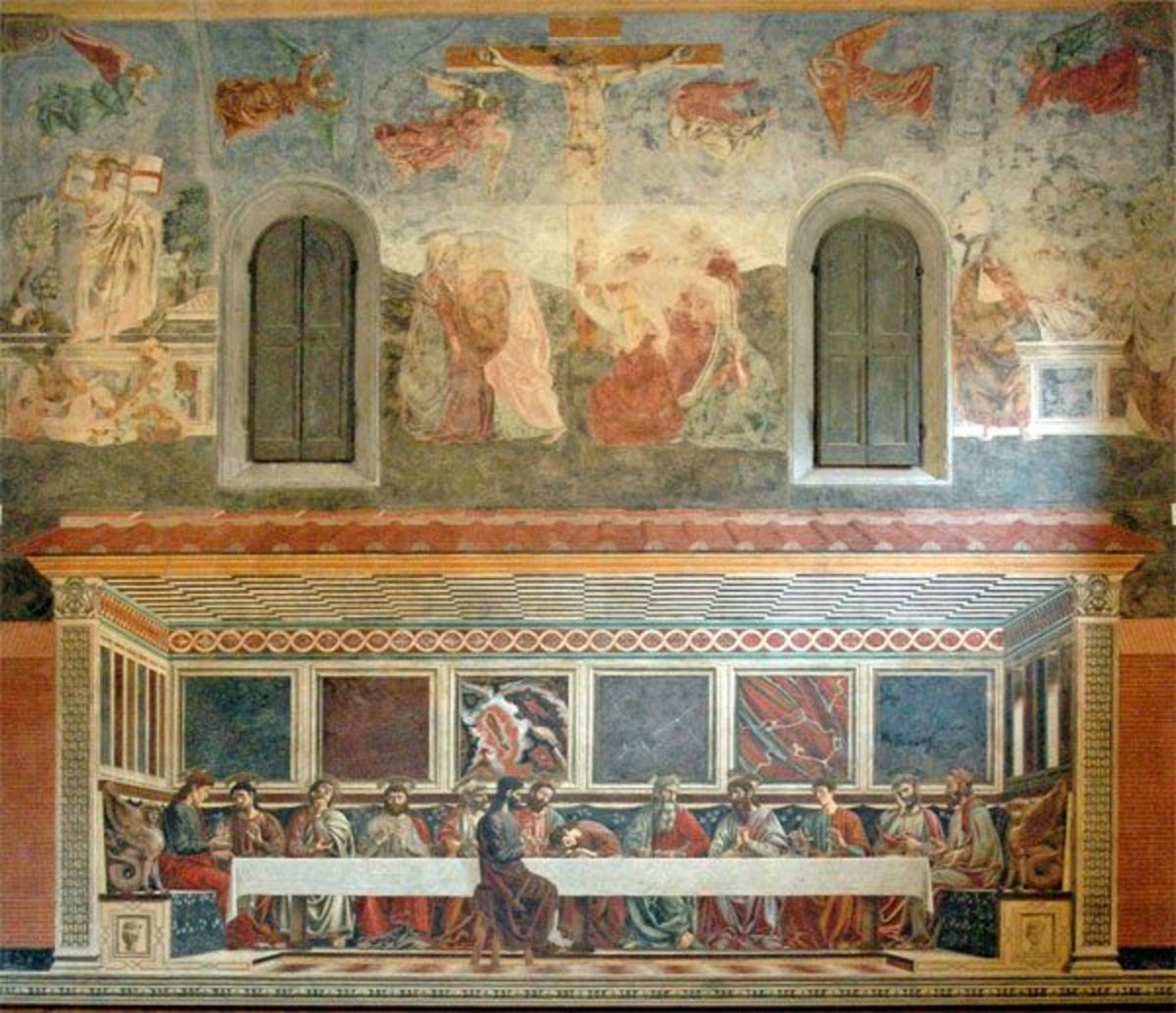
The Last Supper (Cenacolo di Sant'Apollonia)
Last Supper — Andrea del Castagno, c.1447
Andrea del Castagno, Public domain, via Wikimedia Commons
Andrea del Castagno's Last Supper fresco in the refectory of the convent of Sant'Apollonia is the most powerful Pre-Leonardian treatment of the subject — a monumental fresco (approximately 4.7 by 9.8 metres) painted around 1447 for the nuns of a Benedictine convent. The composition shows the thirteen figures (Christ and the twelve apostles) seated behind a long table, with Judas isolated on the near side of the table in front of it (a conventional placement that identifies him as the betrayer by separating him from the community).
The faces of the apostles — particularly Peter, James, and the figure generally identified as Christ — are intense psychological portraits; the figure identified as Judas is depicted with a characteristically dark, brooding expression. The marbled table and wall decoration are rendered in false-perspective trompe-l'oeil, creating an illusionistic architectural setting for the sacred scene. Above the Last Supper, three smaller scenes depict the Crucifixion, the Entombment, and the Resurrection.
Andrea del Castagno (c.1419-1457) was a Florentine painter of the generation of Fra Angelico and Paolo Uccello, trained in a tradition of harsh sculptural realism influenced by Donatello. His approach to the human figure — massive, powerful, psychologically direct — is the opposite of Fra Angelico's grace and sweetness.
The Sant'Apollonia Last Supper was a convent commission (made for the nuns' refectory, where they would eat their meals facing it daily) and was not publicly known until the convent was dissolved in 1860. The fresco's influence on the tradition of refectory Last Supper paintings (including Leonardo's) is indirect but significant.
The refectory of Sant'Apollonia is now a state museum dedicated to the fresco. The experience of entering the former refectory and seeing the Last Supper fresco at close range — it is approximately at the scale of the original table and room — is one of the most intimate encounters with a major Renaissance fresco available in Florence. The face of Christ, in particular, is a study in absorbed calm entirely different from Leonardo's agitation; the faces of the apostles around him are individual character studies of remarkable intensity.
When standing before this work, look carefully: Last Supper — Andrea del Castagno, c.1447. Give it time — what seems decorative often carries the central meaning.
When standing before this work, look carefully: Judas isolated on the near side of the table. Give it time — what seems decorative often carries the central meaning.
When standing before this work, look carefully: Christ's face — absorbed calm. Give it time — what seems decorative often carries the central meaning.
When standing before this work, look carefully: The full fresco — false-perspective trompe-l'oeil setting. Give it time — what seems decorative often carries the central meaning.
Museo del Cenacolo di Sant'Apollonia, Via XXVII Aprile 1, Florence. Free admission (state museum). Open Wednesday-Monday.