
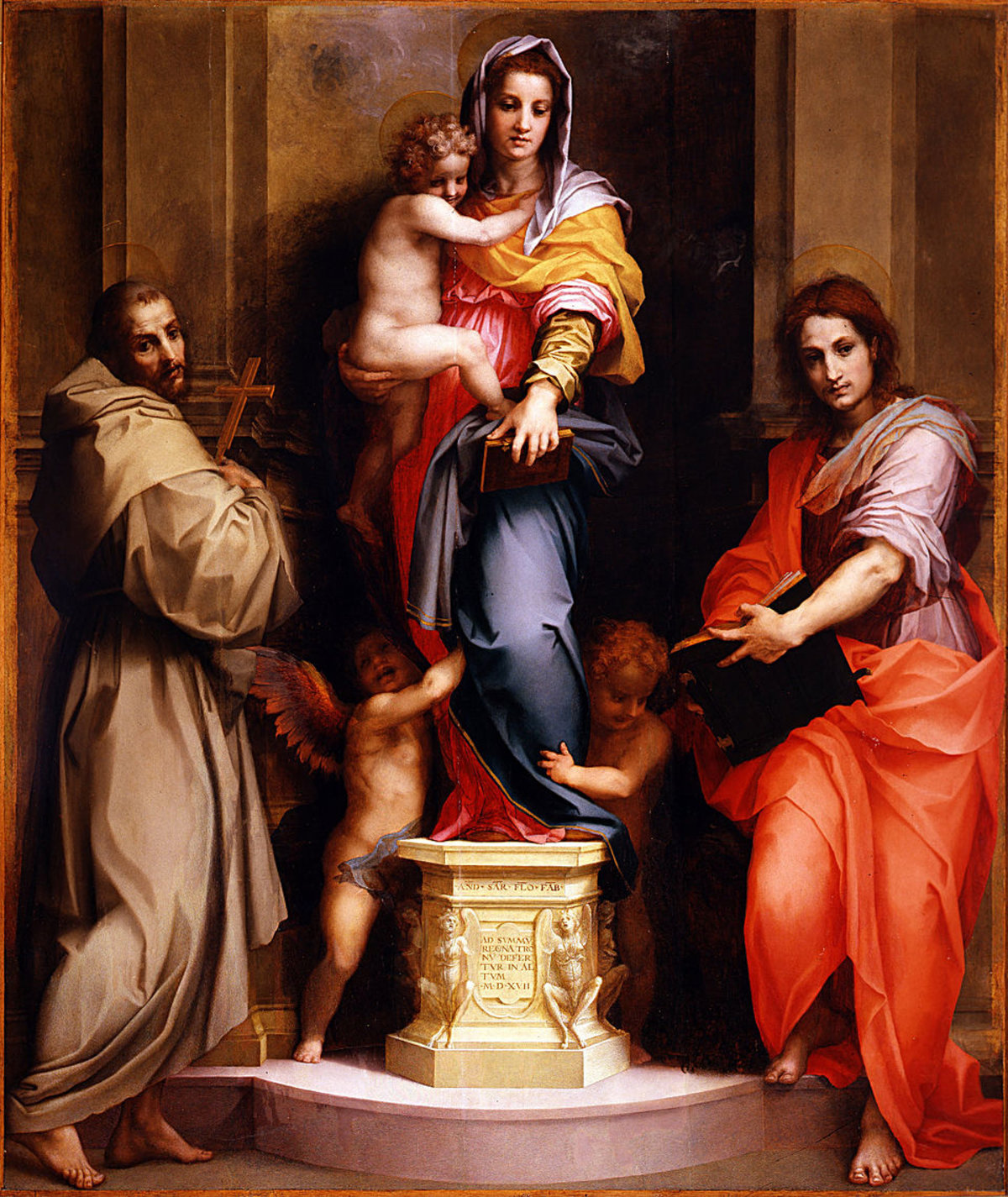
The Madonna of the Harpies
Madonna of the Harpies — Andrea del Sarto, 1517
Andrea del Sarto, Public domain, via Wikimedia Commons
Andrea del Sarto's Madonna of the Harpies (named for the winged figures on the base of the Virgin's pedestal, which are actually more accurately described as locusts or another insect from Revelation rather than harpies) is the finest Florentine High Renaissance altarpiece by an artist other than Leonardo, Michelangelo, or Raphael. The large panel (approximately 207 by 178 cm) shows the Virgin enthroned on a classical pedestal (the insect/harpy figures in low relief at the base), the Christ Child in her arms, with St Francis to the left and St John the Evangelist to the right.
The quality of the paint surface — the softness of the sfumato modelling, the variety and warmth of the colour, the specific elegance of the drapery — is among the finest in Florentine 16th-century painting. Andrea del Sarto was known to his contemporaries as 'il pittore senza errori' (the painter without errors) — a characterisation of his technical perfection.
Andrea del Sarto (1486-1530) was the leading Florentine painter in the generation between Leonardo and Michelangelo's departure from Florence and the development of Mannerism by Pontormo and Rosso Fiorentino — his two pupils. His work represents the culmination of the High Renaissance in Florence: technically perfect, compositionally refined, psychologically warm. Vasari's famous description of del Sarto's limitations (his work is more imitative than creative) obscures the genuine achievement of the Madonna of the Harpies, which is in every way comparable to the finest Raphael altarpieces.
The name 'Madonna of the Harpies' is a misnomer but has become conventional. The figures on the base of the pedestal are described in contemporary sources as Apocalyptic creatures from the Book of Revelation — the pedestal is the base of a vision, not a classical architectural support.
The Christ Child's gesture (standing on his mother's lap, his arms open) is a specific iconographic type suggesting the Orant — the ancient prayer posture — which foreshadows the Crucifixion. St John the Evangelist, at the right, is one of del Sarto's finest figure portraits.
When standing before this work, look carefully: Madonna of the Harpies — Andrea del Sarto, 1517. Give it time — what seems decorative often carries the central meaning.
When standing before this work, look carefully: The pedestal with Apocalyptic creatures. Give it time — what seems decorative often carries the central meaning.
When standing before this work, look carefully: The Christ Child standing — Orant posture. Give it time — what seems decorative often carries the central meaning.
When standing before this work, look carefully: St John the Evangelist — del Sarto's finest portrait type. Give it time — what seems decorative often carries the central meaning.
Uffizi Gallery, Room 26 (del Sarto, Pontormo, Rosso), Florence.