
The Ognissanti Madonna
Ognissanti Madonna — Giotto di Bondone, c.1310
Giotto di Bondone, Public domain, via Wikimedia Commons
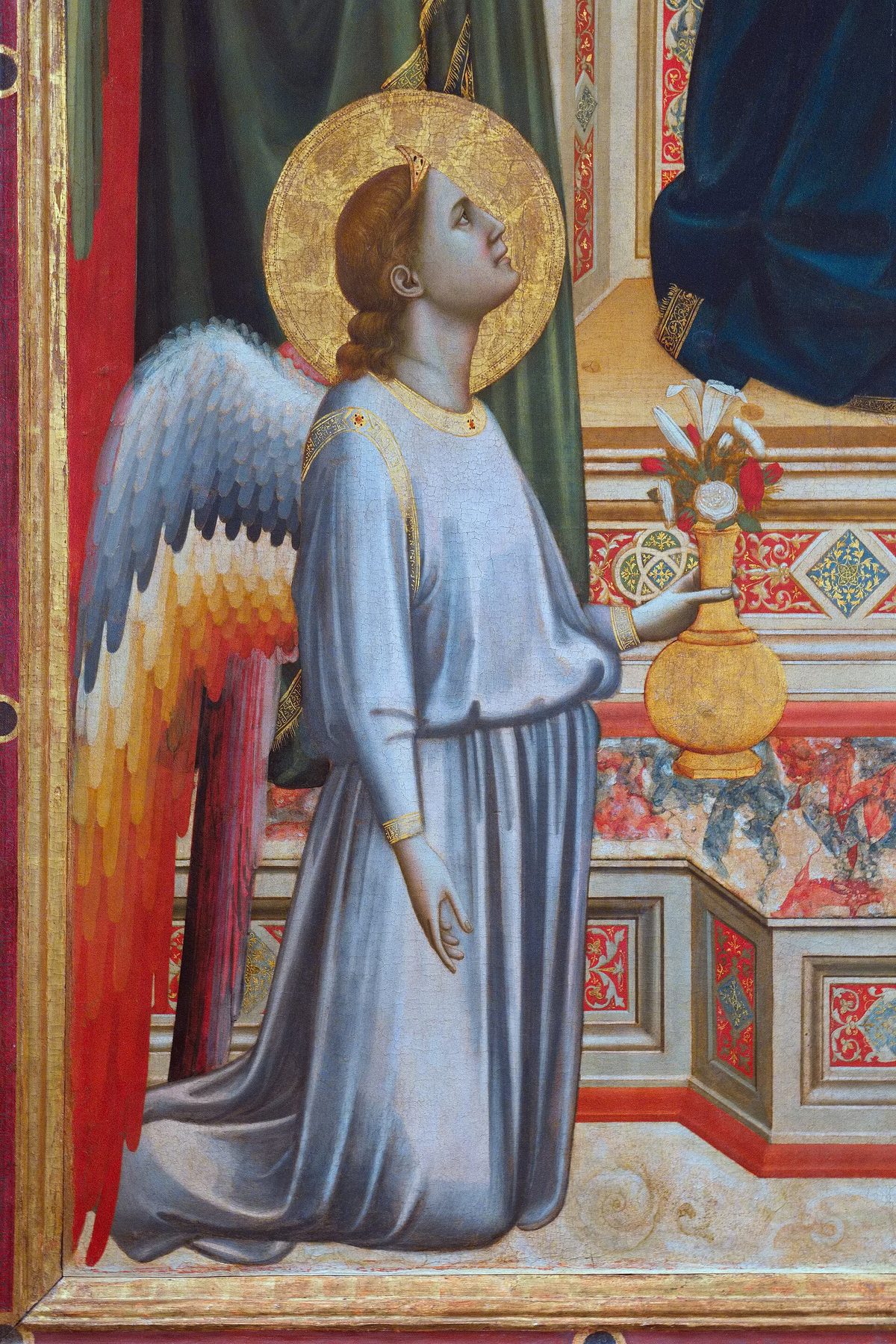
Giotto's Ognissanti Madonna (also called the Maestà di Ognissanti) is the single most important painting in the history of Western art — the work that initiated the break from the flat, hieratic Byzantine tradition and began the thousand-year project of naturalistic representation that reached its culmination in the Renaissance. Painted around 1310 for the Florentine church of the Ognissanti, it shows the Madonna and Child enthroned and surrounded by angels and saints — a Maestà (Majesty) composition similar to Duccio and Cimabue. But where Byzantine Maestà figures are flat patterns of gold and line, Giotto's Madonna and Child have weight, volume, and physical presence: she sits in space, not on a surface; the throne recedes in perspective; the angels have different expressions; the drapery falls according to the body beneath it.
Giotto di Bondone (c.1267-1337) had no documented training under any master whose work survives — the story of his discovery by Cimabue, painted by Vasari, is probably legendary. What is certain is that Giotto's mature style represents a complete rupture with everything that preceded it: the introduction of three-dimensional space, psychological individuation of figures, narrative naturalism, and atmospheric observation all begin with him.
The Ognissanti Madonna is contemporary with the Arena Chapel frescoes in Padua (see entry 69-70), which are the fullest demonstration of his narrative genius. The Uffizi Maestà was painted for the high altar of Ognissanti and was transferred to the Uffizi in 1919.
The painting gains most from comparison with its neighbours in the Uffizi. Duccio's Rucellai Madonna (nearby) and Cimabue's Santa Trinita Madonna (also nearby) were painted in the generation before Giotto — the comparison of the three Maestà paintings in the same room is one of the great art-historical demonstrations: the progression from Byzantine flatness (Cimabue), through Sienese refinement (Duccio), to Florentine spatial revolution (Giotto) is visible in twenty steps across a single gallery.
Look at the throne in Giotto's version: the hexagonal form recedes in perspective, with different faces visible from a single frontal viewpoint. Look at the faces of the angels: each one is an individual, turned at a different angle.
When standing before this work, look carefully: Ognissanti Madonna — Giotto di Bondone, c.1310. Give it time — what seems decorative often carries the central meaning.
When standing before this work, look carefully: The throne receding in space — Giotto's revolution. Give it time — what seems decorative often carries the central meaning.
When standing before this work, look carefully: The individuated angels — different expressions. Give it time — what seems decorative often carries the central meaning.
When standing before this work, look carefully: Room 2 — Cimabue, Duccio, Giotto together. Give it time — what seems decorative often carries the central meaning.
Uffizi Gallery, Room 2 (the Giotto Room). The three medieval Maestà paintings — Cimabue, Duccio, and Giotto — are displayed together, making this room one of the most important in European art history.