
Raphael, Public domain, via Wikimedia Commons
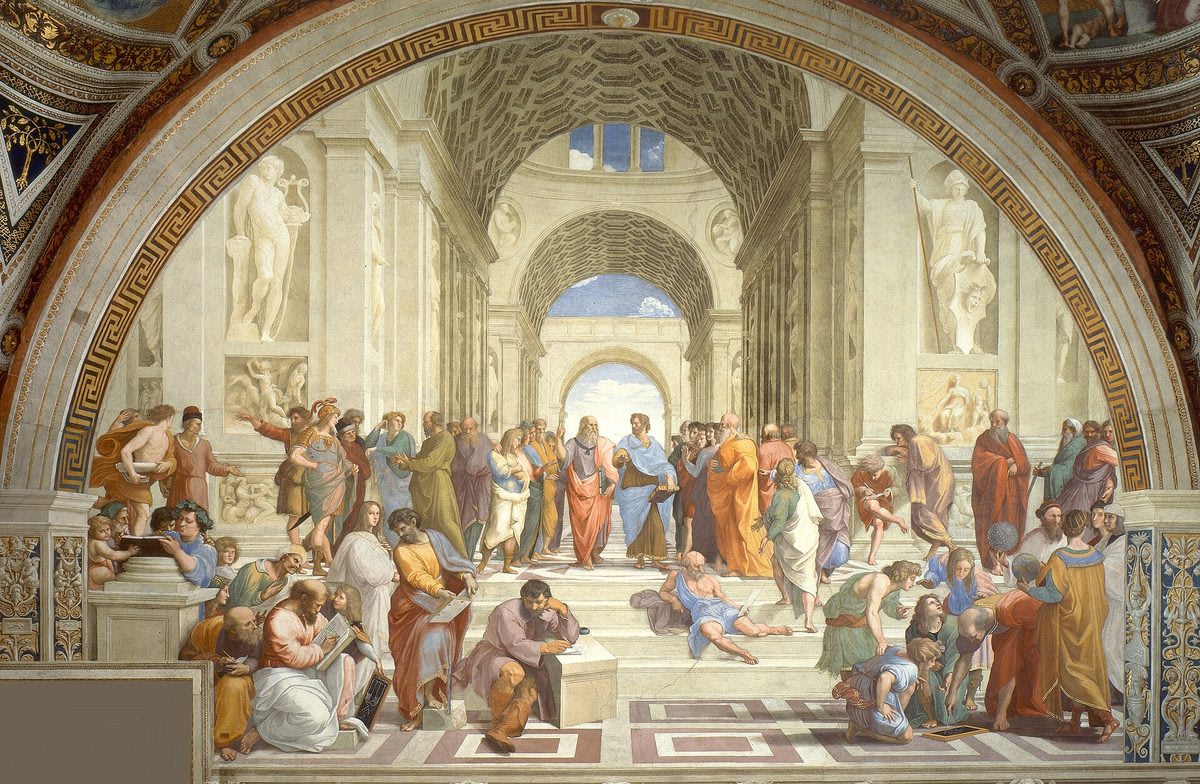
The School of Athens is painted on one wall of the Stanza della Segnatura in the Vatican Apostolic Palace — the private library of Pope Julius II — and depicts the great philosophers of antiquity gathered beneath a vast coffered barrel vault. At its centre, Plato and Aristotle walk in dialogue, Plato pointing upward toward ideal forms and Aristotle gesturing downward toward the material world.
The painting is one of the definitive images of the Renaissance synthesis of classical learning and Christian humanism, and technically one of the most accomplished perspective compositions in the history of art. It was painted in 1510-1511, when Raphael was in his late twenties, directly across from his equally celebrated Disputation of the Holy Sacrament — placing philosophy and theology face-to-face across the room.
Raffaello Sanzio da Urbino (1483–1520) was called to Rome by Julius II in 1508, the same year Michelangelo began the ceiling across the courtyard. Raphael was 25, already famous for his Madonnas and portraits, but untested in fresco at this scale.
He learned quickly. The School of Athens shows him at the height of his technical command: the receding barrel vault creates an illusionistic space of immense depth; the fifty-odd figures are arranged with perfect clarity despite their number; each philosopher is differentiated in pose, expression, and attribute. Raphael is said to have added the figure of Heraclitus (the brooding figure in the foreground left, modeled on Michelangelo) after seeing the Sistine ceiling in progress.
The two central figures are Plato (pointing up, with Leonardo da Vinci's features) and Aristotle (gesturing outward, with a younger face). Around them: Socrates counting on his fingers; Pythagoras writing at lower left; Euclid bent over a compass at lower right (Bramante's features); Diogenes sprawled on the steps; Hypatia at the left edge (possibly a portrait of Imperia, a Roman courtesan).
Raphael himself appears at the far right — a young man in a dark hat looking directly at the viewer. The brooding figure writing alone in the foreground left is Heraclitus, added late to the composition and modeled on Michelangelo. The architectural setting is inspired by Bramante's designs for the new St Peter's Basilica.
When standing before this work, look carefully: The School of Athens — full composition. Give it time — what seems decorative often carries the central meaning.
When standing before this work, look carefully: Plato and Aristotle at the centre. Give it time — what seems decorative often carries the central meaning.
When standing before this work, look carefully: Heraclitus (modeled on Michelangelo) in the foreground. Give it time — what seems decorative often carries the central meaning.
When standing before this work, look carefully: Raphael's self-portrait at the right edge. Give it time — what seems decorative often carries the central meaning.
The Stanza della Segnatura is one of four Raphael Rooms in the Vatican Museums — part of the standard museum circuit. The room is usually crowded; the painting is best appreciated from the doorway where the full perspective composition is visible.
The School of Athens and the Disputation face each other across the room; looking from one to the other gives the full theological programme. Photography is permitted in the Raphael Rooms.