
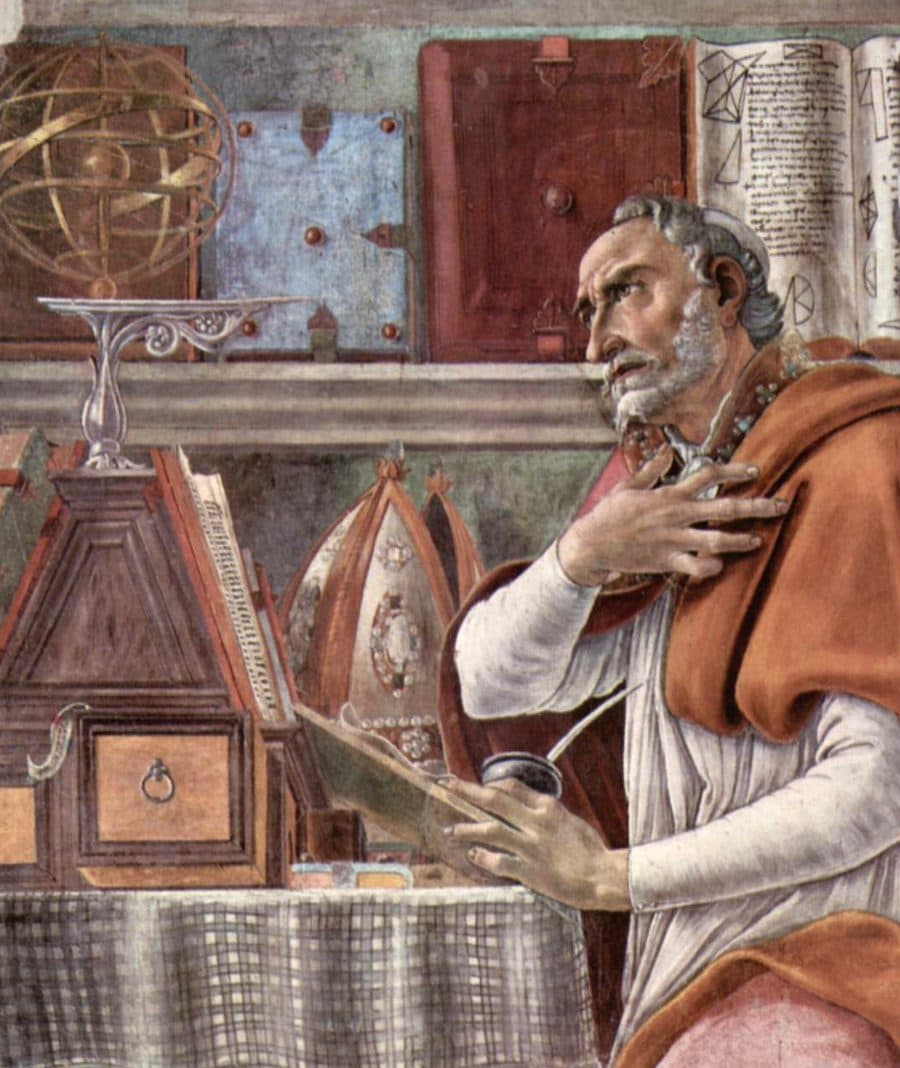
The Life
Aurelius Augustinus Hipponensis — Augustine of Hippo — was born in Thagaste (modern Souk Ahras, Algeria) in 354 AD to a pagan father (Patricius) and a Christian mother (Monica, now St Monica). He became the most influential theologian in the history of Western Christianity, the author of the Confessions (the first autobiography in the Western tradition and one of the greatest works of world literature), the City of God (a foundational work of Christian political theology), and an enormous body of sermons, letters, and theological treatises that shaped Catholic, Protestant, and Orthodox Christianity alike.
He received an excellent rhetorical education, first in Thagaste, then Madauros, then Carthage, where he became a teacher of rhetoric. In Carthage he took a concubine, with whom he had a son, Adeodatus (Given by God), and became increasingly absorbed in the Manichaean sect — a dualist religion that provided intellectual frameworks for the problem of evil that he found compelling. He taught in Carthage, Rome, and Milan — Rome, where he was appointed to the most prestigious rhetoric post in the empire by Symmachus, the pagan prefect, on the recommendation of Ambrose of Milan.
In Milan he encountered Ambrose's preaching, began reading Neoplatonist philosophy (which provided him with a framework for understanding God as incorporeal spirit), and began the slow interior movement toward Christianity. His mother Monica, who had followed him to Milan, prayed ceaselessly for his conversion. He is described as living in suspended torment — convinced intellectually of Christianity's truth, unable to accept the required change of life. The Confessions describe his inner struggle with searing honesty: Lord, give me chastity and continence, but not yet.
The conversion came in a Milan garden in August 386: he heard a child's voice singing Tolle, lege — Take and read. He opened Paul's letter to the Romans and read the passage beginning Put on the Lord Jesus Christ. Something resolved. He was baptised by Ambrose in 387. He returned to Africa, became a priest (more or less against his will — he was seized by the congregation at Hippo and presented to the bishop), and then became bishop of Hippo himself in 395. He served as bishop for 35 years, until his death in 430 during the Vandal siege of Hippo.
The Restless Heart — years of searching
Augustine spent thirty-two years looking for rest in the wrong places: in rhetoric, in Manichaean dualism, in Neoplatonic philosophy, in his concubine, in the pleasures of Carthage, in professional ambition. He found each inadequate and moved on. The Confessions trace this restlessness with extraordinary honesty — the intellectual dissatisfaction, the moral failure, the inability to stop looking. The famous opening — You stir us to take pleasure in praising You; for You made us for Yourself, and our heart is restless until it rests in You — is the diagnosis of everything that preceded the conversion: thirty-two years of God pursuing and Augustine running, until the garden in Milan. Tolle, Lege — Take and Read The conversion scene in the Milan garden is one of the most famous in world literature. Weeping under a fig tree, tormented by his inability to make the final step, Augustine hears a child's voice from a neighbouring house singing Tolle, lege — Take and read. He opens Paul's letter to the Romans at random: Not in orgies and drunkenness, not in sexual immorality and debauchery, not in dissension and jealousy. Rather, clothe yourselves with the Lord Jesus Christ. Something resolved. The long resistance ended. He was baptised the following Easter by Ambrose of Milan. Monica's Prayer — answered The Confessions are also the story of Monica, Augustine's mother — who prayed for his conversion for decades, followed him to Rome when he deceived her and fled to Italy, followed him to Milan, and lived to see him baptised. She died at Ostia on the journey home to Africa, in a state of complete peace — she had seen what she had prayed for. Augustine's account of her death, and their shared mystical experience at Ostia (a mutual experience of something beyond words), is one of the most moving passages in the book. Monica is now a saint (August 27, the day before her son's feast). The Bishop of Hippo — 35 years of pastoral theology Augustine served as bishop of Hippo for 35 years — an extraordinary pastoral and theological ministry in a difficult time. He preached almost every day. He dealt with the Donatist schism (a North African Christian controversy about the validity of sacraments administered by sinful priests), the Pelagian controversy (about grace and free will), and the fall of Rome in 410 and its theological aftermath. The City of God, his response to the fall of Rome, develops the distinction between the City of God and the City of Man — a framework for Christian engagement with political life that remains influential after 1,600 years.
Walk in Their Footsteps
Pilgrimage sites connected to St Augustine of Hippo
Ask St Augustine of Hippo to Intercede
Bring these intentions to this saint in prayer:
Augustine's genius was inseparable from his need. The Confessions are not a record of a man who was always holy; they are a record of God pursuing a man who ran from him for thirty-two years, and the man describing the pursuit honestly, from the inside. The restless heart is not a failure — it is the condition that the answer addresses. The rest that Augustine found in God is only comprehensible against the background of everything he tried before.
“You stir us to take pleasure in praising You; for You made us for Yourself, and our heart is restless until it rests in You.”
Augustine, Doctor of Grace — you ran for thirty-two years and God never stopped following. I too have my years of running: the wrong directions I pursued, the inadequate rests I tried. Speak to me as you were spoken to under the fig tree. Let me hear Tolle, lege. And may I find, in the reading, the rest my heart has been looking for. Amen.