
Raphael, Public domain, via Wikimedia Commons
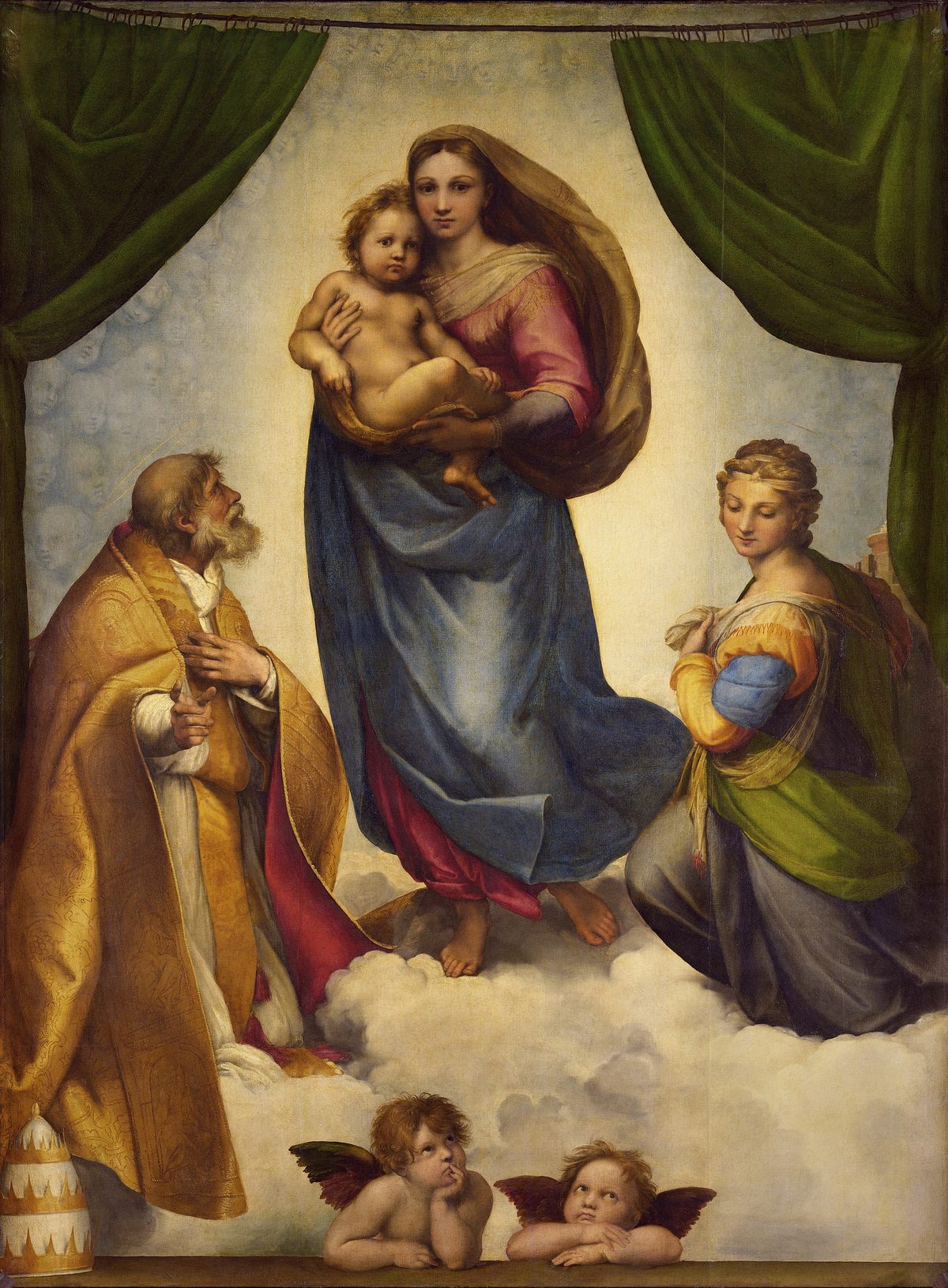
Raphael's Sistine Madonna is one of the most famous paintings in the world — and the source of the two cherubs at the base of the painting who have, detached from the original, become one of the most reproduced images in the history of popular culture. The full painting shows the Madonna and Child appearing in the clouds before two saints — St Sixtus II (who gestures toward the viewer, as if presenting the Madonna) and St Barbara (who looks downward, toward the viewer's world) — with a green curtain drawn aside to reveal the apparition.
The two cherubs at the base lean on a parapet, one propping his chin on his hand and looking upward. The painting was made for the high altar of the Benedictine monastery church of San Sisto in Piacenza and was purchased by Augustus III of Saxony in 1754 for the Dresden gallery.
The Sistine Madonna was painted in 1512, after Raphael had completed the Stanza della Segnatura and Eliodoro in the Vatican and was approaching the apex of his career. The subject — the Madonna appearing in a vision to St Sixtus, the patron saint of the Piacenza church — gave Raphael the opportunity to paint the Madonna not as a fixed devotional image but as a vision in motion: she walks forward on clouds toward the viewer, her feet visible beneath her mantle, her expression a mixture of tenderness and a slight anxiety that has been interpreted as awareness of her son's fate. The Christ child in her arms is not the conventional blessing figure but an infant who looks at the viewer with a directness that many have found disturbing — knowing, rather than childlike.
Look at the Madonna's expression: she has been described as simultaneously 'a simple peasant girl surprised in a garden' and 'a queen aware of sacrifice.' The Christ child's face is the most discussed: Raphael's Christ looks at the viewer with an eye of specific weight, the face more thoughtful than childlike. St Sixtus's gesture (pointing outward toward the viewer) is the painting's theatrically strangest element: he appears to be presenting the vision to us, as if the painting is a window and we are on the other side. The two famous cherubs at the base look upward into the painting with a different quality from the other figures — more casual, more human, more simply present.
When standing before this work, look carefully: The Sistine Madonna — Raphael, 1512. Give it time — what seems decorative often carries the central meaning.
When standing before this work, look carefully: The two famous cherubs — detached from the original. Give it time — what seems decorative often carries the central meaning.
When standing before this work, look carefully: The Christ child's knowing gaze. Give it time — what seems decorative often carries the central meaning.
When standing before this work, look carefully: The Gemäldegalerie Alte Meister, Dresden. Give it time — what seems decorative often carries the central meaning.
Gemäldegalerie Alte Meister, Theaterplatz 1, Dresden. The Sistine Madonna has its own room in the gallery — Room 117 — where it has been displayed since 1754.